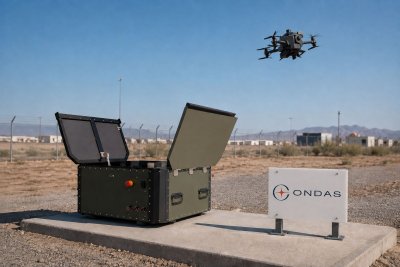
AeroVironment's LOCUST laser weapon system has re-emerged as a focal point in the counter-drone market following a successful U.S. Navy demonstration aboard the aircraft carrier USS George H.W. Bush. According to Pentagon records, the system detected, tracked, and neutralized multiple unmanned aerial vehicles during the test, which took place in October 2025. The event underscores the military's drive to adopt cheaper directed-energy solutions against proliferating drone threats.
The test is timely as U.S. forces accelerate their investment in layered counter-drone defenses. Traditional air defense systems are increasingly strained by low-cost drones, prompting a search for more economical interceptors. Just last week, Reuters reported that the U.S. military deployed Ukrainian counter-drone systems to Prince Sultan Air Base in Saudi Arabia after recent attacks. Timothy Walton of the Hudson Institute noted persistent gaps in U.S. air and missile defenses, while Adam Scher of the Pentagon's counter-drone office cautioned that no single solution fits every threat.
AeroVironment's LOCUST system is a palletized directed-energy weapon that can be quickly loaded onto ships without extensive modifications. John Garrity, vice president of directed energy systems at the company, called the system a "game-changer" for naval and national security, emphasizing its ability to operate on ship power or recharge from it. The test was conducted jointly with the U.S. Navy and the Army's Rapid Capabilities and Critical Technologies Office.
Despite the positive test, AeroVironment shares closed at $196.28 on Friday, down approximately 2.8%. The company's market capitalization stands near $9.76 billion. Investors are weighing the test results against the ongoing integration costs from the company's recent $4.1 billion all-stock acquisition of BlueHalo, a move aimed at deepening its presence in counter-unmanned systems, cyber, and space technologies.
Financially, AeroVironment's fiscal third-quarter revenue surged 143% year-over-year to $408.0 million, with a funded backlog of $1.1 billion. However, the company reported a net loss of $156.6 million, largely due to a $151.3 million goodwill impairment tied to its Space reporting unit and a stop-work order on the Space Force SCAR project. The company is targeting fiscal 2026 revenue of $1.85 billion to $1.95 billion, with adjusted EBITDA between $265 million and $285 million.
The competitive landscape remains intense. Lockheed Martin's HELIOS shipboard laser, a 60-plus kilowatt high-energy weapon, has already been delivered to the U.S. Navy and integrated into existing vessels as part of a layered defense strategy. AeroVironment's modular, roll-on approach must prove its value in terms of integration ease, output, and cost per engagement.
Directed-energy weapons, while promising, face practical hurdles. Environmental factors such as water vapor, salt spray, and temperature fluctuations can degrade laser performance. Additionally, the time required to lock onto targets and the challenges of operating invisible beams on busy carrier decks add complexity. AeroVironment has cautioned that its forecasts depend on government funding, contract schedules, competitive dynamics, and its ability to manage acquisitions and technology development.
For investors, the key question is whether LOCUST and the company's broader counter-drone portfolio can transition from successful demonstrations to large-scale production contracts. The Navy test marks a step forward, but the path to sustained revenue growth will require converting technical wins into funded orders.