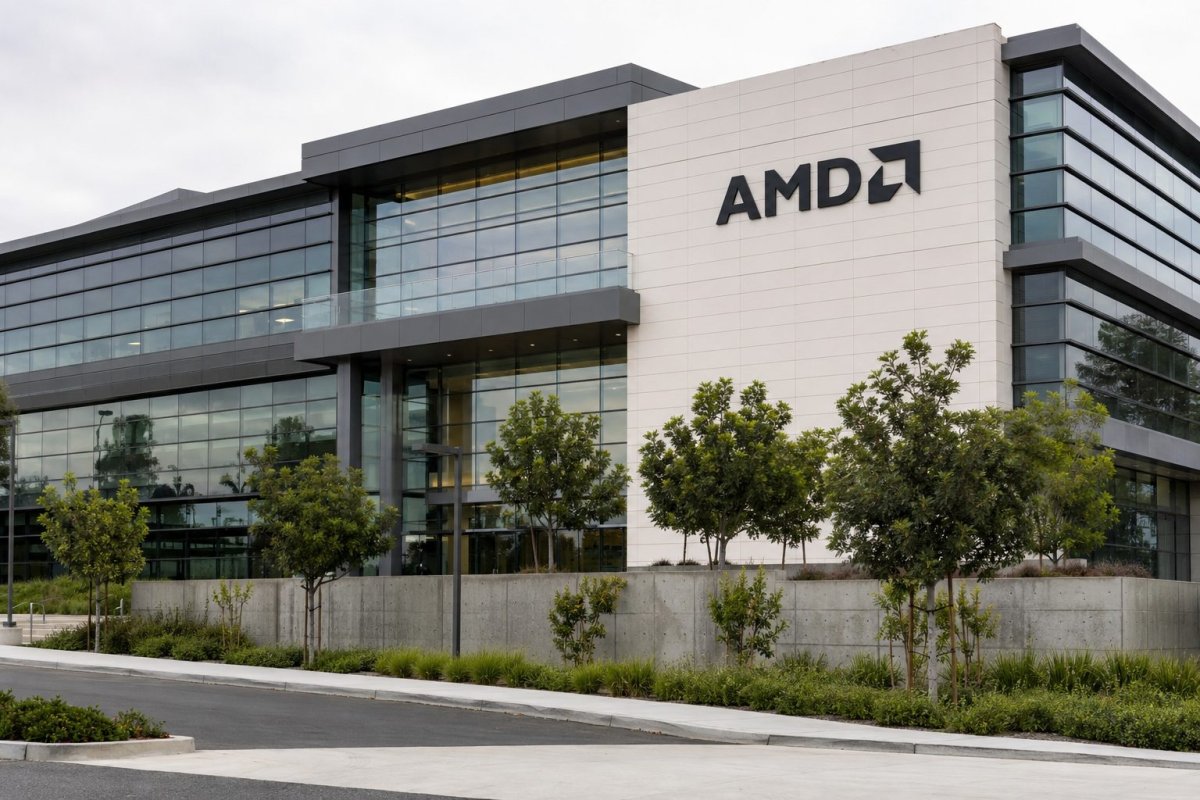
Advanced Micro Devices (NASDAQ:AMD) saw its shares decline 3.71% on Wednesday, closing at $466.42, as the company's ambitious efficiency projections for its AI rack systems were overshadowed by its premium valuation. The stock's slide comes amid a broader semiconductor pullback, with peers like Broadcom (NASDAQ:AVGO) also suffering losses.
AMD's preliminary assessment indicates that its 2026 AI racks will be four times more energy-efficient compared to its 2024 platform. This efficiency metric is significant because energy constraints are increasingly becoming a bottleneck for AI deployments. However, the market's reaction suggests investors are weighing this progress against the stock's rich valuation.
At current levels, AMD trades at approximately 119.7 times trailing earnings, a multiple that is roughly 3.6 times higher than Nvidia's (NASDAQ:NVDA) price-to-earnings ratio of 33.3. This disparity highlights the market's high expectations for AMD's future profit growth, which the company must deliver on to justify its valuation.
The fourfold efficiency improvement is an early estimate, based on shipped product data and simulated outcomes where actual results are not yet available. Notably, the calculation does not include direct testing of AMD's latest MI455X accelerator, which could further refine the figures.
AMD projects that two upcoming racks could deliver the same performance as 570 racks featuring its 2024 MI300X chip. While this is a compelling scenario, it is not yet an established commercial standard. Investors will be looking for concrete evidence of customer adoption, usage rates, and profitability metrics to validate these claims.
The company's operational base is expanding rapidly. In the second quarter, revenue grew 50% year-over-year to $11.54 billion, with data center revenue more than doubling. The data center segment accounted for 58% of total sales, generating $6.72 billion in revenue, up 107% from the prior year. This segment's operating income reached $2.1 billion, representing a 31% margin, which allows operational gains to directly impact the bottom line.
Other segments showed mixed results: Client revenue rose 23% to $3.10 billion, Embedded grew 19% to $977 million, while Gaming declined 31% to $779 million. The strong data center performance underscores AMD's strategic focus on AI infrastructure, but the market remains cautious given the high expectations embedded in the stock price.
On Wednesday, chip stocks broadly declined. Broadcom dropped 4.61% following news that Marvell Technology (NASDAQ:MRVL) announced a custom-chip agreement with Google, sending Marvell shares up 9.85%. Nvidia slipped 0.99%, and Intel (NASDAQ:INTC) fell 4.02%.
Wall Street analysts remain generally optimistic on AMD, with a consensus price target of $608.23, implying a 30% upside from Wednesday's close. However, targets vary widely, ranging from $365 to $1,250, reflecting the uncertainty surrounding AMD's ability to execute on its AI roadmap. Morgan Stanley's $465 target is nearly at the current market level, while Rosenblatt's $700 target suggests a potential $381 billion increase in market value.
AMD also recently initiated a bond offering of between $4 billion and $5 billion, which could be used for general corporate purposes and potential debt repayment. The company's next investor engagement is scheduled for Citi's technology conference on September 8.
As AMD navigates the competitive AI landscape, the key question remains whether its efficiency gains can translate into sustainable earnings growth that justifies its premium valuation. Investors will be closely monitoring customer validation of its rack-level efficiency economics and the company's ability to maintain its growth trajectory.