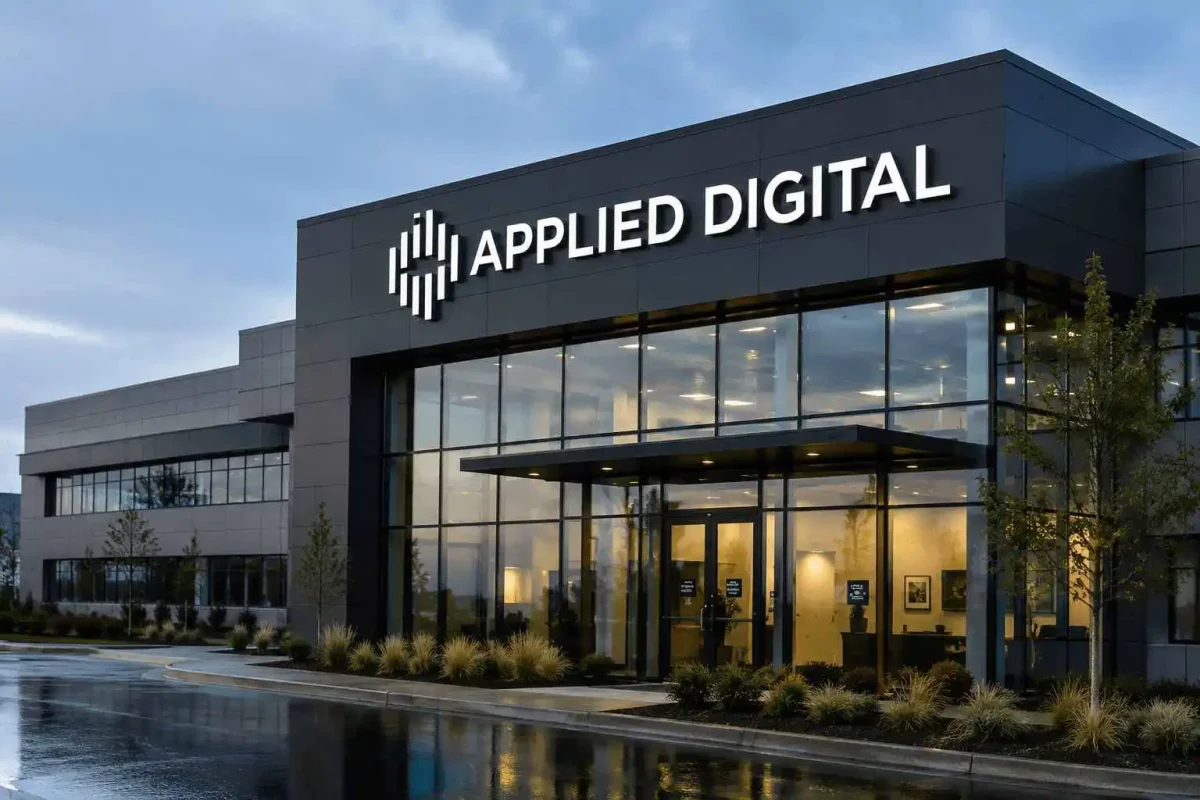
Applied Digital Corporation (NASDAQ:APLD) saw its shares climb 5.4% to $27.81 in after-hours trading on Monday, following the release of fiscal fourth-quarter results that significantly exceeded analyst expectations. The positive reaction came after a 3.0% decline during the regular session, indicating that investors were encouraged by the headline numbers despite underlying operational challenges.
For the quarter ended June 30, 2026, Applied Digital reported revenue of $258.7 million, far surpassing the consensus estimate range of $94.8 million to $104.3 million. Adjusted earnings per share came in at $0.04, a notable improvement compared to the projected loss range of $0.19 to $0.22 per share. This earnings beat was driven largely by tenant fit-out activities, which contributed $152.4 million—or 58.9% of total revenue. However, the gross profit margin on this revenue stream was razor-thin at just 4.5%, as associated costs reached $145.6 million, yielding a gross profit of only $6.8 million.
Operational Capacity Remains a Key Concern
Despite the strong revenue figures, the company's operational capacity remains severely limited. As of June 30, only 175 megawatts (MW) of its contracted 1,410 MW were operational, representing just 12.4% of total committed capacity. This leaves approximately 1.24 gigawatts (GW) of contracted capacity yet to be brought online across multiple campuses. Chief Executive Wes Cummins emphasized that "delivering on time is a genuine differentiator," and the company anticipates launching several new campuses throughout 2027 and 2028.
The base rent from the initial 100-MW facility provides a clearer picture of recurring revenue. Applied Digital generated $44.1 million in base rent during the quarter, which annualizes to approximately $1.76 million per MW. This aligns closely with the implied $1.70 million per MW-year from the company's 15-year contracted revenue of $36 billion, suggesting the economics of signed leases are sound. However, the close alignment does not eliminate the risks associated with construction delays, cost overruns, or tenant concentration.
Customer Concentration and Balance Sheet Risks
Applied Digital's customer concentration is a significant risk factor. Three recent leases with a single, undisclosed hyperscaler account for 810 MW and $20.2 billion in revenue, representing roughly 56% of the company's base-term contracted revenue. This level of dependency on one client exposes the company to potential disruptions if that tenant delays or reduces its commitments.
The balance sheet reflects the massive capital requirements of building out data center capacity. Applied Digital held $4.2 billion in cash, equivalents, and restricted cash, compared with $5.0 billion in debt. Capital expenditures for the fiscal year totaled $2.87 billion, with long-term debt reaching $4.96 billion. The company's GAAP net loss attributable to common shareholders widened to $110.6 million, or $0.39 per share, from $53.1 million a year earlier. Adjusted net income stood at $12.9 million, but much of the discrepancy stemmed from $127.8 million in stock-based compensation expenses. Selling and administrative expenses rose sharply to $165.3 million.
Market Context and Outlook
The after-hours gain follows a 5.9% decline in Applied Digital shares over the previous five sessions, with the stock closing Monday's regular session at $26.375. Investors will now focus on Tuesday's regular trading to assess the sustainability of the move. Key areas of scrutiny include project timelines, funding requirements, and the company's ability to convert contracted megawatts into rental income.
Risks remain substantial. Conversion of contracted capacity could be delayed by supply chain issues, regulatory hurdles, or rising construction costs. The company's limited cash position relative to its debt load could exaggerate liquidity risks. Additionally, the heavy reliance on a single hyperscaler tenant introduces concentration risk that could weigh on valuation. After-hours pricing is subject to change and may be corrected during regular market hours.