AST SpaceMobile (NASDAQ: ASTS) saw its shares advance 1.3% to $69.63 in late-morning trading on Tuesday, as investors weighed a second-quarter revenue shortfall against a growing contracted backlog and reaffirmed full-year guidance. The satellite communications company reported Q2 revenue of $31.52 million, falling short of the $33.86 million consensus estimate, yet the market's reaction was muted, with the stock edging higher.
The company's contracted backlog surged to approximately $1.30 billion, up from previous levels, providing a substantial pipeline of future business. However, management maintained its 2026 revenue guidance of $150 million to $200 million, which implies that the company must generate between $103.7 million and $153.7 million in the second half of the year. That represents a significant acceleration from the $46.3 million recorded in the first half, requiring a 2.24x to 3.32x increase in quarterly run-rate.
Revenue Bridge and Execution Challenges
To meet the lower end of guidance, AST needs to deliver $103.7 million in H2 revenue, which is 2.24 times the first-half total. For the upper end, the requirement jumps to $153.7 million, or 3.32 times the first-half performance. The contracted backlog of $1.30 billion is roughly 7.4 times the midpoint of the guidance range, but the timing of backlog conversion remains unclear.
Investors are focused on the gap between the company's substantial contracted demand and its ability to convert that into recognized revenue. The backlog currently represents only about 4.8% of the company's market capitalization of $27.25 billion, underscoring the premium valuation that hinges on the successful commercialization of its satellite network.
Quarterly Performance and Operational Milestones
Second-quarter revenue climbed to $31.52 million, up from $1.16 million in the same period last year. The breakdown included $24.43 million from gateway deliveries and $7.09 million from services. Despite the revenue miss, shares rose, indicating that investors were largely unfazed by the shortfall, likely due to the stronger backlog and progress on network deployment.
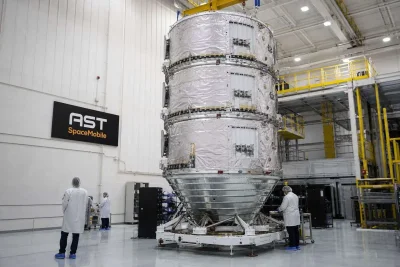
CEO Abel Avellan highlighted that the network now comprises 13 spacecraft in orbit. "As we get ready to ship BlueBirds 14, 15, and 16 and continue expanding our constellation with production ongoing through BlueBird 46, we are preparing to initiate beta services with select strategic partners," he said in the company's release.
The company deployed six satellites over a 50-day span, and Block 2 models are expected to deliver peak speeds approaching 200 Mbps, while Block 1 tests achieved speeds near 100 Mbps. These figures represent technical targets rather than customer revenue.
Network and Financial Position
AST's commercial network spans more than 60 mobile operators serving over three billion subscribers. Nearly 50 gateways are either completed, under installation, or in the planning phase. The company's financial capacity remains robust, with cash and restricted cash of $2.72 billion as of June 30, 2026, down from $2.78 billion at the end of 2025. Pro forma cash, reflecting the July financing, exceeds $3.7 billion.
Total debt increased to $2.97 billion from $2.22 billion at the end of 2025, primarily due to the issuance of $1.15 billion in convertible notes in July, which carry a 1.625% coupon. Capped-call transactions raise the effective conversion price to $149.20 per share. Net property and equipment grew to $2.07 billion from $1.40 billion, reflecting continued investment in satellite infrastructure.
Loss Widens on Involuntary Conversion Charge
The company reported a net loss to common holders of $230.9 million for Q2, compared to $99.4 million in the prior year. The increase was largely driven by a $125.9 million involuntary-conversion charge. Adjusted operating expenses, excluding adjusted cost of revenue, totaled $95.9 million, up from $79.8 million in the previous quarter. The loss per Class A share was 77 cents, versus 41 cents a year ago.
Analyst Sentiment and Risks
Wall Street remains cautiously optimistic. Analysts have issued five Buy ratings, five Hold recommendations, and one Sell rating, with a consensus price target of $87.08, implying a potential 25% upside from current levels. Price targets range from $50.80 to $115. Recent analyst actions include UBS's Chris Schoell (Hold, $78), Roth MKM's Scott Searle (Buy, $108), Cantor Fitzgerald's Colin Canfield (Buy, $90), Piper Sandler's Alexander Potter (Buy, $98), and Bank of America's Michael Funk (Hold, $80).
Risks remain elevated. Delays in launches, satellite malfunctions, and pending regulatory approvals could postpone service rollouts. The backlog may take time to convert into revenue, and additional debt or equity funding could lead to shareholder dilution. The next critical milestone is the initiation of beta services, which will test whether the 3,000 activated digital cells can generate a sustainable revenue run-rate exceeding $50 million per quarter in the second half.