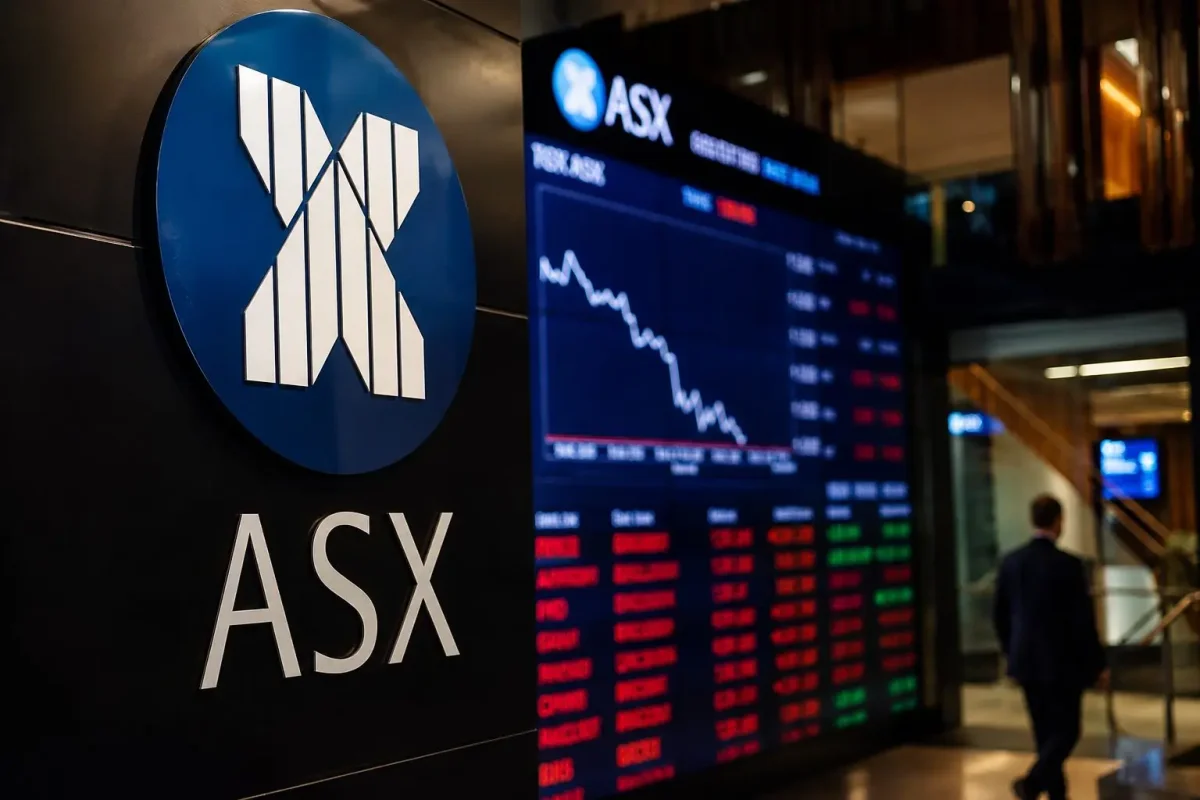
Australian equities ended lower on Tuesday, pressured by a steep sell-off in ASX Ltd after the exchange operator warned of significantly higher technology and regulatory expenditures. The S&P/ASX 200 benchmark fell 0.4% to 8,657 points, with utilities, energy, and technology sectors leading the declines.
ASX Ltd, which operates the country's primary trading, clearing, and settlement systems, saw its shares plummet as much as 12.6% to A$51.40, marking its worst intraday decline since August 2012. The drop underscores growing investor concern over the company's cost trajectory and its ability to maintain dividend payouts amid a major modernization push.
The company now expects fiscal 2027 total expenses to rise between 18% and 21%, while capital expenditure is projected to reach A$180 million to A$200 million, up from a prior range of A$160 million to A$180 million. The spending is directed at technology upgrades, new product development, and the Accelerate reform program, which is part of ASX's response to heightened regulatory scrutiny.
ASX maintained its dividend payout policy of 75% to 85% of underlying net profit, but cautioned that the next two payouts are expected to be at the lower end of that range. The company also reported unaudited operating revenue for the financial year to April 30 rose 12.5% to A$1.03 billion, supported by stronger volumes in interest-rate futures, cash-market trading, clearing, and settlement.
The Australian Securities and Investments Commission (ASIC) in April found that ASX's market-infrastructure resilience had been compromised by high shareholder returns, weak governance focus, and cultural barriers to change. ASIC Chair Joe Longo emphasized that the reset would require sustained focus on leadership, accountability, investment, and stewardship.
Adding to market pressure, Brent crude oil futures rose more than 2% in Asian trade to $98.21 per barrel following U.S. strikes in southern Iran, dampening hopes for a swift peace deal. Commonwealth Bank of Australia strategist Joseph Capurso noted that there remains significant uncertainty, while Standard Chartered's Eric Robertsen warned that inflation and fiscal risks could persist.
Investors are now turning their attention to Wednesday's release of April consumer price index (CPI) data by the Australian Bureau of Statistics, scheduled for 11:30 a.m. AEST. March CPI rose 4.6% year-over-year, the fastest annual pace since September 2023, and any upside surprise could reinforce expectations for tighter monetary policy.
The Reserve Bank of Australia's next board meeting is set for June 16, and traders will closely assess whether fuel costs and services prices are feeding into broader inflation. The ASX rate tracker currently reflects market expectations for the upcoming decision.
Regional markets provided no clear direction, with MSCI's broadest Asia-Pacific index outside Japan edging higher while Japan's Nikkei slipped. This left Australian trading more influenced by domestic company news and the oil price shock rather than a single offshore equity cue.
The risk remains that Tuesday's selling may prove too narrow if oil prices stabilize and Wednesday's inflation print comes in soft. However, a hotter CPI reading, further Middle East escalation, or evidence of companies absorbing higher transport and energy costs would keep pressure on rate-sensitive stocks, travel names, and firms with large technology budgets. For ASX Ltd, the central question is whether investors will fund the necessary repair job—spending more may be essential, but doing so without restoring confidence in the market's infrastructure would be harder to defend.