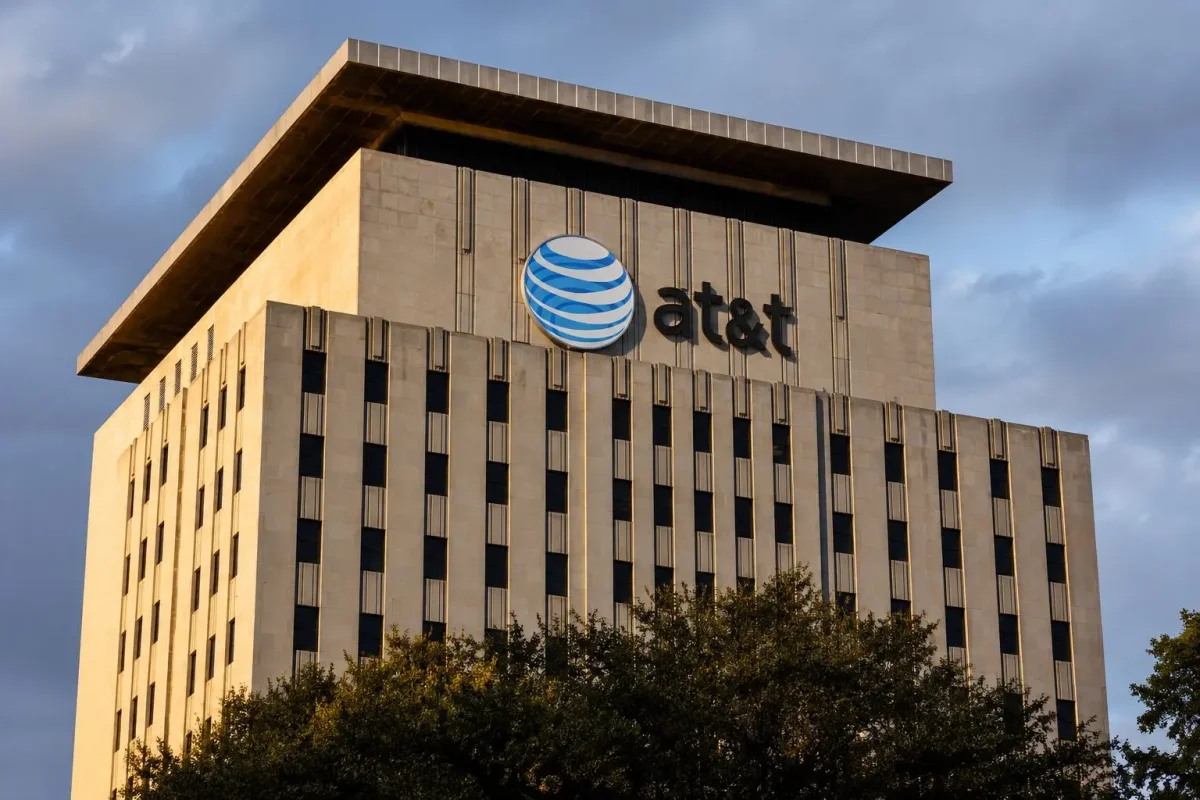
AT&T Inc. saw its stock decline by $0.34 to $22.48 in Wednesday afternoon trading on the New York Stock Exchange, partially reversing a 3.21% gain from the previous session. The telecommunications giant's shares came under pressure as investors weighed the company's ambitious fiber-optic expansion plans against ongoing regulatory challenges and a weaker-than-expected free cash flow forecast for the second quarter.
The company guided for second-quarter free cash flow in the range of $4 billion to $4.5 billion, falling short of the $4.6 billion consensus estimate from Visible Alpha compiled in April. The shortfall is attributed to the significant capital expenditures required for AT&T's fiber network build-out, particularly in the East Cleveland, Ohio area, where the company recently expanded its fiber footprint.
AT&T announced that its AT&T Fiber wired internet service now covers over 9,000 homes and businesses in East Cleveland. The project, a public-private partnership with the city and JobsOhio, is expected to reach more than 12,000 locations by the end of the year. Total investment in the initiative amounts to nearly $6 million, with AT&T contributing $3 million, JobsOhio providing a $1.9 million grant, and the City of East Cleveland allocating $1 million in public funds.
David Lewis, president of AT&T's Heartland States, emphasized the strategic importance of the investment, stating that it brings "more fiber availability, more capacity" to the region. The fiber expansion is part of AT&T's broader strategy to transition from legacy copper networks to high-speed fiber infrastructure, a move that executives believe will drive future revenue growth as data consumption continues to surge.
However, AT&T's transition away from its traditional copper network is encountering regulatory resistance, particularly in California. The California Public Utilities Commission has moved to block AT&T from discontinuing copper-based phone service for new customers, arguing that the company still has carrier-of-last-resort obligations in certain areas. State officials have urged a U.S. court and the Federal Communications Commission to reject AT&T's request to end the option, warning that the company's shutdown plan would affect approximately 184,000 homes and 15,000 businesses across 360 wire centers by June 2027.
AT&T has countered that maintaining its copper network costs approximately $1 billion annually, even though it serves only 3% of households in its California operating territory. Susan Santana, AT&T California state president, announced in May that the company plans to invest $19 billion in network infrastructure in California through 2030, with a focus on transitioning from copper to fiber. AT&T has assured customers that phone and 911 services will be maintained throughout the transition.
The company is also seeking FCC permission to cease offering operator-dialed long-distance calls in Alaska by July 31, a service that handled fewer than 820 calls in the past year, according to Broadband Breakfast. This move underscores AT&T's efforts to shed legacy services that are no longer economically viable.
AT&T's first-quarter results showed strength in subscriber growth, with 294,000 postpaid phone net additions, surpassing the 272,000 analyst average estimate from FactSet. Revenue rose approximately 3% year-over-year to $31.5 billion. The company is scheduled to report its second-quarter earnings before the New York Stock Exchange opens on July 22, with a conference call set for 8:30 a.m. ET that day.
Brian Mulberry, chief market strategist at Zacks Investment Management, noted after the first-quarter report that AT&T is investing heavily because "data is going to be the revenue of the future." The company, along with rivals T-Mobile and Verizon, continues to subsidize Apple's new iPhones to attract subscribers, while Verizon has been increasing its own technology and fiber investments.
In the broader market, Verizon Communications shares fell $0.92 to close at $45.82, while T-Mobile US declined $1.40 to $183.17, as the entire telecommunications sector faced headwinds.