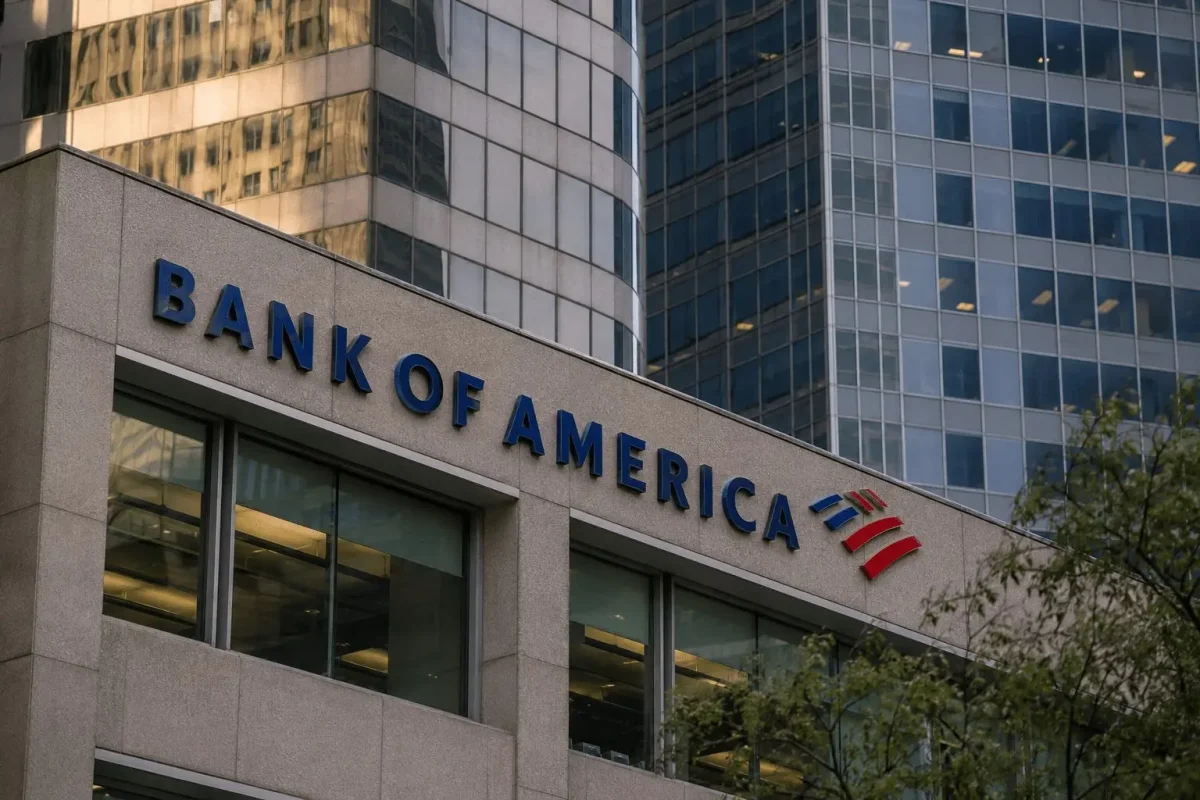
Bank of America (BAC) shares maintained their post-earnings gains on Friday, closing at $61.27, down 0.3% on the day but up 2.7% for the week. The market's attention shifted to the company's exposure to interest rate movements, a critical factor given that net interest income (NII) comprised about 51% of second-quarter revenue, totaling $16.0 billion, or $16.2 billion on a fully taxable-equivalent basis.
Net Interest Income Growth and Rate Sensitivity
Net interest income rose 9% in the second quarter compared to the prior year. Management projects that full-year 2026 NII growth will approach the upper end of its 6%-8% target range. However, the bank's internal rate model indicates that a 100-basis-point parallel decline from the June 30 forward curve would reduce NII by approximately $2.2 billion over the next 12 months, while a similar increase would add only $1.0 billion. This translates to a downside-to-upside ratio of 2.2 times, meaning the potential negative impact from falling rates is more than double the potential benefit from rising rates.
This asymmetry is particularly significant as the rate curve's structure plays a key role in valuation. The projected $2.2 billion decline represents about 3.4% of annualized second-quarter NII, and 4.7% of annualized pretax income for the same period. Investors are closely monitoring the Federal Reserve's next moves, with the central bank set to meet at the end of July.
Earnings Beat and Revenue Diversification
Bank of America reported second-quarter earnings of $1.21 per share, surpassing the consensus estimate of $1.13. Revenue increased 15% year-over-year to $31.6 billion, while net income advanced 27%. Operating leverage reached 6.6%, reflecting strong cost management. The earnings mix became more diversified, with trading revenue surging 33% to an all-time high of $7.1 billion, and investment-banking fees jumping 50% to $2.1 billion.
Credit quality remained stable, with the net charge-off ratio declining to 0.47% from 0.55% in the prior quarter. Average loans grew 8%, with gains across all business segments, signaling healthy demand. Chief Executive Brian Moynihan noted, "Near-term, pipelines remain strong, and commercial borrowing has picked up," indicating continued loan growth despite the lingering rate risk.
Market Context and Peer Comparison
Bank of America's stock currently trades at 15.2 times earnings, sitting between its major peers: JPMorgan Chase (JPM) at 16.9 times and Wells Fargo (WFC) at 13.5 times. The stock outperformed the SPDR S&P Bank ETF (KBE), which fell 1.5% on Friday. The S&P 500 (SPX) lost 1.0% on the day.
Looking ahead, over 80 S&P 500 companies are scheduled to report results next week, with American Express (AXP) providing fresh insights into consumer spending. The Federal Reserve's late-July meeting will be a key catalyst for interest rate expectations. Bank of America is set to report its next earnings on October 14, and in the interim, yields and deposit pricing could influence its earnings multiple.
Risks and Outlook
Several risks could impact Bank of America's performance. A more rapid drop in interest rates would weigh on NII as projected by the bank's model. Rising deposit costs could further compress spreads. While the record trading quarter was a bright spot, such strong performance may be difficult to sustain. Additionally, oil price shocks due to geopolitical tensions could reignite inflation and increase market volatility, potentially affecting the bank's outlook.
As the market shifts its focus from bank earnings to interest rate trajectories, Bank of America's rate sensitivity remains a central theme for investors. The company's ability to navigate a changing rate environment will be crucial in determining its stock performance in the coming months.