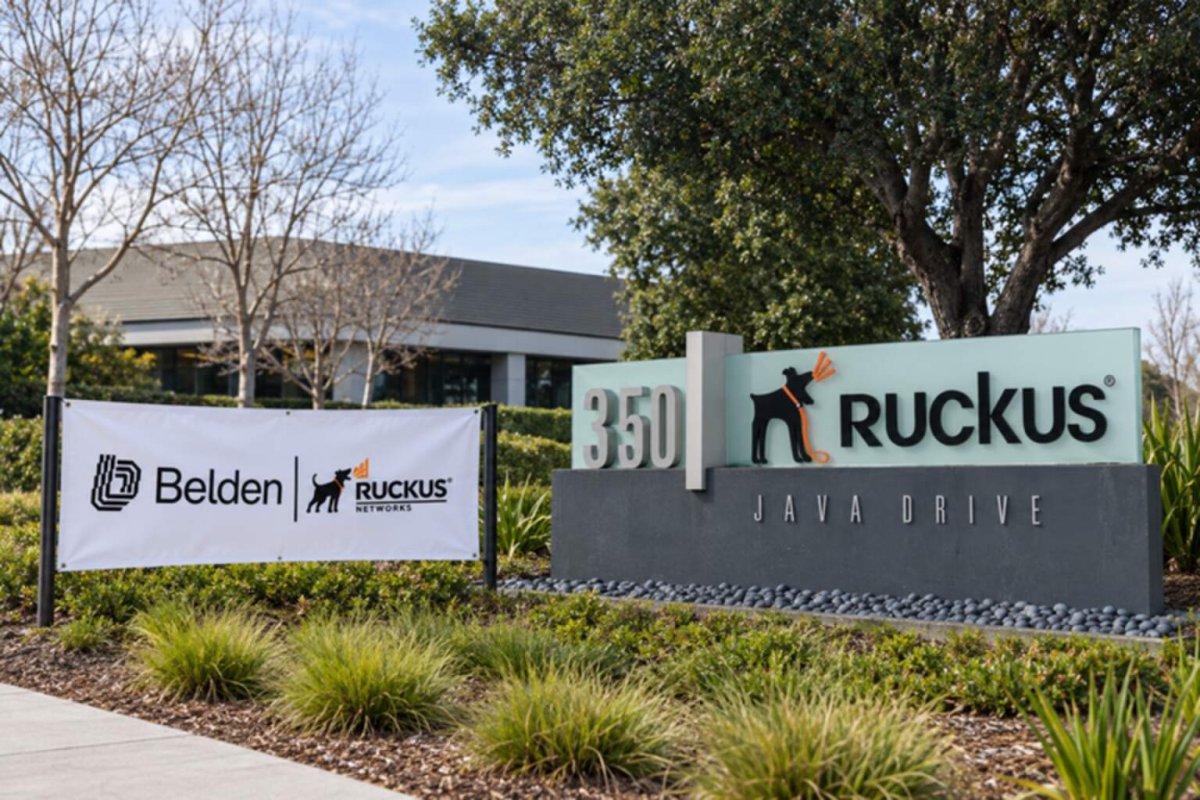
Belden Inc.'s (NYSE: BDC) $1.9 billion acquisition of RUCKUS Networks promises to reshape its financial profile, but the pro forma numbers reveal a sharp trade-off: higher margins and revenue come with a significant debt load that will test the company's integration and cash-flow discipline.
According to a regulatory filing submitted after Friday's market close, had the two businesses been combined at the start of 2025, first-quarter revenue would have climbed roughly 25% to $869.8 million, while gross margin would have expanded to 43.2% from Belden's standalone 37.1%. Yet the cost of that transformation is equally stark: long-term debt jumps to $3.05 billion from $1.26 billion, and net income collapses to just $7.4 million from $51.0 million due to financing costs and purchase-accounting adjustments.
Belden completed the acquisition from Vistance Networks on July 1, adding RUCKUS's Wi-Fi, enterprise switching, and network-management operations. The company funded the deal with cash and a new term loan. Friday's amendment to its SEC filing does not alter the transaction; instead, it offers shareholders a first detailed look at what the combined income statement and balance sheet might have looked like.
Belden shares closed at $122.26 on September 11, up 6.2% in regular trading, according to Yahoo Finance. Because the filing arrived after the bell, that move should not be interpreted as a market reaction to the new data.
Intangible-Heavy Purchase Price
Belden's preliminary purchase price allocation values the acquired net assets at $1.908 billion. Goodwill accounts for $739.6 million and identifiable intangible assets for another $1.04 billion—together representing about 93.3% of the net purchase price, a TS2 calculation shows.
That concentration is not inherently alarming; in networking acquisitions, software, customer relationships, and technology often carry more value than physical assets. However, it raises the execution bar. Those assets justify their valuation only if RUCKUS retains customers, protects pricing, and converts its high gross margin into cash. The goodwill also leaves Belden more exposed to a future impairment if the acquired business underperforms.
The accounting drag is substantial. On a full-year 2025 basis, pro forma revenue rises to $3.402 billion from Belden's reported $2.715 billion, yet operating income falls to $116.8 million from $315.7 million. Pro forma net income becomes a $7.3 million loss, compared with Belden's $237.5 million profit. A $75 million inventory step-up and amortization of acquired intangibles are among the deal-related adjustments depressing those figures.
Deleveraging Is the Real Test
The new term loan bears interest at SOFR plus 2.25 percentage points, or a base rate plus 1.25 points, and matures in July 2033. It amortizes at only 0.25% per quarter, so operating cash flow—not scheduled principal payments—will determine how quickly the balance comes down. In the first-quarter illustration, added interest expense is $27.0 million, taking combined net interest expense to $40.5 million from Belden's standalone $13.5 million.
Floating-rate sensitivity matters. On roughly $1.8 billion of incremental debt, a one-percentage-point change in the benchmark rate equates to about $18 million of annual interest before repayments, a TS2 calculation. Lower rates would help; a renewed rise in SOFR would absorb cash that could otherwise reduce leverage.
The strongest counterargument is that the filing is an accounting illustration, not a forecast. It does not present a fully integrated cost base, and several purchase-accounting charges are noncash or temporary. When Belden announced the transaction in April, management projected immediate adjusted-EPS accretion, net leverage below 3.0 times within the first full year after closing, and a return to about 1.5 times by 2029. It also paused share repurchases while debt is elevated.
That makes the next scorecard unusually clean. RUCKUS must preserve the gross-margin lift while combined free cash flow pulls debt down. If both occur, the low pro forma GAAP earnings will look more like acquisition noise than economic damage. If leverage stays near $3 billion or the acquired margin erodes, Friday's filing will instead have revealed how little room Belden left itself for an integration miss.