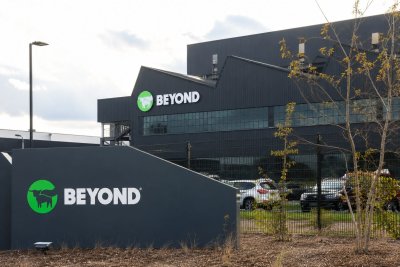
Beyond Meat Inc. (NASDAQ: BYND) experienced a sharp decline on Tuesday, with shares closing at $0.4176, down 19.7% on volume of 142.1 million shares. The drop came as the company confirmed its 1-for-30 reverse stock split, which will become effective on August 13 at 11:59 PM EDT. Split-adjusted trading is set to begin on August 14, leaving just 12 regular trading sessions before Nasdaq's August 31 compliance deadline.
The reverse split is a critical move for the plant-based meat producer to regain compliance with Nasdaq's minimum bid price requirement of $1.00 per share. Based on Tuesday's closing price, the theoretical post-split price would be approximately $12.53, providing a buffer of 12.5 times the minimum bid threshold. However, the split does not alter the company's underlying fundamentals or create any economic value for shareholders.
CEO Ethan Brown described the split as an "important step toward maintaining our Nasdaq listing." The new CUSIP will be 08862E307, while the ticker symbol remains BYND. The company will round fractional shares up to whole shares under specified procedures, ensuring that ownership percentages remain broadly unchanged.
The market's reaction has been severe. BYND shares have lost 34.1% since August 4, and Tuesday's intraday low of $0.41 marked a new 52-week trough. Trading volume on August 11 was approximately 4.8 times the stock's prior 20-session average, indicating heightened investor anxiety.
Despite the stock's turmoil, the company's second-quarter results offered some positive signals. Revenue reached $68.8 million, surpassing the LSEG estimate of $62.4 million. The company guided third-quarter revenue to $60 million to $65 million, with a midpoint of $62.5 million, just 0.5% above the consensus estimate of $62.2 million. However, revenue declined 8.2% year-over-year, and gross margin contracted by 2.1 percentage points to 8.5%. Operating losses narrowed to $30.8 million from $37.5 million, but adjusted EBITDA loss widened to $27.7 million from $24.7 million.
Geographic performance remained mixed. U.S. revenue fell 14.4% to $37.6 million, while international retail grew 16.5% to $18.5 million. International foodservice, however, dropped 16.0%. Liquidity improved, with cash and restricted cash at $186.1 million, but debt carrying value stood at $323.8 million. First-half operating cash use declined to $23.2 million from $58.0 million.
Analyst sentiment remains bearish. The consensus rating is Strong Sell, with 0 buys, 3 holds, and 6 sells. The average price target is $0.83, which translates to a mechanical post-split equivalent of $24.90. Targets range from $0.50 to $1.00, or $15.00 to $30.00 post-split. These figures are mechanical conversions and do not represent new forecasts, as the split does not change analyst ratings or the underlying challenges.
The immediate focus is on the compliance calendar. The split becomes effective late Thursday, and Friday's close will start the potential streak of 10 consecutive sessions at or above $1.00. The tenth session would occur on August 27, well ahead of the August 31 deadline. However, risks remain: a reverse split may restore bid-price compliance, but it cannot repair declining revenue or negative adjusted EBITDA. Thin post-split liquidity could amplify volatility, and Nasdaq may still assess other listing standards.
For investors, the immediate hurdle is mechanical and visible. The harder question is whether international retail growth can outpace U.S. weakness before liquidity tightens again.