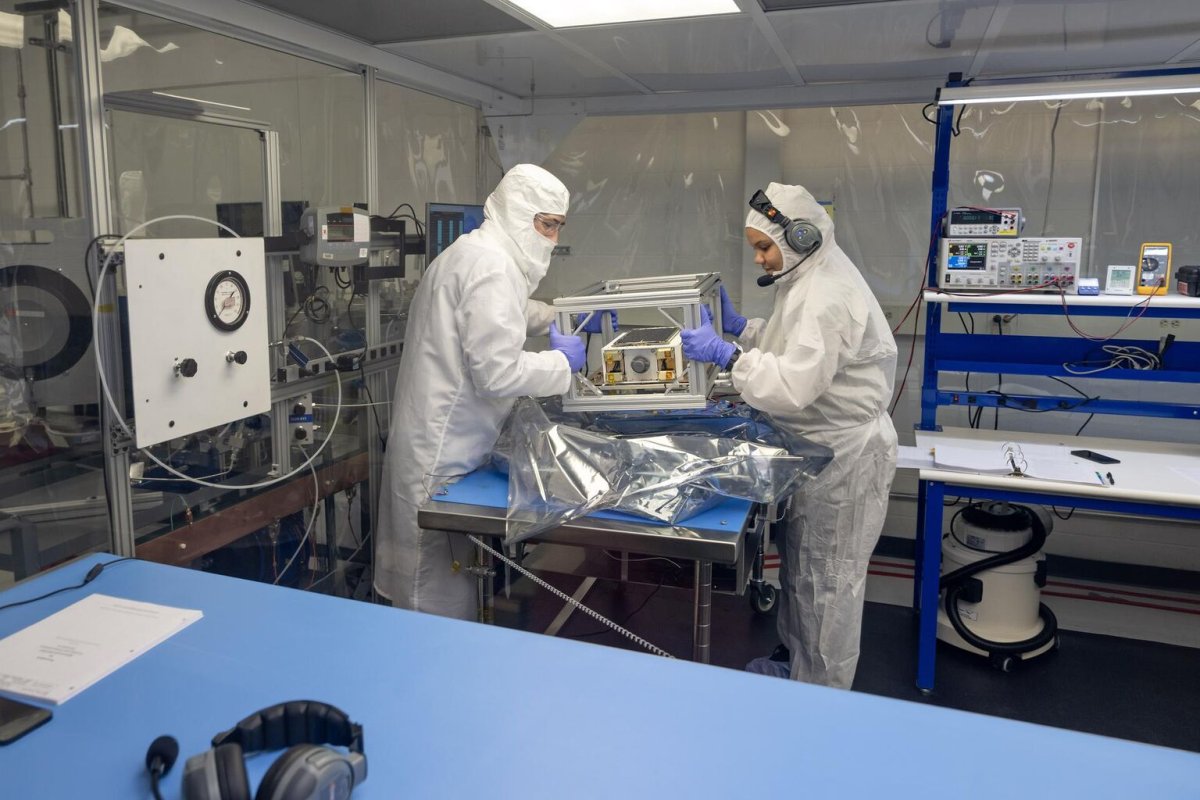
NASA has confirmed that the flight hardware for its ASCENT Propulsion Dual Mode mission successfully completed thermal-vacuum, helium-leak, and spin testing on September 25. The milestone clears the way for final checkouts and solar-array integration on the 6U CubeSat, which is slated to launch no earlier than October 1 aboard a SpaceX Falcon 9 from California.
The shoebox-sized spacecraft will be deployed approximately 325 miles (523 kilometers) above Earth for a nine-month demonstration. Its central objective is to validate whether a single liquid propellant can reliably feed two fundamentally different types of thrusters.
One Tank, Two Propulsion Modes
The ASCENT spacecraft carries one chemical thruster and four electric electrospray thrusters, all drawing from a common tank of ASCENT propellant, formerly known as AF-M315E. According to mission reporting, this shared architecture reduces the need for separate tanks, valves, and plumbing that would typically be required for distinct chemical and electric systems.
In chemical mode, the propellant passes through a heated catalyst bed, where decomposition generates hot gas and relatively high thrust for rapid maneuvers. In electric mode, the conductive liquid is charged and then accelerated as tiny ions or droplets through an electric field. This produces far less force but uses propellant more efficiently.
The two modes address different timing requirements: an electrospray burn can accumulate a change in velocity over hours while consuming propellant slowly, whereas a chemical pulse can move the spacecraft quickly when timing is critical. The common architecture allows operators to choose the appropriate timescale without carrying an additional liquid, tank, or feed system. However, it does not eliminate power and thermal constraints.
Performance Metrics and Force Gap
The force disparity between the two modes is stark. The chemical thruster is rated at 0.1 newtons (100,000 micronewtons), while MIT's laboratory electrosprays have produced 6 to 12 micronewtons across tested currents. These figures come from different test configurations and are not a direct flight comparison, but they illustrate why neither mode replaces the other.
ASCENT enables the pairing because it is both energetic and electrically conductive. The Air Force Research Laboratory, which developed the propellant, reports 50% more density-specific impulse than hydrazine. That measure combines density and efficiency; it is not a claim of 50% higher specific impulse alone.
For a CubeSat, density matters because tank volume competes directly with payload space. More impulse in the same volume can preserve room for instruments or batteries. The actual saving depends on tankage, valves, heaters, and power electronics. NASA has not published that complete mass balance for the flight article.
Handling and Contamination Risks
Lower handling risk can simplify pre-launch operations. AFRL attributes this advantage to lower vapor pressure and reduced reactivity under atmospheric conditions. However, the propellant is not harmless: its chemical reactor runs hot, material compatibility is demanding, and crews still manage pressurized liquid. A shared tank also concentrates risk—contamination or pressure loss could affect both propulsion branches.
The completed helium test checked whether the pressurized flight plumbing and seals leaked inside a vacuum chamber. This is particularly important because both propulsion branches share a tank and feed path; a leak could disable both modes instead of one isolated subsystem.
Thermal-vacuum testing exercised hardware without air and through simulated temperature changes. The spin test measured mass properties and the center of gravity, supporting attitude control, antenna pointing, and solar-array alignment.
NASA disclosed no temperature range, leak-rate threshold, or qualification margin for this campaign. The milestone therefore establishes that the flight article passed the agency's planned checks, not how much margin remains. It also says nothing yet about long-duration valve behavior or repeated transitions between modes.
Temperature is a real variable for the electric side. MIT researchers measured fairly steady thrust from 20°C to 60°C, but specific impulse fell from about 680 to 580 seconds—a reduction of roughly 15%. The test used ground hardware, not the complete spacecraft in orbit.
Lessons from Lunar Flashlight
ASCENT has flown before, but NASA's Lunar Flashlight mission exposed a serious integration risk. Its chemical system could not produce consistent thrust for lunar orbit insertion. NASA's Jet Propulsion Laboratory said debris from an additively manufactured feed system likely obstructed narrow fuel passages.
The new CubeSat is not a repeat of that propulsion layout. It adds electrosprays and a common feed architecture, while using one chemical thruster rather than Lunar Flashlight's four. Mission officials told Aerospace America they applied tighter cleanliness precautions. A successful helium leak test does not, by itself, prove that every microscopic passage is debris-free.
This distinction sets the standard for interpreting the ground milestone. The spacecraft has cleared environmental and physical checks. It has not demonstrated full thrust, reliable switching, or the planned operating life in space. Those are the flight experiment.
Next Steps in Orbit
After launch, the team expects roughly one week of battery, solar-array, and communications checkouts. Chemical burns are planned first during the mission's second and third weeks. Operators would then activate the four electrosprays. The sequence creates clear, observable gates.
If both branches work, the spacecraft will alternate short chemical and electric burns, demonstrating the flexibility of a dual-mode propulsion system. Success would mark a significant step toward more capable small satellites, enabling extended missions with greater maneuverability and efficiency.