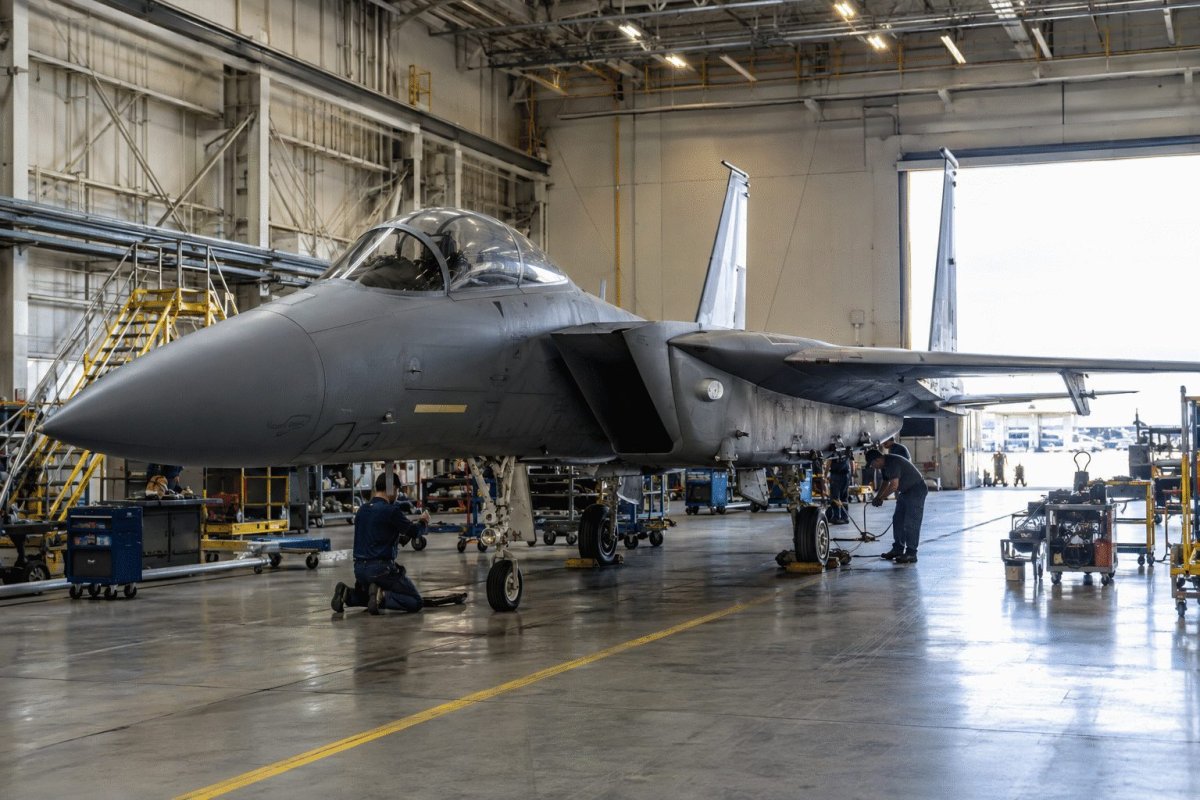
Boeing (NYSE: BA) shares closed Tuesday at $211.08, up 0.29%, after the U.S. Air Force awarded the company a ceiling contract worth $131.23 billion for its F-15 Eagle Crest program. In after-hours trading, the stock added another 0.08% to reach $211.25. The modest gain came despite the contract's enormous headline value, as investors focused on the limited initial funding and the program's long-term execution risks.
Initial Funding: A Fraction of the Ceiling
The contract, announced in a government notice, carries a ceiling of $131.23 billion, but only $343,740 was obligated at the time of award. That amounts to 0.00026% of the maximum potential value, underscoring the difference between a contract ceiling and guaranteed revenue. Under an indefinite-delivery, indefinite-quantity (IDIQ) arrangement, the ceiling represents a purchasing framework, not a commitment to buy the full amount.
Scale Relative to Boeing's Defense Business
To put the ceiling in context, it equals 154% of Boeing Defense, Space & Security's backlog of $85 billion as of the second quarter of 2026. It also represents 17.5 quarters of the segment's latest quarterly revenue of $7.48 billion. These comparisons highlight the contract's potential capacity, but they do not translate directly into booked sales or earnings.
Contract Details and Scope
The F-15 Eagle Crest contract covers a wide range of activities, including aircraft production, integration, modernization, upgrades, retrofits, and sustainment. Work will be performed in St. Louis and is scheduled through August 2037. The ordering period ends in August 2031, with an option to extend to 2036. The award was sole-source, meaning Boeing was the only bidder, and it also permits foreign military sales to countries such as Japan, Israel, Saudi Arabia, South Korea, Singapore, Indonesia, and Poland. Actual task orders will determine the revenue mix and timing.
Market Reaction and Trading Activity
Tuesday's market response was restrained. Boeing's stock gained $0.62 per share, adding approximately $490 million in quoted equity value based on 790.37 million shares outstanding. Trading volume was 4.85 million shares, 18% below the 65-day average, according to WSJ market data. The stock's 0.29% rise closely tracked the S&P 500's 0.32% gain, while Boeing outperformed the broader industrial-goods group, which fell 1.44% on the day.
Margin Challenges Persist
Despite the contract's scale, margins remain a key concern. Boeing Defense reported $7.48 billion in second-quarter revenue, up 13% year-over-year, but posted a 0.2% operating loss. The quarter included $280 million in losses related to the VC-25B presidential aircraft program, according to Boeing's July 28 earnings release. The company held $20.0 billion in cash and marketable securities at quarter-end, with consolidated debt of $45.9 billion. While large future orders could improve factory utilization, working capital requirements and program charges will ultimately determine the cash-flow impact.
Analyst Outlook and Risks
The analyst community remains cautiously optimistic. A current aggregation of 22 analysts rates Boeing as a “Moderate Buy” with an average price target of $272.58, implying roughly 29.1% upside from Tuesday's close. However, target prices range from $223 to $305, reflecting uncertainty about the defense segment's profitability and the broader commercial aerospace recovery.
The primary risk is conversion: Congress and foreign customers may fund less than the contract ceiling, delay orders, or alter specifications. Even funded work could disappoint if fixed-price charges or supplier costs keep the defense margin near zero. The next evidence will come from funded task orders, their disclosed values, and any changes in backlog. Boeing is scheduled to report third-quarter results on October 28. Until then, the $343,740 obligation serves as the more realistic measure of near-term commitment.