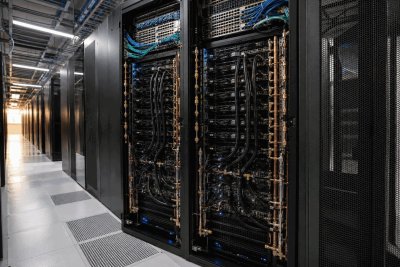
Cisco Systems (NASDAQ: CSCO) delivered a robust fiscal fourth-quarter performance on Wednesday, surpassing analyst expectations and raising its artificial intelligence revenue forecast for the coming fiscal year. However, the upbeat guidance came with a cautionary note: while AI is set to become a major growth driver, it also introduces margin pressures and concentration risks that are giving some investors pause.
Q4 Results Beat Consensus
The networking giant reported quarterly revenue of $17.3 billion, up 18% year-over-year and 2.8% ahead of the consensus estimate of $16.83 billion. Adjusted earnings per share came in at $1.22, a 23% increase from the prior year and five cents above the FactSet consensus of $1.17. Adjusted gross margin stood at 66.3%, within the company's guidance range, while adjusted operating margin reached 35.9%, above the 34%-35% guidance range.
Segment-wise, networking revenue surged 28%, and security revenue grew 14%. Product orders climbed 35% year-over-year, or 25% when excluding hyperscaler customers. The company's AI infrastructure orders totaled $4.0 billion in the quarter, bringing the full-year figure to $9.3 billion, slightly ahead of the $9.0 billion target.
AI Revenue Target Raised
Looking ahead, Cisco raised its fiscal 2027 AI revenue forecast to $7.5 billion, representing an 87.5% increase from an estimated $4.0 billion in fiscal 2026. This AI revenue is expected to account for approximately 37% of the company's projected $9.5 billion revenue growth next year. The remaining $6.0 billion in growth implies a 10% increase in non-AI revenue, a challenging but achievable goal given the company's current momentum.
CEO Chuck Robbins emphasized Cisco's readiness to support customers in their AI deployments, calling the current demand cycle a “networking supercycle.” The company's strong order book, particularly from hyperscalers, underpins this optimism. However, the concentration of AI orders among a few large customers remains a key risk.
Margin Concerns and Cost Discipline
Despite the strong top-line growth, adjusted gross margin contracted by 210 basis points to 66.3%, reflecting the product mix shift toward AI infrastructure. However, adjusted operating margin expanded by 160 basis points to 35.9%, as the company kept a tight lid on expenses. Adjusted operating expenses rose just 5% year-over-year, well below the 18% revenue growth, demonstrating effective cost discipline.
Analysts note that while the margin mix is a concern, Cisco's ability to maintain operating leverage is a positive sign. The company's focus on efficiency is expected to continue, but investors will be watching for any signs of margin erosion as AI revenue scales.
Outlook and Guidance
For the first quarter of fiscal 2027, Cisco expects revenue in the range of $18.0 billion to $18.2 billion, with adjusted EPS of $1.32 to $1.34. For the full year, the company projects revenue between $72.2 billion and $73.4 billion, implying 15% growth from fiscal 2026's $63.3 billion. Adjusted EPS is forecast at $5.05 to $5.11, up 17.3% at the midpoint from $4.33.
The fiscal 2027 outlook implies a 15% revenue increase and a 17.3% EPS increase at the midpoint, signaling continued momentum. However, the company's reliance on AI hyperscaler revenue, which is expected to nearly double, introduces execution risk. The conversion of the $9.3 billion order backlog into actual revenue will be a key metric to watch.
Market Reaction and Analyst Sentiment
Shares of Cisco rose 3.2% in regular trading ahead of the earnings release but fell in after-hours trading as investors weighed the margin pressure and the ambitious AI target. Options markets implied a swing of about 7% either way by Friday, underscoring the uncertainty.
Analyst sentiment remains largely positive, with 13 out of 26 analysts rating the stock a Strong Buy, 4 a Buy, 8 a Hold, and 1 a Sell. The average price target stands at $130.23, reflecting upside from current levels. However, the stock has already surged 60% over the past year, and the high bar set by the AI growth story means any misstep could be punished.
Key Risks Ahead
Investors should be mindful of several risks. AI orders are heavily concentrated among a few hyperscale customers, and timing of deployments can be unpredictable. Product mix shifts could further pressure gross margins. Increased competition and potential reductions in enterprise spending could also impact conversion rates. The next step for Cisco is to execute on its $9.3 billion backlog while maintaining the operational leverage that protected fourth-quarter earnings.
In summary, Cisco's latest results underscore its successful pivot to AI, but the journey is not without challenges. The company's ability to deliver on its AI revenue target while managing margins will be crucial for sustaining investor confidence.