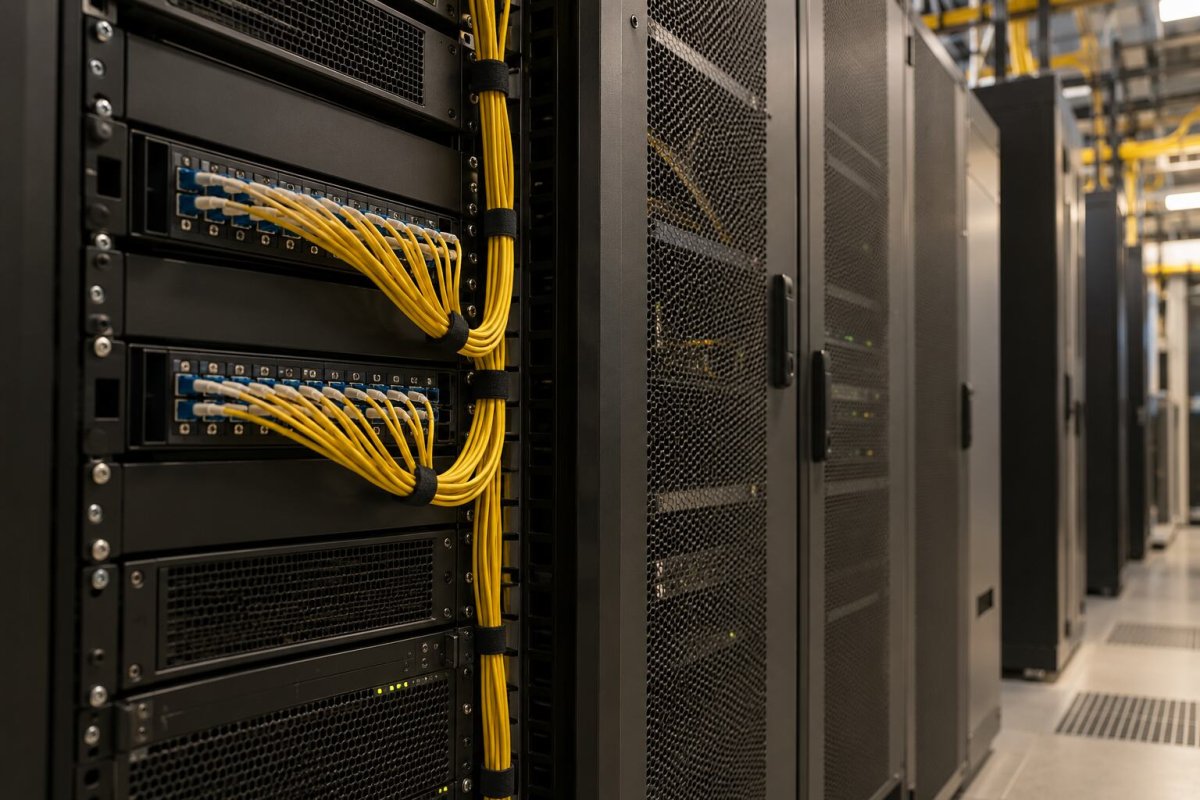
CoreWeave (NASDAQ: CRWV) announced Tuesday that the majority of its planned 22.5 megawatts (MW) of IT capacity in Denmark is now operational. The deployment, housed at atNorth's DEN01 facility in Ballerup, Greater Copenhagen, marks a significant step in the company's European expansion. This move comes as part of a broader network rollout targeting seven additional markets, scheduled to be completed by mid-2027.
The new computing capacity addresses a practical challenge for customers: data placement. With high-performance AI workloads, the physical location of data relative to compute resources can significantly impact efficiency. CoreWeave's announcement highlights that even a dedicated 400 gigabit-per-second (Gb/s) link would take at least 5.6 hours to transfer a single decimal petabyte (PB) of data, assuming the connection operates at its theoretical maximum. Real-world factors like storage latency and network congestion would extend this time considerably.
Network Design and Data Transfer Considerations
CoreWeave's network design specifies multiple 400 Gb/s connections at each access point. While parallel links increase aggregate bandwidth, customers must utilize these links effectively to benefit. The company emphasizes the need for sustained transfer measurements, not just available GPU capacity, when deciding where to stage datasets. This underscores the importance of network performance in AI operations.
Within the Danish facility, CoreWeave deploys Nvidia Blackwell systems with Quantum-X800 InfiniBand, which supports 800 Gb/s networking within the compute fabric. However, this internal fabric speed is distinct from the backbone's 400 Gb/s connections. The internal network handles inter-processor communication for AI workloads, while the backbone transfers datasets, model states, and finished models between locations. CoreWeave notes that these transfers can take hours or days, and faster regional transport can shorten preparation time but does not necessarily improve training speed.
Danish Deployment Details
The atNorth DEN01 campus lists 30 MW of published power capacity and supports liquid-cooled racks above 100 kilowatts. CoreWeave's announcement does not provide an exact live megawatt figure or a specific GPU count for the Danish site. The facility's heat-reuse agreement, announced in November 2025, targets heating more than 8,000 local homes starting in 2028. Tuesday's computing milestone does not confirm that heat deliveries have begun, a distinction relevant for assessing local benefits.
atNorth's facility guide lists one-way latency of 5.4 milliseconds to London and 44 milliseconds to New York, about eight times higher. These figures are published by the site operator; CoreWeave has not provided corresponding measurements for its planned Asian routes.
Network Expansion and Resilience
CoreWeave's backbone design aims to handle interrupted transfers. Each access point connects to at least two others through four physically diverse paths, and each region connects to two access points. Hardware-based MACsec encryption protects traffic in transit, according to the company's design note. "Our customers need more than access to computing capacity," said Sachin Jain, Chief Operating Officer, in Tuesday's release.
The new access points will serve the UAE, India, Indonesia, Singapore, Australia, South Korea, and Japan. These are network locations, not newly activated computing halls. CoreWeave aims to begin rolling them out later in the fourth quarter of 2026, with the full loop expected by mid-2027.
Market Implications
This expansion positions CoreWeave to better serve global AI customers who require geographically distributed compute and data storage. The focus on network performance and data placement reflects a growing industry trend where AI workloads demand not only raw compute power but also efficient data movement. CoreWeave's stock (CRWV) may see investor interest as the company executes on its expansion strategy.
However, the announcements remain schedule targets, and transfer performance data is not yet available. Link rates do not guarantee throughput during cable failures or congestion. Investors should monitor the rollout progress and any performance benchmarks released by the company.