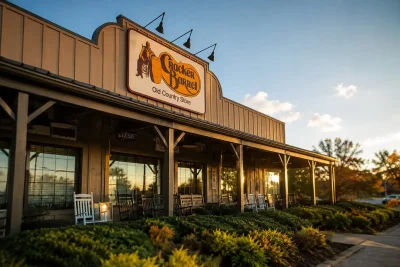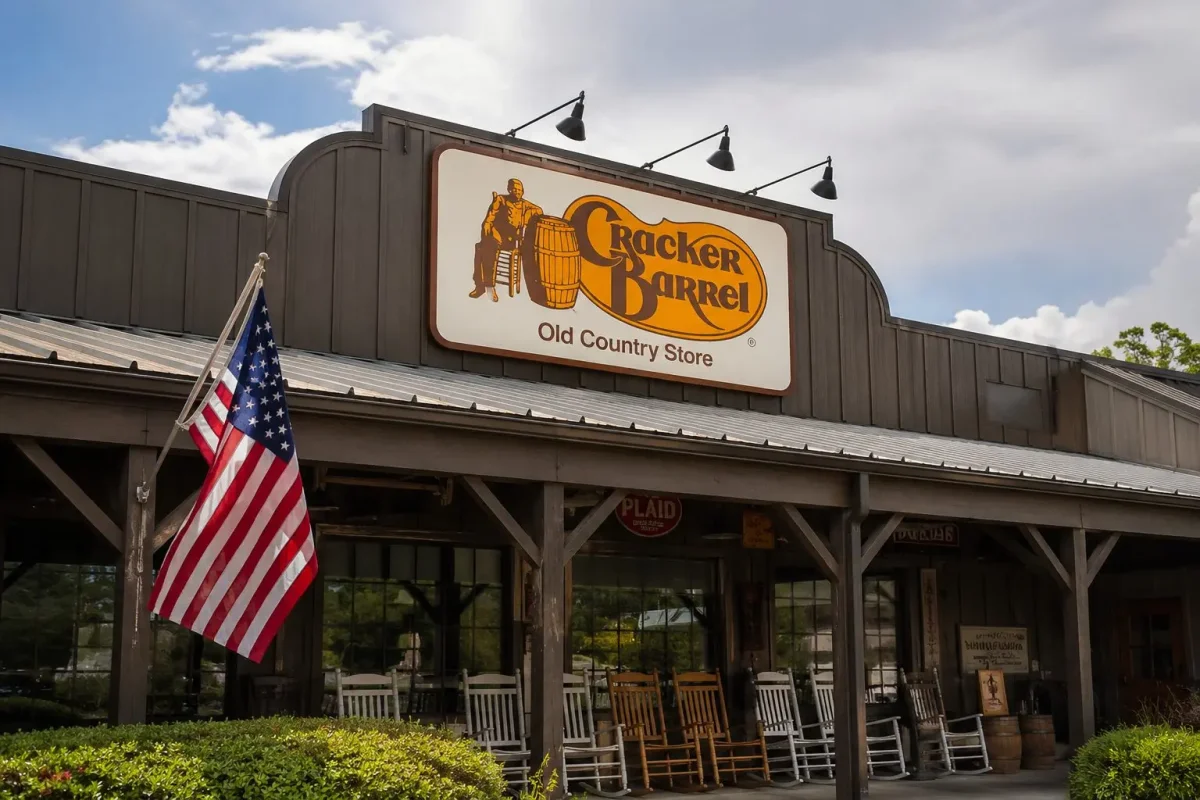
Cracker Barrel Old Country Store, Inc. (NASDAQ: CBRL) saw its stock price surge more than 26% in late morning trading Wednesday, following the release of fiscal third-quarter results that surprised Wall Street. The company reported an unexpected profit and raised its full-year revenue and adjusted EBITDA forecasts, providing investors with the most compelling evidence yet that its turnaround strategy is gaining momentum.
Shares of the struggling restaurant and retail chain hit $45.81, up $9.51 from the previous close, with trading volume exceeding 6 million shares. The stock opened at $43.50 and touched a high of $48.88 earlier in the session. Despite the sharp rally, the stock remains roughly 17% lower over the past twelve months, reflecting the deep challenges the company has faced.
Surprising Profit Beats Expectations
For the quarter ended May 1, Cracker Barrel reported revenue of $797.4 million, a 2.9% decline year-over-year but ahead of the $775.3 million analysts had anticipated. The company posted adjusted earnings of $0.29 per share, a stark contrast to the $0.45 loss per share expected in the Zacks consensus survey. On a GAAP basis, net income reached $42.8 million, or $1.90 per diluted share, compared to $12.6 million, or $0.56 per share, in the same quarter last year. The GAAP results included a $47.4 million pretax benefit from an interchange-fee litigation settlement, which the company excluded from its adjusted figures.
Guidance Raised on Cost-Cutting and Operational Improvements
Investors largely dismissed the one-time settlement and focused on the improved outlook. Cracker Barrel raised its fiscal 2026 revenue guidance to a range of $3.27 billion to $3.30 billion, up from the prior $3.24 billion to $3.27 billion. The company also lifted its adjusted EBITDA forecast to $120 million to $125 million, significantly above the previous $85 million to $100 million range. Adjusted EBITDA, a key measure of operating cash flow, came in at $40.3 million for the quarter, supported by reductions in advertising and supply costs.
President and CEO Julie Masino stated that the company's efforts to fix operations, rebuild guest relationships, and improve profitability "continue to gain traction." She added that Cracker Barrel is "well-positioned to sustain this new momentum." However, the company's comparable restaurant sales still fell 2.6% during the quarter, and comparable retail sales dropped 1.8%.
Traffic Remains the Achilles' Heel
The most significant weakness remains guest traffic. Cracker Barrel reported a 6.7% decline in comparable restaurant guest traffic for the third quarter. The company partially offset this by increasing the average check by 4.3%, driven by a 4.4% menu price increase. However, relying on higher prices to compensate for fewer visits is a risky strategy, especially as consumers face persistent inflation, high debt levels, and declining savings rates. The company's quarterly filing also cited negative press and pushback against recent brand changes, including a new logo and test-store remodels, as factors contributing to the traffic decline.
Wall Street Reacts with Upgrades
Following the earnings report, Wells Fargo upgraded Cracker Barrel to Overweight from Equal Weight and raised its price target to $50 from $35. The bank cited the third-quarter beat and raised guidance as signs that the turnaround is gaining traction. Despite the upgrade, the stock's rally reflects optimism that may be premature if guest counts do not recover. The company also noted that it ended the quarter with its credit facility untapped and approximately $541.3 million in available liquidity. Cracker Barrel has $149.9 million in 0.625% convertible senior notes maturing in June 2026, which it plans to repay using its revolving credit facility.
Outlook and Risks
The key question for investors is whether Cracker Barrel can translate improved guest metrics into actual traffic gains while maintaining its higher profit targets. If traffic continues to trend negative, the company may find it increasingly difficult to raise menu prices without losing customers. Retail sales, which are closely tied to diner traffic, could also suffer. Additionally, rising food costs, wage pressure, tariffs on merchandise, and the looming debt refinancing leave little margin for error. The company's updated fiscal 2026 goals—$3.27 billion to $3.30 billion in revenue and adjusted EBITDA between $120 million and $125 million—now serve as the benchmark for investors to measure progress.