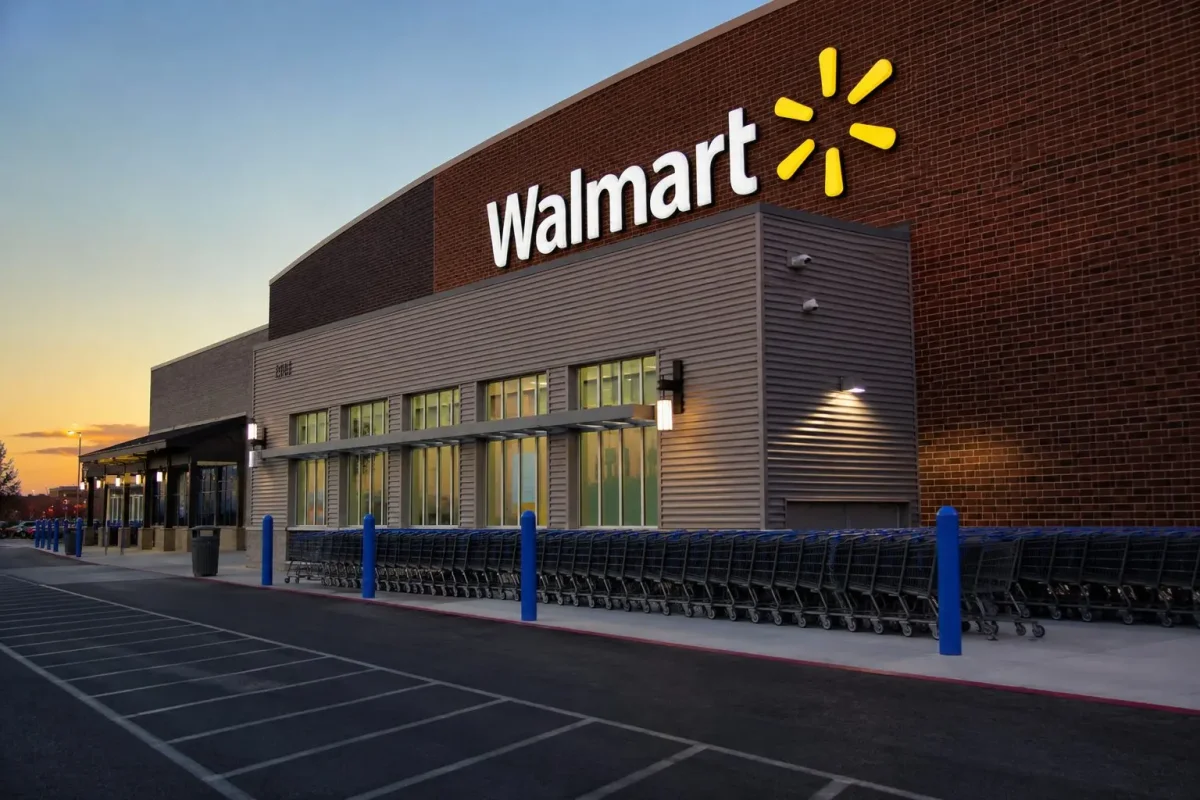
Walmart Inc. (NASDAQ:WMT) shares edged up 0.6% to $114.60 on Monday afternoon, giving the retail giant a market capitalization near $916.7 billion. However, a fresh discounted cash flow (DCF) analysis values the stock at just $34.35 per share, revealing a valuation gap of roughly $642 billion based on approximately 8 billion shares outstanding.
This stark discrepancy underscores the market's willingness to look beyond traditional supermarket metrics. Investors are increasingly pricing in Walmart's transformation into a higher-margin business fueled by advertising, membership fees, marketplace commissions, and automated fulfillment. The bet is that these new revenue streams will accelerate profit growth faster than sales, a crucial challenge for a stock trading at 40.2 times trailing earnings.
Q2 Forecast: Profit Must Outpace Sales
Walmart's own guidance for the fiscal second quarter sets a high bar. The company expects net sales growth of 4% to 5% and operating income growth of 7% to 10% on a constant currency basis. Achieving this would require operating leverage, with profit growth outpacing revenue by 2 to 6 percentage points. This contrasts sharply with the first quarter, where revenue rose 7.3% but operating income increased only 5%, as higher fuel costs trimmed 250 basis points from operating income growth. CEO John Furner described the strategy as a "disciplined approach" aimed at strengthening returns.
E-commerce and Advertising Surge
Walmart's shift toward higher-margin revenue is evident in its recent numbers. Global e-commerce sales climbed 26% in the first quarter, global advertising revenue jumped 37%, and Walmart Connect U.S. rose 44% excluding Vizio. Membership fee income worldwide added 17.4%. Yet, free cash flow was negative $1.9 billion after capital spending, highlighting the uneven nature of the transformation. The company continues to invest heavily in infrastructure and technology to support these growth initiatives.
Valuation Crosscurrents
The stock presents four distinct valuation perspectives. Yahoo Finance's analyst consensus price target stands at $138.59, implying a 21% premium to the current price. GuruFocus's historical multiple model values the stock at $94.32, while its earnings-based DCF model yields $34.35 and its free-cash-flow DCF model comes in at $18.07. These wide disparities reflect the uncertainty surrounding Walmart's ability to consistently deliver on its profit growth ambitions.
Compared to peers, Walmart's trailing P/E of 40.2x sits between Costco's 46.5x and Amazon's 29.6x, with Target at 17.8x. Walmart's earnings yield of 2.5% is below the 4.58% yield on 10-year Treasuries, meaning investors are accepting lower current income in exchange for expectations of faster profit growth. Costco's yield is even lower, while Target offers a higher yield without such aggressive growth assumptions.
Cramer's Bullish Call
Jim Cramer has thrown his support behind the bulls, calling Walmart's recent decline "an incredible buying opportunity" and describing the retailer as "one of the greatest companies on earth." His comments come as Walmart cuts prices on thousands of items, including a 12% reduction on ground beef, 50% off cherries, and up to a third off branded 24-pack sodas. Julie Barber, Walmart U.S. chief merchant, said the company is making "even more investments in price."
Risks Remain
The $34 DCF figure is not a typical sell-side target. GuruFocus rates the model's predictability at just one out of five, citing significant sensitivity to growth and discount rate assumptions. Bulls face clear risks: price cuts may boost store traffic but compress merchandise margins, while higher fuel, wages, and delivery costs threaten the 7%-10% operating income growth target. CFO John David Rainey said in May that the company plans to "play offense despite the short-term pressure on profits."
Investors will get their next look at Walmart's progress on August 20, when the company reports fiscal second-quarter results. The key metric will be the spread between operating income and revenue growth, which serves as the clearest comparison between the $34 DCF model and Wall Street's $139 price target. Until then, the $642 billion valuation gap remains the central debate.