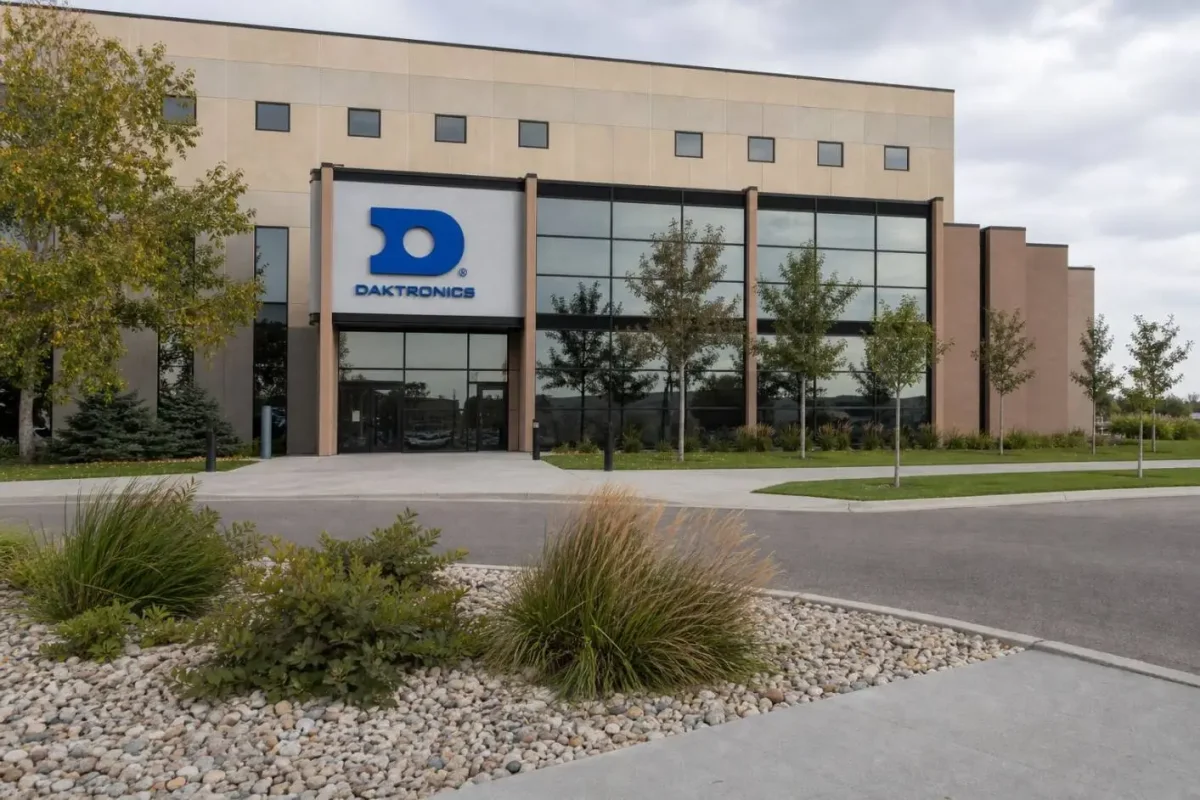
Shares of Daktronics, Inc. (NASDAQ: DAKT) experienced a sharp reversal on Wednesday, surrendering an intraday gain of 11.5% before closing lower. The stock opened at $21.015, touched a high of $21.595, but closed at $19.13, down 1.2% from the previous day's close of $19.36. In after-hours trading, the stock slipped further to $18.90, marking a 2.4% decline from Tuesday's close.
The dramatic turnaround came after CBS Sports reported that acting CFO Howard Atkins confirmed inquiries from the U.S. Securities and Exchange Commission (SEC) and the National Basketball Association (NBA) regarding the company's endorsement relationship with basketball star Kawhi Leonard. Daktronics stated it is cooperating with the inquiries, but the news cast a shadow over otherwise strong fiscal first-quarter results.
For the fiscal first quarter of 2027, Daktronics reported diluted earnings per share of $0.40, a 21.2% increase from $0.33 in the same period last year, surpassing the consensus estimate of $0.35 from three analysts polled by FactSet. Revenue rose 7.1% to $234.6 million, beating the expected $230.3 million. Operating cash flow also improved, climbing 20.3% to $31.4 million.
Despite the earnings beat, the company's order book showed weakness. New orders fell 19.6% to $191.8 million from $238.5 million in the year-ago quarter, while backlog declined 13.6% to $311.3 million from $360.3 million. Management attributed the decline to several large deals shifting into the second quarter. CEO Ramesh Jayaraman noted that the pipeline "remains robust," and the backlog has now exceeded $300 million for six consecutive quarters.
Gross margin improved to 30.5% from 29.7%, aided by tariff refunds, though higher memory and other input costs partially offset the gain. The balance sheet remains solid, with cash of $154.6 million against just $10.5 million in debt, resulting in net cash of $144.1 million. During the quarter, Daktronics repurchased 225,500 shares at an average price of $19.56.
The after-hours price of $18.90 sits 3.4% below the buyback average, suggesting that investors are weighing the regulatory risk and softer bookings against the company's strong cash position. The regulatory inquiry could lead to legal costs or reputational damage, while the benefit from tariff refunds may not recur, and memory costs could pressure margins.
Investors will be watching for further details on the SEC and NBA inquiries, as well as order conversion trends, at the company's annual meeting scheduled for September 16. The stock's volatility highlights the market's sensitivity to regulatory news, even when fundamentals appear strong.