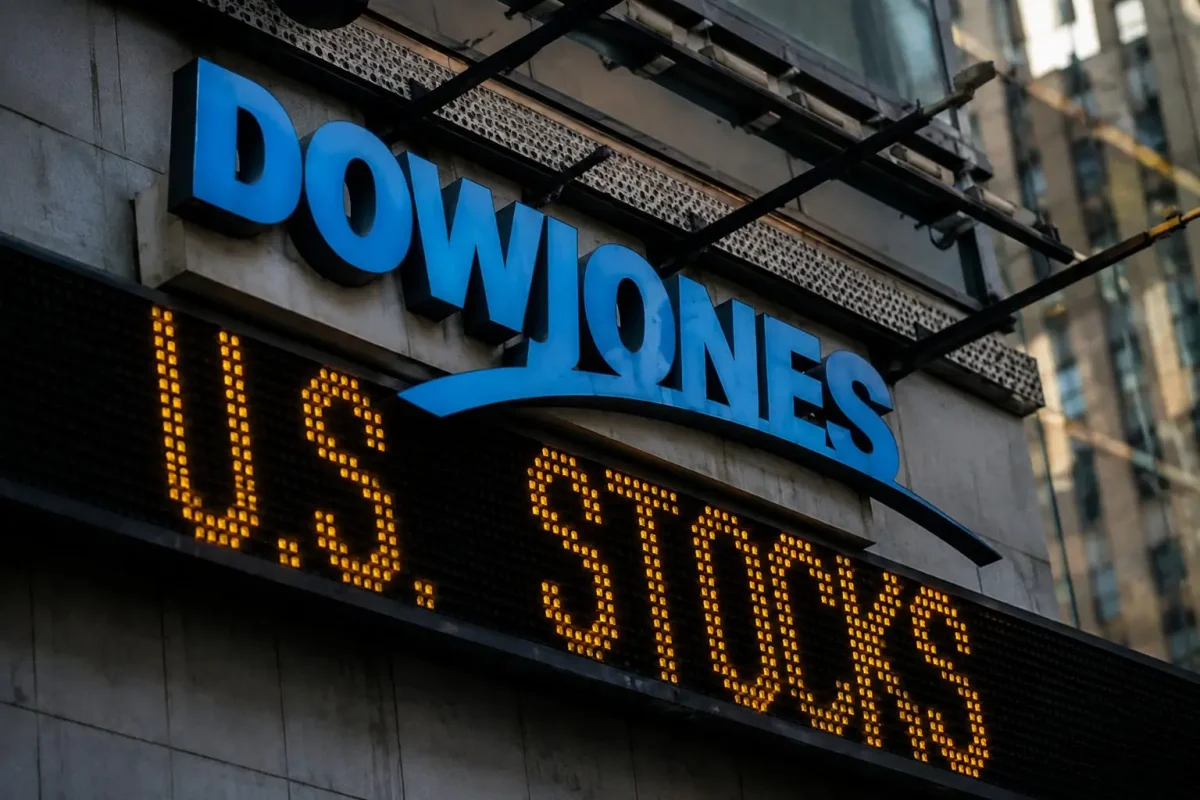
The Dow Jones Industrial Average achieved a historic milestone on Tuesday, closing above 54,000 for the first time ever. The index surged 1,036.66 points, or 1.95%, to settle at 54,215.07, marking its second consecutive record close. The rally was spearheaded by Caterpillar Inc. (NYSE: CAT), whose shares jumped following a robust earnings report, contributing roughly a third of the Dow's total gain.
Caterpillar's stock surged $54.53, adding approximately 324 points to the Dow, which translates to 31.2% of the index's daily advance. The construction and mining equipment giant reported quarterly revenue of $20.54 billion, a 24% increase year-over-year, and adjusted earnings per share of $8.17, comfortably beating the $6.20 consensus estimate from LSEG. The company's order backlog expanded to $72.1 billion, signaling sustained demand.
The market's focus on AI-driven infrastructure demand was evident, as Caterpillar's gains highlighted a broadening of the AI investment cycle beyond traditional software and semiconductor sectors. CEO Joe Creed noted, "Strong order rates and a growing backlog reflect broadening momentum." Revenue from the construction industry surged 35%, while power and energy revenue advanced 17%.
Other notable contributors to the Dow's rise included Goldman Sachs (NYSE: GS), Cisco Systems (NASDAQ: CSCO), and Nvidia (NASDAQ: NVDA). Goldman Sachs added 164 points, Cisco contributed 34 points, and Nvidia chipped in 36 points. Together, these three stocks accounted for roughly half of the Dow's gain, underscoring the index's price-weighted structure, which gives greater influence to higher-priced shares.
The broader market also rallied, with the S&P 500 climbing 1.89% to 7,743.77, and the Nasdaq Composite advancing 2.61% to 26,590.99. Semiconductor stocks jumped nearly 7%, and the S&P technology sector rose 4.5%. Advancing issues outnumbered decliners by a 2.11-to-1 ratio on the New York Stock Exchange.
Macroeconomic factors provided additional tailwinds. U.S. crude oil prices fell 5.43% to $75.98 per barrel, easing inflation concerns and reducing the likelihood of a Federal Reserve rate hike in September. The yield on the 10-year Treasury slipped to 4.635%, supporting equity valuations. June job openings declined to 7.359 million, indicating a gradual softening in labor demand without a sharp downturn.
Corporate earnings have been remarkably strong, with 85.2% of the 304 S&P 500 companies that have reported so far beating expectations, well above the historical average of 67.5%. This broad-based earnings strength has fueled investor optimism, though some strategists caution against complacency. "I don't sense one ounce of skepticism among investors," said Jack Ablin, chief investment officer at Cresset Capital, in a Reuters interview.
Despite the celebratory mood, risks remain. Talks to reopen the Strait of Hormuz have not reached a definitive deal, and a sudden spike in crude oil prices could reignite inflation fears and push Treasury yields higher. The Dow's heavy reliance on a few high-priced stocks also exposes it to concentration risk. Investors will closely watch Friday's payroll data, with analysts expecting an 80,000 increase in employment and unemployment holding steady at 4.2%.