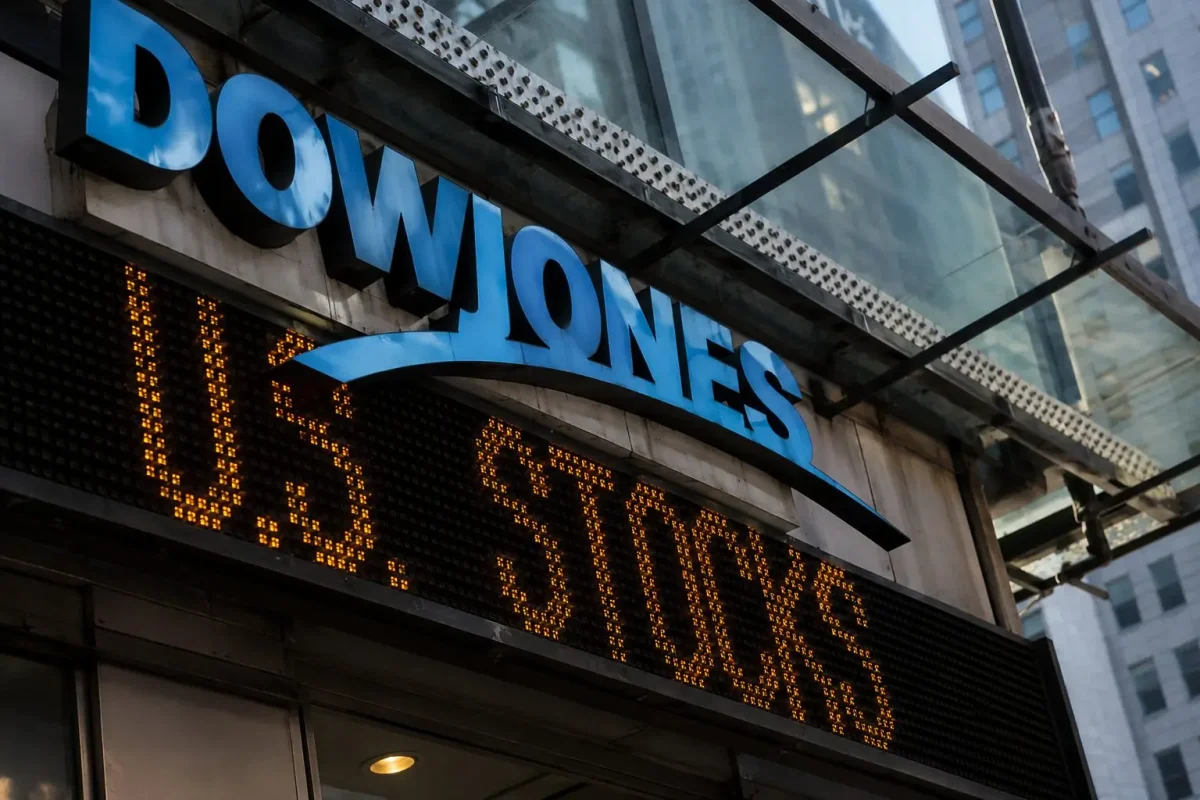
The Dow Jones Industrial Average eked out a modest gain on Monday, closing up 44.70 points, or 0.09%, to 51,076.85, as a surge in technology stocks—led by Nvidia (NVDA)—helped offset headwinds from rising oil prices and geopolitical uncertainty. The S&P 500 added 20.19 points, or 0.27%, ending at 7,600.03, while the Nasdaq Composite climbed 114.75 points, or 0.43%, to 27,087.37.
Nvidia shares moved higher after the company unveiled its RTX Spark chip platform, a new artificial intelligence-focused processor for Windows PCs developed in partnership with Microsoft (MSFT). Nvidia CEO Jensen Huang declared, “The PC is being reinvented,” while Microsoft CEO Satya Nadella described RTX Spark as enabling “unmetered intelligence” in both work and home environments. The announcement lifted major tech stocks and gave the Nasdaq a notable boost, though other chipmakers such as Qualcomm (QCOM) and Intel (INTC) saw declines.
Gains remained concentrated in technology and AI-linked names, reflecting narrow market breadth. Decliners actually outnumbered advancers on the New York Stock Exchange, according to Reuters data, suggesting that the broader market lacked conviction. The Dow, a price-weighted index of 30 blue-chip companies, was helped by the strength in higher-priced tech components.
Brent crude oil futures settled at $94.98 per barrel, after prices rose sharply on reports of renewed fighting linked to the U.S.-Iran ceasefire, as reported by the Associated Press. Rising oil prices tend to fuel inflation concerns, weighing on household spending and complicating the outlook for central bank rate cuts. Thomas Martin, senior portfolio manager at GLOBALT in Atlanta, noted, “We don’t really know where things stand” regarding Middle East talks, adding that the market appears to expect some resolution but lacks clarity on potential terms.
On the economic front, the Institute for Supply Management reported its manufacturing PMI rose to 54 in May, marking the fifth consecutive month of expansion (a reading above 50 indicates growth). While price increases moderated compared to April, the data adds to the complexity facing the Federal Reserve as it weighs its next policy move. “The market has been toggling back and forth,” said Matthew Keator, managing partner at the Keator Group, pointing to oil as the main swing factor.
Amanda Agati, chief investment officer at PNC Asset Management Group, commented that investors are trying to price “a path to peace” amid messy headlines from the Middle East. The mixed signals have kept the market in a tight range, with gains largely reliant on a handful of high-flying tech stocks.
Looking ahead, all eyes will be on the May jobs report from the Bureau of Labor Statistics, due Friday at 8:30 a.m. ET, followed by the Federal Reserve’s policy meeting on June 16-17. The labor data and the Fed’s decision will be key in shaping near-term market direction.
Thomas Carroll, equity market strategist at Stifel, warned that the narrow leadership could be a warning sign. A market breadth indicator he tracks is “signaling a rotation is coming,” he told the Associated Press. If oil prices continue to climb, inflation fears intensify, or Big Tech loses momentum, the Dow’s seemingly quiet advance could prove more fragile than it appears.