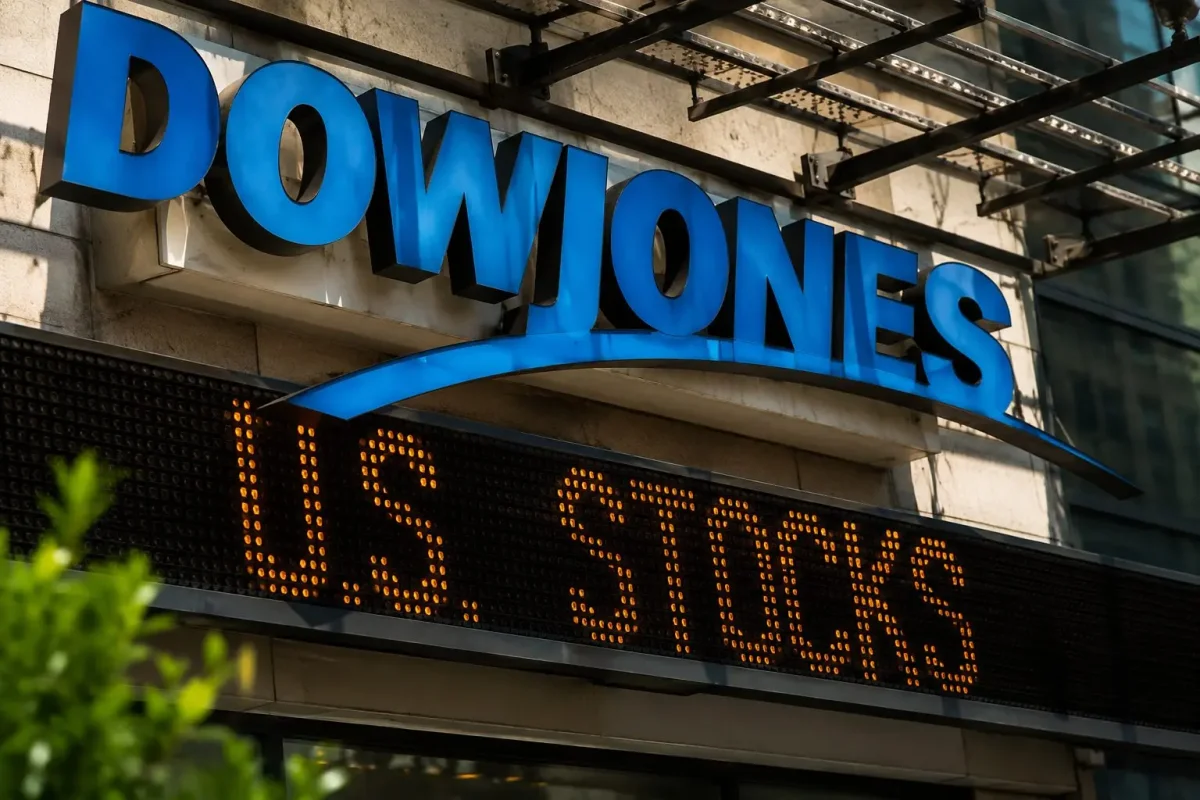
NEW YORK, July 17, 2026 – The Dow Jones Industrial Average managed to stay afloat on Friday, slipping just 0.10% to 52,502.38 at the opening bell, as a standout performance from insurance giant Travelers Companies (NYSE:TRV) provided a counterweight to deepening losses in the technology sector. The blue-chip index’s resilience masked a more pronounced downturn in the broader market, with the S&P 500 falling 0.74% and the Nasdaq Composite dropping 1.36% to 25,529.73 by late morning.
Travelers shares surged 8.2% to $365.67, contributing roughly 164 points to the Dow. The rally followed the company’s better-than-expected second-quarter results, with adjusted earnings of $10.04 per share, far exceeding the analyst consensus of $5.42. Catastrophe losses fell sharply to $518 million from $927 million a year earlier, underscoring improved underwriting performance. CEO Alan Schnitzer highlighted that “underlying underwriting income and net investment income have grown into a formidable earnings base,” providing a rare single-stock boost to the Dow.
Without Travelers’ contribution, the Dow would have been down approximately 0.4%, illustrating a stark divergence between the index’s price-weighted structure and the broader market’s capitalization-weighted weakness. The Dow’s relative stability also reflects a defensive rotation, as investors favored energy and utility stocks amid rising geopolitical tensions and a cautious outlook for tech.
The technology sector bore the brunt of the selloff, with the Philadelphia Semiconductor Index sliding 23.5% from its record close on June 22, confirming a bear market for chip stocks. Concerns over the sustainability of AI-related spending weighed heavily on valuations. Netflix (NASDAQ:NFLX) dropped nearly 9% after issuing a softer third-quarter outlook, dragging the communication-services sector down 2.4%. The broader tech rout has prompted a significant rotation from growth into value and defensive names.
In commodities, oil prices gained further traction, with U.S. crude climbing 2.47% to $80.90 per barrel amid escalating U.S.-Iran attacks. The yield on the 10-year Treasury note declined to 4.525%, reflecting a flight to safety. Energy and utility sectors outperformed, as investors sought refuge from tech volatility.
Looking ahead, next week’s earnings reports from Alphabet (NASDAQ:GOOGL), Tesla (NASDAQ:TSLA), and Intel (NASDAQ:INTC) will be closely watched as a test of the ongoing market rotation. Analysts are divided on whether the chip correction will deepen or if improved guidance from these tech bellwethers could stem the outflow from growth stocks. Mona Mahajan, Edward Jones’ head of investment strategy, noted, “We’re seeing a bit of a defensive trade take hold this morning,” as investors balance risks between a potential broader correction and a renewed shift back to technology.
The market’s current dynamics highlight the structural differences between major indexes, with the Dow’s price-weighting occasionally masking underlying weakness. As the earnings season progresses, the interplay between defensive and growth sectors will likely determine the next leg for equities.