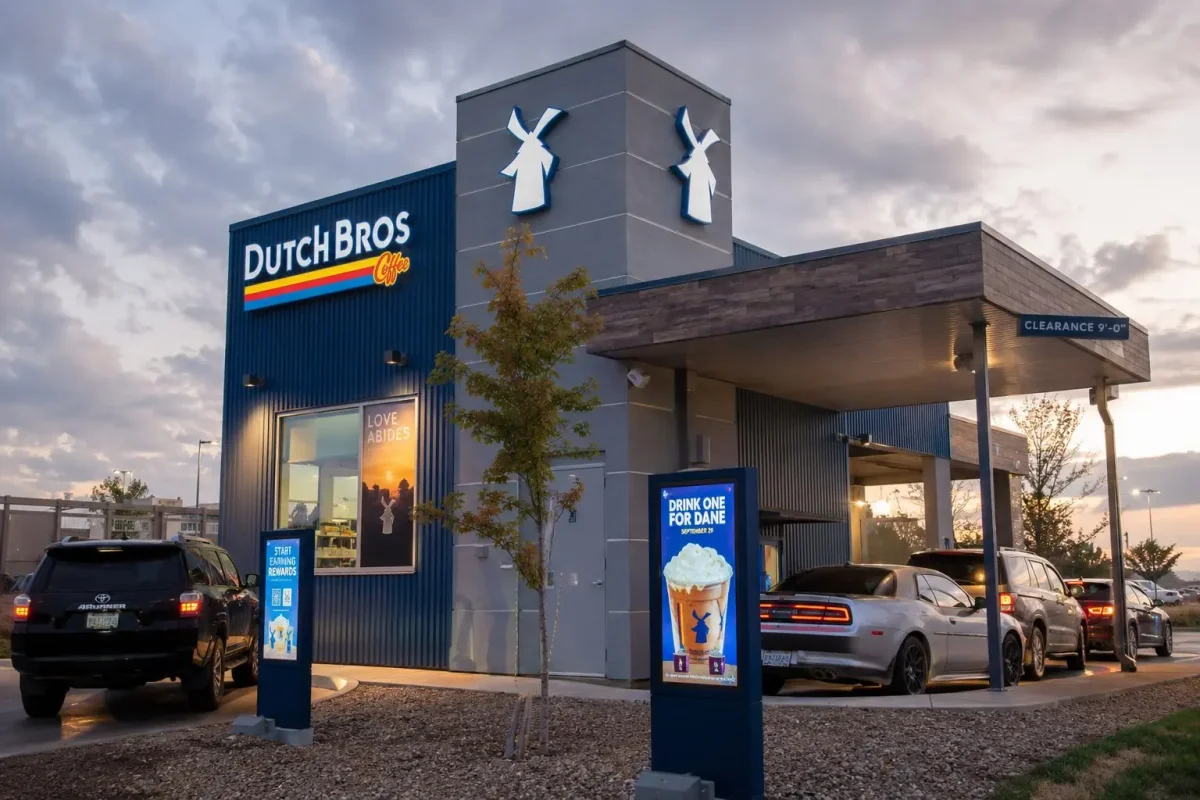
Shares of Dutch Bros Inc. (NYSE: BROS) experienced a sharp decline on Thursday, dropping 18.4% to $53.60 by midday, despite the company raising its full-year guidance. The selloff, which saw trading volume surge past 9 million shares—well above the daily average of 3.6 million—reflects investor concerns over weakening customer traffic and the quality of the company's growth outlook.
Q2 Earnings Beat, But Traffic Slows
The coffee chain reported second-quarter revenue of $550.9 million, a 32.5% increase year-over-year and a 4.8% beat over consensus estimates. Adjusted earnings per share came in at $0.33, surpassing the $0.29 expected by analysts. Adjusted EBITDA grew 27.8% to $113.7 million, though the margin contracted by approximately 80 basis points to 20.6%.
Despite the solid earnings beat, investors focused on the company's comparable sales composition, which showed a significant slowdown in transaction growth. Systemwide transactions increased just 1.7% in Q2, down from 5.1% in the first quarter. This shift toward higher average ticket prices—which rose 4.1% in Q2—raised concerns about the sustainability of growth as pricing support fades.
Guidance Raise Largely Acquisition-Driven
Dutch Bros lifted its full-year revenue midpoint by $50 million to $2.115 billion, and adjusted EBITDA midpoint by $12.5 million to $387.5 million. However, management revealed that the recently acquired Phoenix franchise business would contribute approximately $25 million in revenue and $5 million in adjusted EBITDA this year, accounting for half of the revenue increase and 40% of the EBITDA increase.
Excluding the acquisition, organic revenue growth is estimated at just 1.2% above the prior midpoint, and organic EBITDA growth at roughly 2%. This suggests the headline guidance increase was largely driven by the deal rather than core operational momentum.
Capital Expenditures Surge
The company also guided capital expenditures significantly higher, with the midpoint rising 29% to $360 million. CFO Josh Guenser attributed the increase primarily to the Phoenix acquisition, which also includes plans for as many as 65 site conversions. This elevated spending outlook adds another layer of pressure on free cash flow.
Traffic Concerns Persist
Management projects third-quarter systemwide comparable sales growth of 4% to 5%, below the 5.8% achieved in Q2. The company cited challenging transaction comparisons and reduced pricing, with effective pricing expected to be under one percentage point in the second half. The lingering impact of last year's food rollout also continues to weigh on traffic.
Despite these headwinds, Dutch Bros continues to expand aggressively, opening 48 new shops in Q2, 44 of which are company-operated. The chain ended June with 1,225 locations, up from 1,043 a year ago. Systemwide annual unit volume rose 6.8% to $2.193 million, and Order Ahead accounted for 16% of transactions—metrics management believes offer opportunities to boost traffic.
Analyst Reactions and Market Context
The stock's decline outpaced losses in comparable companies, with Starbucks (NASDAQ: SBUX) down 1.1% and Black Rock Coffee Bar (NASDAQ: BRCB) down 9.2%. This suggests the selloff was company-specific rather than sector-wide.
Despite the negative price action, sell-side analysts remained largely bullish. Morgan Stanley, Citi, UBS, D.A. Davidson, Oppenheimer, Telsey Advisory, and RBC Capital all maintained Buy ratings with price targets ranging from $70 to $88. According to FactSet, 23 analysts have Buy ratings, one has Overweight, and one has Hold, with a median price target of $80—representing a 49% premium to Thursday's midday level.
Risks and Outlook
Key risks include robust productivity at new stores, increasing digital adoption, and rising foot traffic, which could trigger a rebound. However, rising coffee and occupancy costs may squeeze margins, and execution risk remains regarding the Phoenix integration and site conversions.
For now, investors are interpreting the raised guidance as acquisition-driven, shifting focus to organic traffic. Dutch Bros must demonstrate it can maintain transaction volumes as pricing support diminishes. The company's ability to convert its expansion into sustainable, organic growth will be critical in the coming quarters.