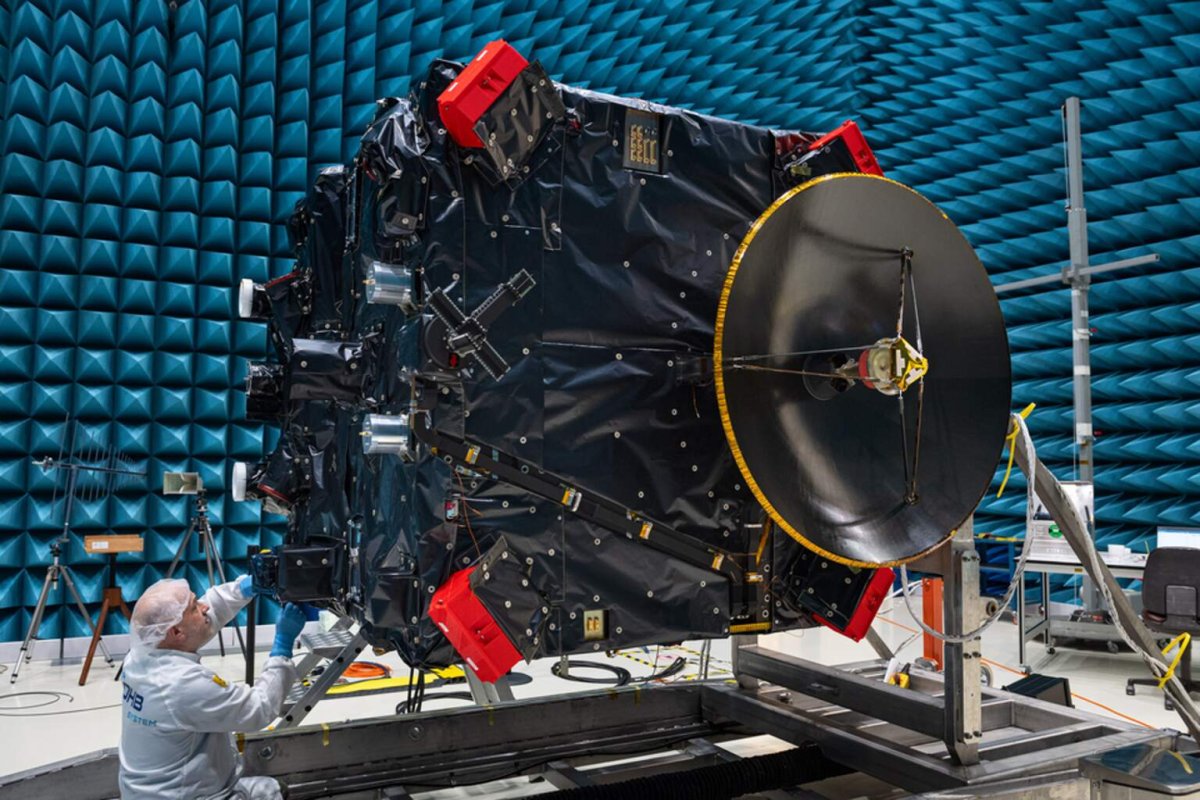
In a significant milestone for planetary defense, the European Space Agency's Hera spacecraft has captured its first resolved image of the Didymos binary asteroid system, distinguishing the smaller Dimorphos from its larger companion Didymos. The announcement was made on October 27, as the probe continues its approach toward the site of NASA's Double Asteroid Redirection Test (DART) impact.
The newly released image, taken from a distance of 1,280 kilometers, shows Dimorphos as roughly one pixel, with a nominal sampling of about 120 meters per pixel based on the camera's specifications. While the pair can now be distinguished, the image does not yet reveal the DART impact site in detail. The mission team expects much sharper views as Hera closes in, with detailed images of Dimorphos planned for release on November 25.
Mission Objectives and Scientific Goals
Hera's primary objective is to measure Dimorphos's mass within 10% accuracy, a key parameter for understanding the momentum transfer efficiency of the DART impact. The 2022 collision altered Dimorphos's orbital period by approximately 33 minutes, but the mass of the asteroid remains a critical unknown. The estimated momentum enhancement factor, which ranges from 2.2 to 4.9, varies significantly depending on the assumed mass. Narrowing this uncertainty is essential for future planetary defense missions.
The camera study, published in March 2026, specifies an angular sampling of 93.7 microradians per pixel. At the current range of 1,280 kilometers, this translates to a linear sampling of about 120 meters per pixel. As Hera approaches, the sampling will improve dramatically: at 302 kilometers it will be about 28 meters per pixel, and at 10 kilometers it will be less than 1 meter per pixel. However, feature visibility also depends on illumination and viewing geometry.
DART Impact and Its Aftermath
DART struck Dimorphos on September 26, 2022, shortening its orbital period by about 33 minutes, as reported in NASA's initial science analysis. Material ejected from the asteroid added recoil, amplifying the push beyond the incoming spacecraft's own momentum. The momentum enhancement factor, estimated between 2.2 and 4.9, is mass-dependent, highlighting the need for precise mass measurements.
Researchers inferred an instantaneous drop in orbital speed of about 2.7 millimeters per second by analyzing the altered orbital period. However, the enhancement interval spans a factor of about 2.2 between its endpoints, underscoring the uncertainty in the current estimates. A future deflection calculation would also require knowledge of the target's physical properties, such as its internal structure and material composition.
Hera's Measurement Strategy
The camera study requires tracking Didymos around the pair's common center of mass, with surface landmarks tracked to a positional accuracy of about one meter. Repeated observations will measure the asteroid's movement through its orbit, enabling precise mass determination. The mission also aims to characterize the DART impact site, including crater shape, with an accuracy of 0.5 meters.
A DART impact-site study in NASA's technical archive explains why a momentum factor alone is not sufficient. Local material properties determine how debris is excavated, affecting the resulting recoil. Characterizing the site provides evidence for testing numerical impact models, which are crucial for predicting the effectiveness of kinetic impactors.
Mission Status and Future Steps
Hera captured the frame from 1,280 kilometers away, after earlier braking maneuvers reduced its speed relative to the asteroids to 20 meters per second. The system is currently about 197 million kilometers from Earth. ESA's size guide places Dimorphos's diameter at approximately 151 meters, compared with 780 meters for Didymos. At the calculated sampling, these diameters span roughly 1.3 and 6.5 pixels, respectively, assuming the stated diameters face the camera.
“Our views will much grow sharper as Hera comes closer,” said mission manager Ian Carnelli in ESA's release. The upcoming detailed images of Dimorphos, scheduled for release on November 25, will help determine whether DART left a distinct crater or reshaped the asteroid more broadly. These observations are critical for validating numerical impact models and improving our understanding of asteroid deflection techniques.
As Hera continues its journey, the mission represents a crucial step in planetary defense, providing the data needed to turn theoretical deflection concepts into practical, reliable strategies. The success of this mission could inform future efforts to protect Earth from potential asteroid threats.
