Amazon (NASDAQ:AMZN) has taken a significant step forward in its Project Kuiper satellite internet initiative by moving 40 broadband satellites into United Launch Alliance's (ULA) dedicated Vulcan integration facility at Cape Canaveral, Florida. The announcement, made on October 26, confirms that these satellites will form the payload for LV-01, the first of 38 contracted Vulcan missions. This batch marks a substantial increase in Amazon's launch capacity, carrying 11 more satellites than its recent Atlas V missions, a 37.9% boost per flight.
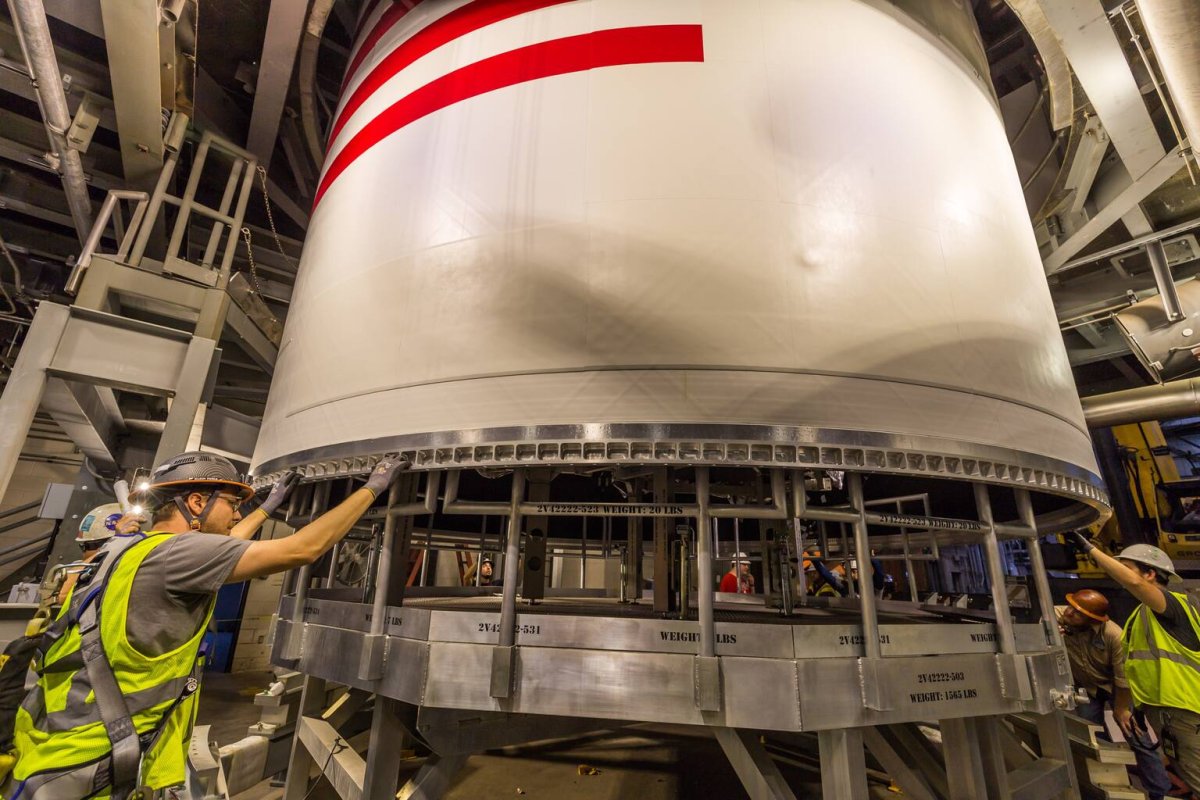
The new payload size also surpasses the 36-satellite configuration flown on the Ariane 64 rocket in June, adding four additional spacecraft. This strategic increase is made possible by Vulcan's unique configuration, which pairs a larger fairing with a reduced-size upper stage. ULA's low Earth orbit (LEO) version of the Centaur V upper stage carries one-third less propellant than the standard variant, and this weight reduction frees up additional performance for the satellite payload, according to ULA.
Amazon's satellite deployment strategy is becoming more efficient with each launch. The company has already flown 29 satellites on an Atlas V mission in early July and 36 on an Ariane 64 flight in June. The new Vulcan mission, LV-01, will carry 40 satellites, representing a 37.9% increase over the Atlas V load and an 11.1% increase over the Ariane payload. This progression highlights Amazon's commitment to accelerating the deployment of its Kuiper constellation, which aims to provide global broadband coverage.
The transfer of the satellites to the integration hangar occurred last week, with the spacecraft already enclosed in a 70-foot payload fairing. However, Amazon has not yet confirmed when the payload will be mated to the rocket or provided a specific liftoff date. ULA has scheduled LV-01 for no earlier than November, though an exact day remains unannounced. This timeline suggests a potential race with Amazon's next Ariane mission, which is targeted for November 23.
Vulcan's Innovative Upper Stage Design
The Vulcan rocket's adaptability is central to Amazon's increased payload capacity. ULA published the dimensions of the new LEO-optimized Centaur V stage on June 2, revealing a 35-foot-tall stage, approximately six feet shorter than the high-energy version. This reduction in height corresponds to roughly 15% less stage height, based on ULA's rounded figures. Both versions of the Centaur V are powered by two RL10 engines fueled by liquid hydrogen and liquid oxygen, but the shorter stage carries less propellant, making it ideal for missions that do not require high-energy trajectories.
The reduced propellant load, about 67% of the standard, allows the rocket to allocate more of its thrust to lifting satellites into orbit. This design optimization is a key factor in enabling Amazon to pack more spacecraft into each launch, thereby reducing the number of missions needed to complete the Kuiper constellation.
Ground Infrastructure and Launch Capacity
ULA's ground infrastructure at Cape Canaveral has also been expanded to support the increased launch tempo. The second integration lane includes a dedicated mobile launch platform and an offline upper-stage processing cell, allowing crews to prepare the Centaur stage concurrently with booster work before stacking. Both integration lanes feed into Space Launch Complex 41, meaning parallel assembly does not create a second launch pad. Pad access and mission readiness remain the primary constraints on launch frequency.
Amazon has invested over $200 million in ULA's Cape Canaveral facilities and services, including the second integration building, rail system, and mobile platform. This investment was intended to double launch capacity, and the recent progress suggests it is paying off. Rajeev Badyal, Project Kuiper's leader, told Ars Technica on October 8 that Amazon already has enough satellites for initial service, with later launches aimed at expanding coverage and network resilience.
Path to Commercial Service
Launch is only the first step before commercial operation. Amazon will conduct spacecraft health checks, orbit raising, and commissioning after deployment. For example, the upcoming Ariane mission will place satellites near 465 kilometers before raising them to 630 kilometers. This process is critical to ensuring the satellites are fully operational before they begin providing broadband services.
However, risks remain. LV-01 has yet to fly with the new upper-stage configuration, and any launch delay or commissioning issues could postpone the availability of usable network capacity. Additionally, the payload announcement does not establish a sustained Vulcan launch rate, and Amazon's ability to maintain a rapid cadence will be crucial to its competitive position against rivals like SpaceX's Starlink.
As Amazon prepares for the first Vulcan launch, the company is also targeting its next Ariane mission for November 23. The question on investors' minds is whether Vulcan's larger batch will launch first, potentially accelerating the timeline for Kuiper's commercial rollout. With the satellite internet market heating up, Amazon's aggressive deployment strategy could be a game-changer.