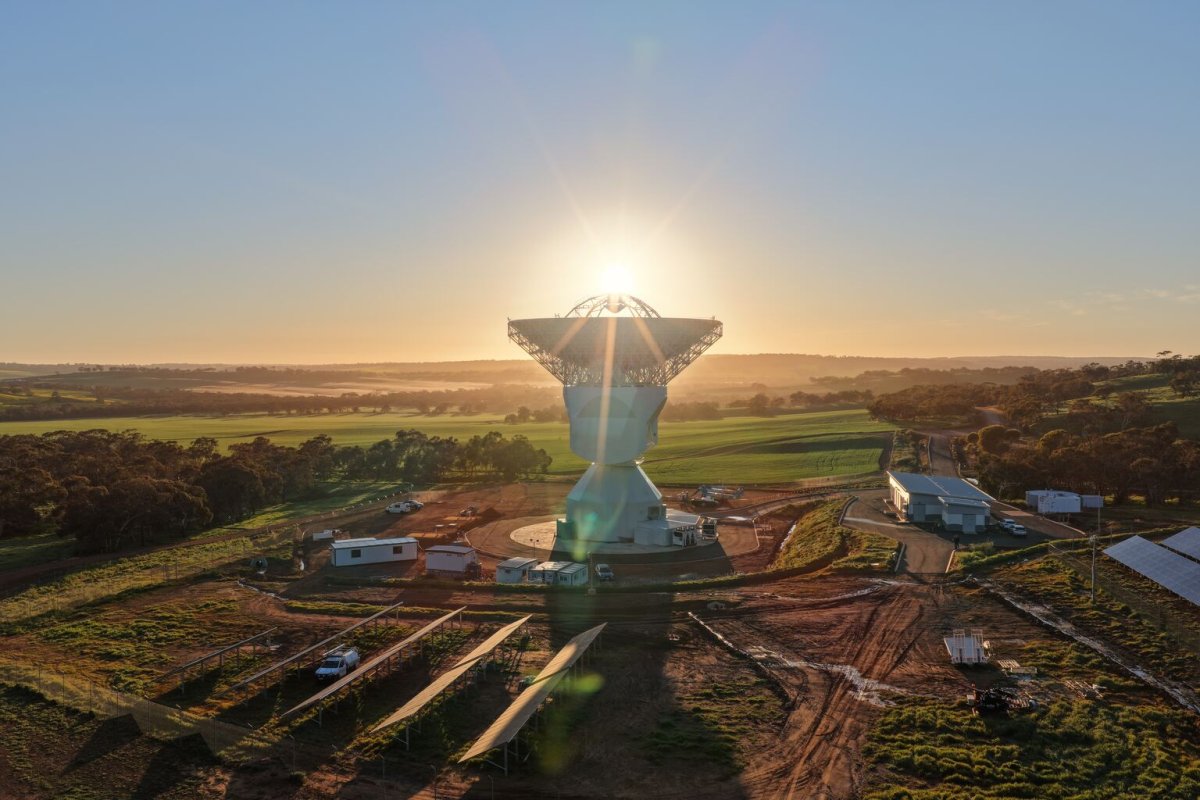
The European Space Agency (ESA) has achieved a significant milestone in deep-space communications. Its 35-metre Deep Space Antenna 4 (DSA 4), located in New Norcia, Western Australia, is now routinely sending commands to two Mars orbiters simultaneously during a single tracking pass. The two spacecraft—Mars Express (MEX) and the ExoMars Trace Gas Orbiter (TGO)—are using separate X-band frequencies, allowing the ground station to maintain distinct communication links with each mission without interference.
This dual-uplink capability, confirmed in an ESA update released on November 19, 2026, represents a major step forward in optimizing the agency's ground-station network, known as Estrack. Previously, the network faced scheduling bottlenecks as multiple missions competed for limited antenna time. With this new arrangement, ESA can now efficiently support two of its most important Mars missions during the same pass, reducing the pressure on the network and enabling more frequent contact with both spacecraft.
Technical Breakthrough: Sharing One Dish
The key to this achievement is a hybrid coupler supplied by Thales Alenia Space. This device allows two separate command signals to be combined and fed into the antenna's single feed system, while keeping the two signals isolated from each other. ESA describes this dual X-band uplink capability as unique, underscoring the novelty and technical sophistication of the setup.
This is not the first time ESA has attempted to control two orbiters from one dish. A similar demonstration took place on January 30, 2020, when engineers at the older New Norcia (DSA 1) used a mixed approach: they sent S-band commands to Mars Express while TGO received X-band commands. However, that arrangement was suboptimal, as Mars Express's S-band receiver was originally reserved for emergency use only. Moreover, the S-band signal was more susceptible to interference from the Sun during solar conjunction, requiring extra configuration and limiting its reliability.
Advantages of Dual X-Band
Now, with both orbiters operating on X-band, the system is more robust and easier to manage. The dual X-band uplink eliminates the need for special S-band configurations and works even during solar conjunction periods, when the Sun's radiation can degrade weaker signals. The main constraint is geometric: the two spacecraft must appear close together in the sky as seen from the antenna. Since both are in orbit around Mars, they often share a relatively small patch of sky, making simultaneous tracking feasible. Missions in widely different directions would still require separate antenna pointings.
DSA 4: A State-of-the-Art Facility
DSA 4, also known as New Norcia 3, entered routine operations on April 1, 2026. The antenna is equipped with a 20-kilowatt radio transmitter and receivers cooled to -263°C, which significantly reduces noise and enhances sensitivity to faint spacecraft signals. The station can receive data in X-, K-, and Ka-bands, and transmit in X-band, with future plans to add K-band transmission capability.
This new dish is part of a core network of four 35-metre deep-space antennas: two at New Norcia, one at Cebreros in Spain, and one at Malargüe in Argentina. All are operated remotely from ESA's European Space Operations Centre in Darmstadt, Germany. Ground stations like these are vital for receiving spacecraft health and science data, measuring their motion and distance, and transmitting commands.
Future Expansion and Implications
ESA has announced that its planned fifth deep-space antenna will also be equipped with a hybrid coupler and dual X-band uplinks, further expanding the network's flexibility. This November's development is a clear indication that ESA is investing in technologies that allow existing infrastructure to support more missions simultaneously, a crucial capability as the number of active deep-space missions continues to grow.
For the space industry, this achievement highlights the importance of ground-segment innovation. While spacecraft often capture the headlines, the ground network is equally critical to mission success. The ability to command two orbiters at once not only improves efficiency but also reduces operational costs and extends the lifetime of ground assets. As commercial space activities expand, such capabilities will become increasingly valuable.
In summary, ESA's New Norcia 3 antenna has set a new standard for deep-space communications, demonstrating that with the right technology, one dish can indeed serve two masters. This development will have lasting implications for the agency's Mars exploration program and beyond.
