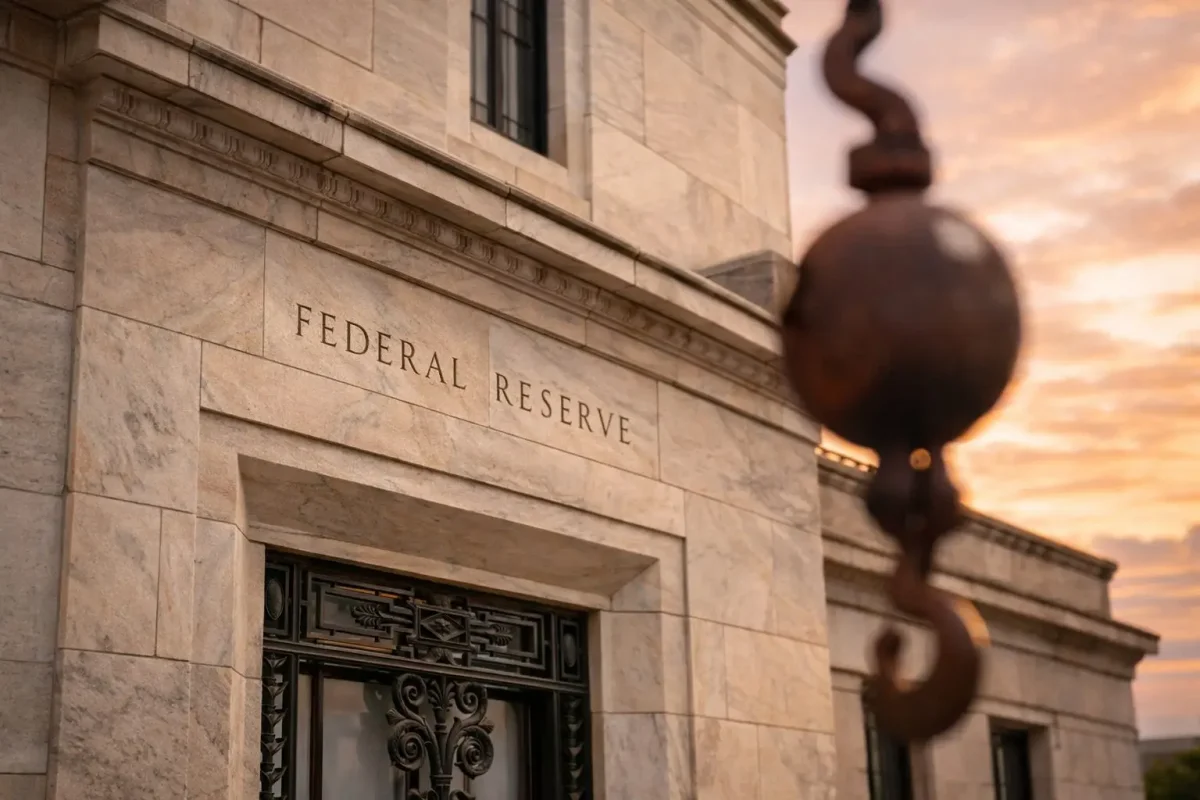
The Federal Reserve concluded its March policy meeting on Wednesday, March 18, 2026, by maintaining the target range for the federal funds rate at 3.50% to 3.75%. In a significant update to its economic projections, the central bank's median forecast now indicates just a single quarter-percentage-point rate cut for the year 2026, a shift from prior expectations.
Revised Economic Projections
Officials marked up their inflation outlook for 2026, now expecting the core Personal Consumption Expenditures (PCE) price index—the Fed's preferred inflation gauge—to reach 2.7% by year-end. This is an increase from the 2.4% forecast released in December. The headline PCE index is also projected at 2.7%, up from a prior 2.5% estimate. Concurrently, the unemployment rate forecast was held steady at 4.4%, while the growth estimate was nudged higher to 2.4% from 2.3%.
The central bank's internal "dot plot," which charts individual policymakers' rate expectations, remained anchored at a year-end 2026 policy rate of 3.4%, consistent with one 25-basis-point cut. The plot revealed a notable division among officials: seven members anticipated no change, another seven projected one cut, and five foresaw at least two reductions.
Policy Divergence and Market Reaction
Governor Stephen Miran dissented from the majority decision, advocating for an immediate 25-basis-point rate cut. Chair Jerome Powell was scheduled to provide further context in a press conference at 2:30 p.m. EDT. Financial markets reacted negatively to the Fed's cautious stance and heightened inflation outlook. In afternoon trading, the Dow Jones Industrial Average fell approximately 380 points, while the S&P 500 and Nasdaq Composite each shed about 0.6%.
The policy statement acknowledged that economic growth remains solid, but noted job gains have moderated and inflation persists above the Fed's 2% target. It highlighted elevated uncertainty in the economic outlook, specifically pointing to events in the Middle East as a potential risk to both employment and inflation goals.
Energy Prices Complicate the Path
A major factor influencing the Fed's deliberation is a renewed surge in energy prices. Brent crude oil traded above $108 per barrel, driven by geopolitical tensions involving Iran. This complicates the inflation fight, as higher crude costs can filter through to gasoline, freight, and broader consumer prices. The Fed is weighing whether this oil spike and stronger pipeline inflation, evidenced by a 0.7% jump in U.S. producer prices for February (3.4% year-over-year), could keep price pressures stubbornly high.
The danger is twofold: persistent high energy costs could force the Fed to delay its lone expected rate cut further. Conversely, if geopolitical tensions ease and labor market data softens more than anticipated, calls for quicker policy easing could reemerge. Economists note the outlook heavily depends on the duration of conflict and whether oil prices sustain their rally or retreat to pre-conflict levels.
Analyst Commentary
Economists anticipated the Fed's cautious posture. Diane Swonk, chief economist at KPMG, described the pre-meeting forecasts as unfolding under a "cloud of uncertainty." Thomas Ryan of Capital Economics observed there was "nothing in the price data" to suggest the Fed was prepared to cut rates imminently. Gregory Daco, chief economist at EY, characterized the Fed's stance as "wait-and-see," noting that interest rates are currently hovering near a neutral level—neither stimulating nor restraining growth.
The energy price surge is a global concern, shifting focus to upcoming policy cues from other major central banks, including the European Central Bank, the Bank of England, and the Swiss National Bank. The Fed's updated projections underscore the delicate balancing act facing policymakers as they navigate stubborn inflation, a cooling labor market, and volatile commodity prices.