Firefly Aerospace Inc. shares climbed more than 12% on Friday, pushing the stock back above its initial public offering price as renewed enthusiasm surrounding SpaceX's potential listing sparked a broad rally across publicly traded space companies. The stock reached $48.11 by early afternoon, with trading volume near 5.9 million shares and a market capitalization of approximately $7.7 billion.
The timing of the move is closely tied to developments at SpaceX, the dominant private space firm. Reuters reported Friday that SpaceX has moved closer to an IPO, with a filing indicating a staged resale plan for insiders and a targeted valuation of roughly $1.75 trillion. For Firefly, a SpaceX listing would provide public markets with a clearer benchmark for the space economy, often leading investors to use smaller listed companies as proxies when the industry leader remains private.
The buying was not confined to Firefly. According to The Wall Street Journal, AST SpaceMobile and Virgin Galactic each rose more than 9% on Friday, while Rocket Lab also posted gains, as the broader space sector rode the wave of SpaceX-related optimism.
Market participants are divided on whether a SpaceX IPO would siphon capital away from rivals or lift the entire group. Stéphane Beyazian, an analyst at ODDO BHF, told Reuters that some investors are eager for space exposure and hope for a re-rating across the sector.
Firefly went public in August 2025, pricing its upsized IPO at $45 per share, and began trading on the Nasdaq under the ticker FLY. Friday's move brought the stock modestly above that offer price after a volatile first year as a public company.
The company's financials remain early-stage with significant losses. Firefly reported first-quarter revenue of $80.9 million, a 40% increase from the prior quarter, and guided for 2026 revenue between $420 million and $450 million. However, it posted a net loss of $96.7 million for the quarter. CEO Jason Kim described the period as another quarterly revenue record, emphasizing the company's focus on scaling production.
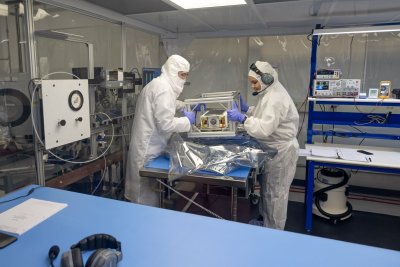
Firefly has been investing in capacity, announcing on May 19 that it had moved into a new headquarters, expanded cleanroom space, and added an innovation lab. COO Ramon Sanchez stated that the company is now producing rockets and spacecraft at scale for defense, exploration, and commercial customers.
Despite the rally, risks remain. Firefly's latest quarterly filing highlights potential pitfalls, including delayed or failed launches, manufacturing quality challenges, dependence on government funding, and the ability to realize its backlog. For now, the stock is trading less on company-specific catalysts and more on the prospect of SpaceX's IPO as a sector-defining event. The true test will be whether Firefly can convert higher revenue, new facilities, and defense contracts into consistent launches and narrowing losses.