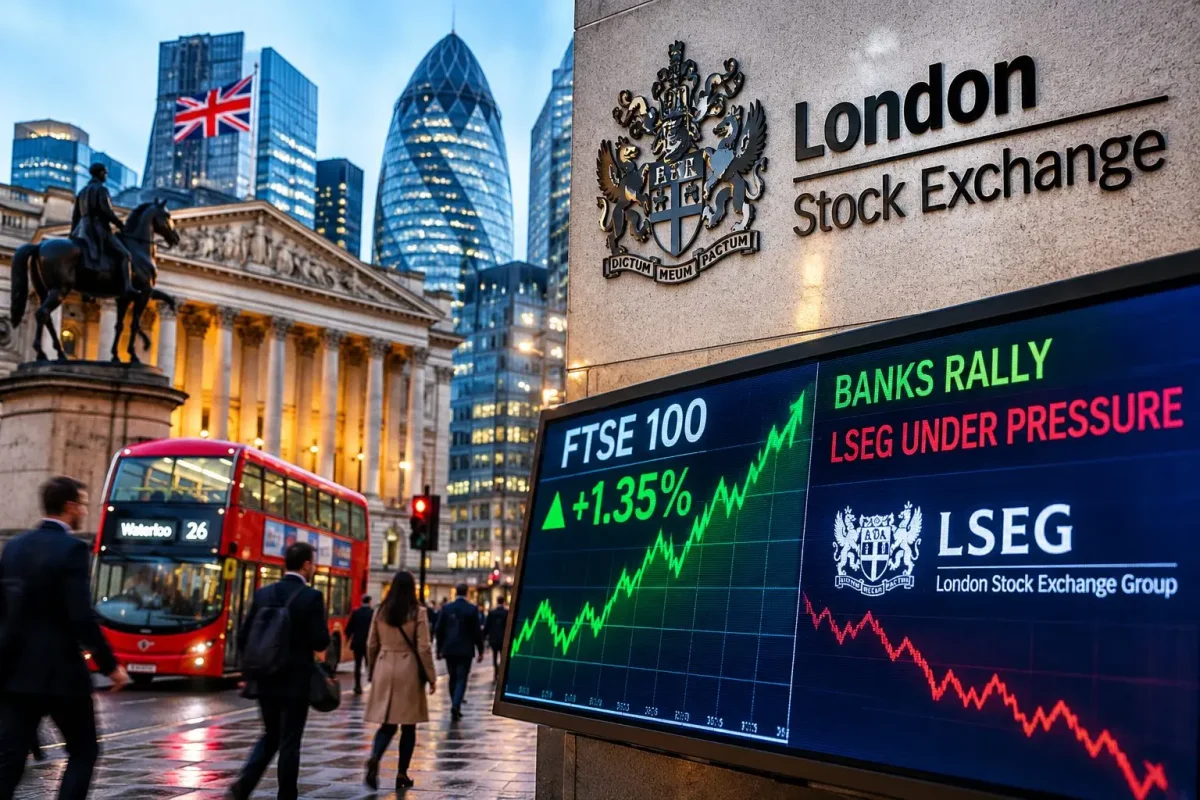
London’s FTSE 100 index advanced 0.6% to 10,316.05 in morning trading on Thursday, buoyed by a strong recovery in heavyweight financial stocks. HSBC Holdings and Standard Chartered each climbed 2%, while Prudential surged 3.4%. The mid-cap FTSE 250 remained flat.
The rally came after the index closed near mid-May lows on Wednesday, with defensive sectors like energy and consumer staples providing stability. However, Thursday’s shift into financials did not constitute a full risk-on move, as broader market enthusiasm remained tempered.
Crude oil prices hovering just below $95 a barrel kept investors on edge, with ongoing tensions in the Middle East fueling caution. Market participants are also awaiting the European Central Bank’s latest interest rate decision later today. Daniela Hathorn, senior market analyst at Capital.com, noted that market direction hinges on whether ECB President Christine Lagarde frames any potential tightening as a one-off move or signals a broader cycle.
Banking stocks received a tailwind from rate expectations. Data from LSEG and Reuters indicate that traders now price in a 25-basis-point rate hike by the Bank of England in September, providing support for lenders even as other sectors remained shaky.
Technology and data stocks faced headwinds. Oracle’s recent push for increased AI spending has reignited fears that companies may cut conventional software budgets to fund artificial intelligence initiatives. UBS downgraded its rating on European IT stocks from attractive to neutral, reflecting growing caution.
London Stock Exchange Group shares fell 1.22% to trade at 8,902p, underperforming the broader market. Despite a 27% gain since Elliott Management’s stake was disclosed, LSEG shares plunged nearly 13% in a single day back in February on AI disruption concerns. UBS analyst Michael Werner described LSEG’s AI narrative as a “show me” story, emphasizing the need for the company to demonstrate its ability to monetize AI data. Deutsche Bank’s Benjamin Goy called the stock “pretty cheap,” while BofA’s Hubert Lam noted that management has clarified LSEG’s role in the AI ecosystem. Blue Whale’s Stephen Yiu, however, warned that disruption risks remain tangible. LSEG’s forward P/E stands at around 18, lower than Moody’s and MSCI but above FactSet.
LSEG is actively pursuing revenue from integrating its data into AI systems. CEO David Schwimmer said in April that the “LSEG Everywhere” initiative is progressing, with over 150 customers connected or onboarding to its Model Context Protocol server, which provides AI agents with controlled access to licensed LSEG data. First-quarter total income, excluding recoveries, rose 9.8% on an organic constant-currency basis.
Frasers Group saw only a modest gain after making a €2 billion cash bid for Hugo Boss. Mike Ashley’s company already holds a 26.06% stake in the German retailer. The offer was just 4.3% above Hugo Boss’s closing price on Wednesday.
Wizz Air shares rose following the release of annual operating profit that exceeded forecasts, though the results were mixed. The carrier predicted weaker first-quarter RASK and withheld fiscal 2027 guidance due to the Iran conflict. CEO Jozsef Varadi told Reuters, “No one is guiding.” Bernstein analyst Alex Irving remarked that the airline’s second-half capacity plans “took us by surprise.”
Halma slumped after forecasting low double-digit organic constant-currency revenue growth through March 2027, including about five points of additional growth from photonics. The Wall Street Journal reported that shares dropped 11%, on track for their biggest single-day decline since March 2020.
Analysts caution that Thursday’s bounce is narrow. A further rise in oil prices could stoke inflation and prompt central banks to adopt a more hawkish stance. Renewed concerns about AI spending may weigh on software and data stocks again. LSEG also faces a UK debate over an equities consolidated tape, a pooled market-data feed that could threaten parts of its data business. For now, London is trading more on balance sheets than narratives, with banks catching bids but AI-linked stocks still needing to prove their value.