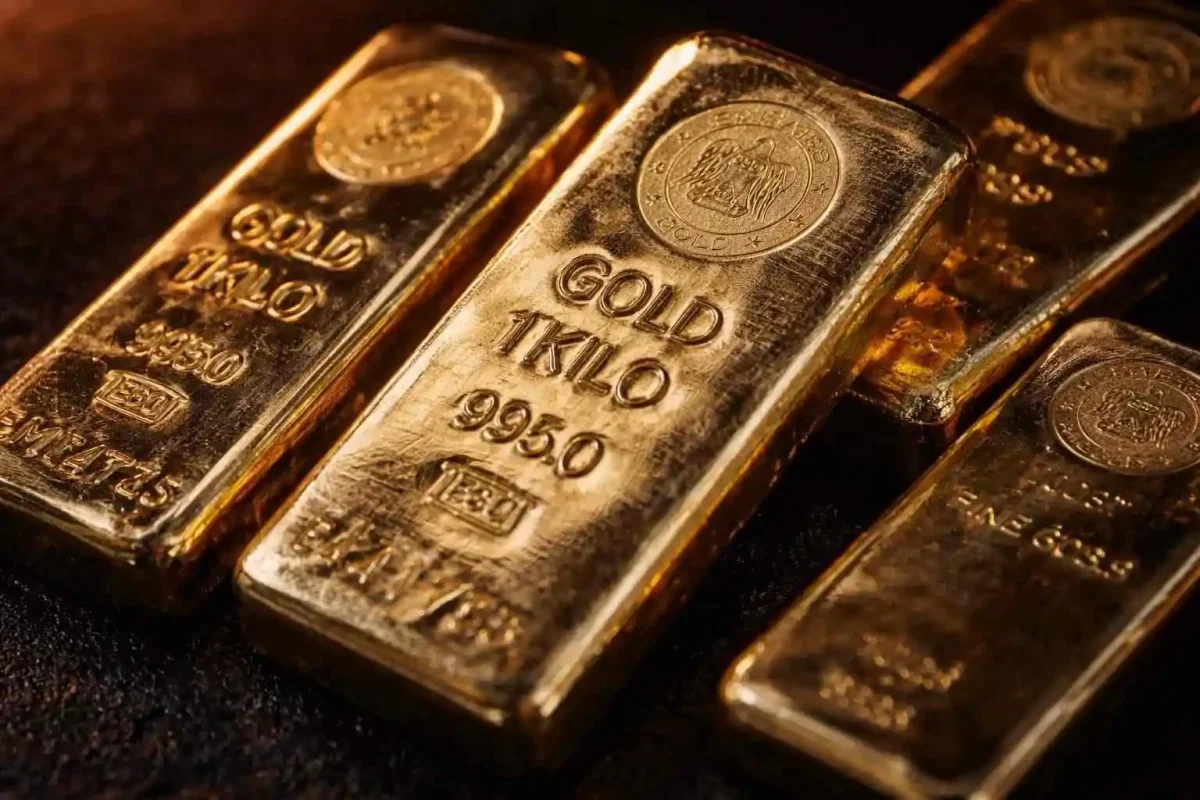
Precious metals markets enter the new week under a renewed cloud of geopolitical uncertainty, with spot gold last quoted at $4,829.40 per ounce. Trading activity paused for the weekend after a volatile Friday session that saw the metal briefly touch $4,889.60. The primary catalyst for the renewed market tension is Iran's decision to maintain the closure of the Strait of Hormuz, a critical global oil chokepoint, reversing earlier signals of a potential reopening.
Weekend Reversal Shifts Market Narrative
The price action on Friday initially reflected a more optimistic outlook, with gold gaining 1.5% to $4,861.32 by the afternoon in New York, according to Reuters data, putting it on track for a weekly advance exceeding 2%. U.S. gold futures settled 1.5% higher at $4,879.60. This rally was fueled by a weaker U.S. dollar, which saw its index fall 0.3% to a seven-week low of 97.96, and by speculation that easing energy costs could pave the way for Federal Reserve interest rate cuts later this year.
However, the narrative shifted decisively over the weekend. Marine traffic data confirmed no vessel movements through the Strait since midnight, and reports indicated U.S. and Iranian officials made little progress in talks concerning the waterway and broader nuclear issues. U.S. President Donald Trump announced that American envoys were returning to Pakistan for renewed discussions with Tehran, while also warning that further military strikes remained an option if U.S. demands were not met.
Broader Precious Metals Complex Rises
The risk premium was not isolated to gold. The entire precious metals sector saw buying interest. Spot silver climbed 4.2% on Friday alone, reaching $80.70 an ounce for a weekly gain over 7%. Platinum edged up 0.82% to $2,100, while palladium added 0.46% to $1,542. This broad-based strength signals investors are seeking hedges across the complex against the dual threats of geopolitical instability and persistent inflation.
The closure of the Strait of Hormuz directly pushes oil and inflation concerns back to the forefront of market psychology. Analysts note the situation creates a two-sided risk for gold. A swift diplomatic resolution and reopening of the strait could lead to lower oil prices, a rebound in general risk appetite, and a reduction in gold's safe-haven appeal. Conversely, a prolonged shutdown threatens to boost global energy costs, underpin bullion as a chaos hedge, and keep inflationary pressures sticky—a scenario that could complicate the Federal Reserve's ability to implement rate cuts.
Federal Reserve Policy in the Crosshairs
The inflation implications directly tie into monetary policy expectations. Fed Governor Christopher Waller commented on Friday that if the geopolitical conflict concludes soon, rate cuts in 2024 remain possible. However, he cautioned that persistently high energy costs and a protracted strait closure could keep inflation elevated and potentially weaken labor markets. Gold, which pays no yield, typically becomes more attractive when expectations for rate cuts rise, as the opportunity cost of holding it versus interest-bearing assets falls.
Peter Grant, vice president and senior metals strategist at Zaner Metals, had previously highlighted the Hormuz reopening as a "key event," suggesting cheaper oil could be "good news for gold" by supporting rate cut bets. He projected gold could challenge the $5,000 level in the near term, though those comments preceded the weekend's escalations.
Market Outlook and Key Levels
Gold's rally in 2026 has been substantial. Data from Trading Economics shows the metal reached $4,833.56 per troy ounce on April 17, marking a daily gain of 0.94% and a staggering 40.74% increase from the same period last year. The metal continues to hover below the psychologically significant $5,000 mark watched closely by traders.
The immediate test for markets on Monday will be less about technical chart levels and more about fundamental developments: monitoring tanker traffic reports, gauging the reaction in crude oil prices, and observing whether the U.S. dollar retains its Friday weakness. Gold investors are facing the kind of headline-driven volatility they often pursue, though the accompanying inflation risk is an unwelcome side effect of the current geopolitical standoff.