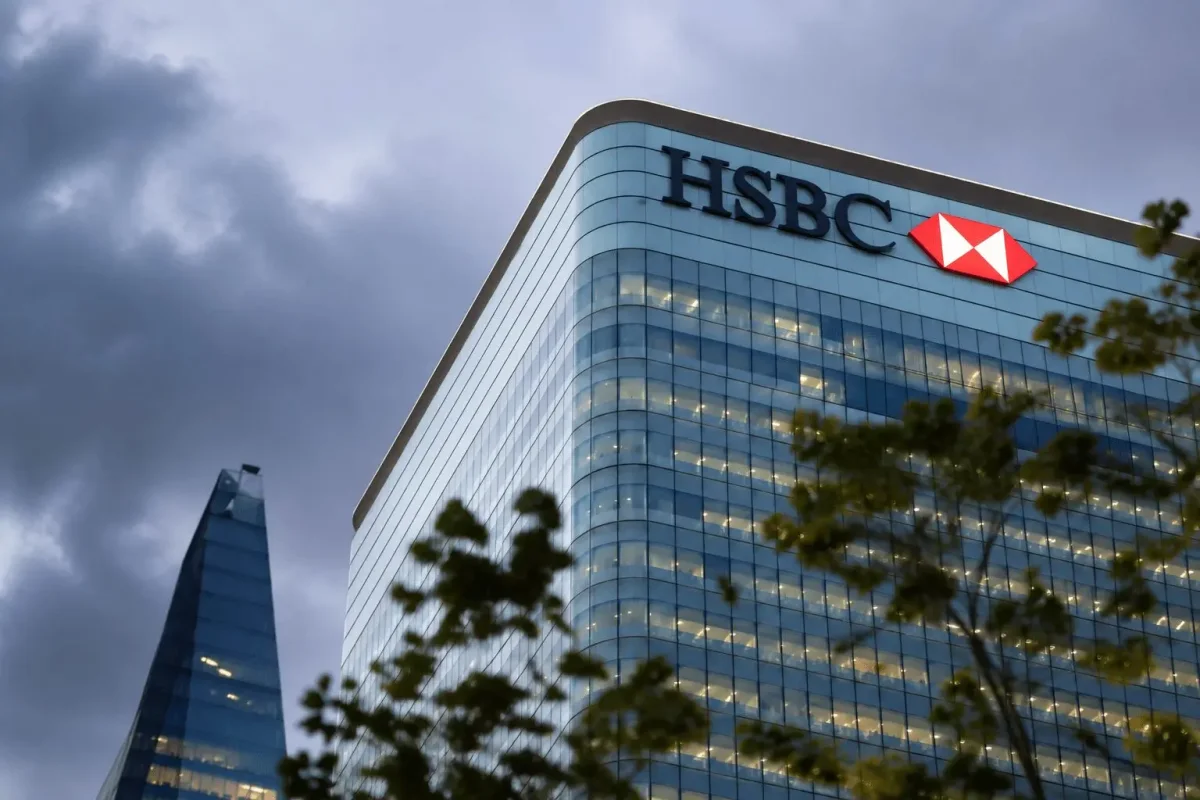
LONDON, July 20, 2026 – HSBC Holdings Plc (LON:HSBA) saw its shares slip 0.04% to 1,491.6 pence by 10:00 BST on Monday, remaining near its 52-week high. The modest decline comes as market participants weigh the bank's upcoming interim results against a backdrop of expected improvements in credit quality and a valuation premium relative to peers.
Credit-Loss Expectations
Analyst consensus points to a 17% reduction in quarterly credit losses compared to the first quarter's pace. For Q1 2026, expected credit losses (ECL) totaled $1.3 billion. The full-year 2026 ECL consensus stands at $4.547 billion, implying approximately $3.247 billion for the remaining three quarters. That translates to roughly $1.082 billion per quarter, a notable deceleration from the Q1 run rate. However, this figure is derived from a run-rate calculation rather than a direct projection, leaving room for uncertainty.
Key Drivers of Q1 Charge
Two specific factors accounted for 54% of the Q1 charge. A securitisation exposure linked to fraud resulted in a $400 million cost, while economic volatility and uncertainty in the Middle East added another $300 million. HSBC Chief Financial Officer Pam Kaur noted, "We don't see anything comparable there," referring to the bank's review of its largest risk concentrations.
Valuation Premium
HSBC's price-to-earnings (P/E) ratio stands at 16.58x, roughly 20% higher than Standard Chartered's 13.76x and 39% above Barclays' 11.93x. The bank also offers the highest dividend yield among the trio at 3.73%. The premium is supported by strong returns: HSBC reported a return on tangible equity (RoTE) of 18.7% in Q1, excluding notable items, with all four business units exceeding 17% on this measure. Market consensus projects full-year 2026 RoTE at 17.1% (17.8% excluding notable items), with pretax profit anticipated at $37.105 billion.
Outlook and Risks
CEO Georges Elhedery expressed confidence in achieving targets set in February 2026. Net interest income guidance was raised to approximately $46 billion from a prior minimum of $45 billion. However, management increased its ECL forecast to approximately 45 basis points, up from 40 basis points. Share repurchases remain contingent on quarterly capital reviews.
Risks include new private-credit losses, escalating Middle East conflict, and reduced wealth flows. HSBC's stress tests indicated a pretax impact in the mid-to-high single-digit range, potentially pushing RoTE below 17%. A Q2 ECL of around $1.08 billion aligns with the full-year trajectory, but another quarter at $1.3 billion would leave little flexibility, posing a challenge to the current valuation.