Infleqtion (INFQ) saw its shares climb again in Tuesday's premarket trading, adding to the gains from the previous session. The stock rose 5.09% to $14.93 before the bell, following a 5.03% increase on Monday that brought the closing price to $14.21. The upward momentum comes on the heels of a White House directive aimed at accelerating federal quantum technology initiatives and the company's launch of a new quantum-space coalition.
White House Order Drives Quantum Focus
On June 22, President Donald Trump issued an executive order mandating a national push to develop a quantum computer for scientific purposes. The order directs federal agencies to draft five-year plans for quantum-based sensors and networks, with a specific requirement for the Pentagon to deploy quantum sensors by 2028, as reported by Reuters. Quantum sensors, which leverage quantum effects to measure time, motion, and gravity with extreme precision, are seen as a near-term application that could precede full-scale quantum computing.
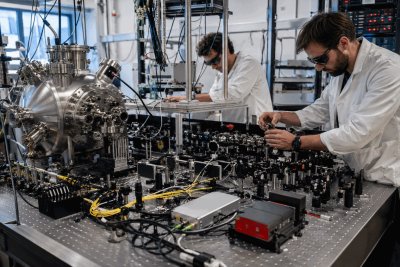
Infleqtion CEO Matthew Kinsella, who attended the White House signing ceremony, told Reuters that quantum sensing offers “lots of interesting things” before quantum computing matures. The company, which develops quantum bits using neutral atoms controlled by lasers, described U.S. quantum leadership as a “national imperative” following the order. Infleqtion also highlighted its recent selection by the U.S. Commerce Department for a proposed $100 million in funding.
Quantum-Space Coalition Launched
In a separate development, Infleqtion announced the formation of the America's Quantum Space Initiative, a coalition that includes Voyager Technologies, Armada, Monarch Quantum, and the University of Colorado Boulder. “The opportunity is bigger than any one company,” Kinsella said. Armada CEO Dan Wright emphasized that space provides the kind of demanding environment where quantum systems must demonstrate “operational advantage.”
The initiative aims to advance quantum sensing, timing, navigation, communications, and computing for future space systems. Infleqtion has prior experience in this domain, having worked on NASA's Cold Atom Laboratory aboard the International Space Station and participating in NASA's Quantum Gravity Gradiometer Pathfinder mission, which is expected to deploy the first quantum gravity sensor in space.
Market Reaction and Sector Impact
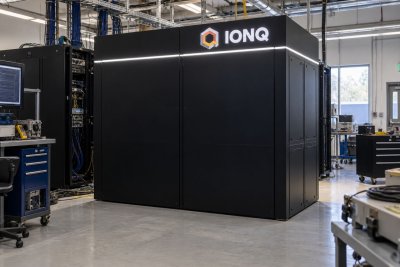
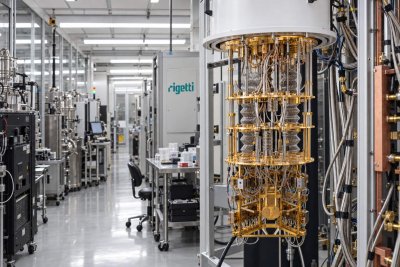
The broader quantum sector showed mixed reactions to the news. IonQ rose approximately 3.2%, while Rigetti traded flat and D-Wave Quantum slipped about 1%. The White House order appeared to bolster the sector's narrative, but gains were not evenly distributed across all names.
Infleqtion's stock remains thinly traded and highly volatile. Monday's volume of 20.22 million shares was well above the 65-day average of 13.86 million, according to MarketWatch. The company only began public trading recently, with its common stock and warrants listing on the New York Stock Exchange on February 17 under the tickers INFQ and INFQ WS, following a merger with Churchill Capital Corp X.
Financials and Risks
Infleqtion reported first-quarter revenue of $9.5 million, up 14% year-over-year, but posted a GAAP operating loss of $33.6 million. Management raised its 2026 revenue target to at least $40 million. As of the end of March, the company held $569 million in cash, cash equivalents, and available-for-sale securities, which CFO Ilan Hart said provides “flexibility to invest.”
Despite the positive catalysts, the company faces significant risks. The White House order requires congressional funding to be fully realized, and Infleqtion's success hinges on its ability to commercialize its technology, secure partners and contracts, and manage its development timelines. The stock's recent gains are driven largely by policy momentum and strategic announcements, but real revenue generation may still be some way off. The company has stated it has no plans to pay cash dividends in the foreseeable future.