Shares of Infleqtion, Inc. climbed 5.6% to $12.84 in early trading Tuesday, riding a wave of renewed interest in the quantum computing sector. The move came as several industry peers released their first-quarter financial results, providing fresh data points on revenue, bookings, and backlog. Notably, no new company-specific filings from Infleqtion drove the rally, indicating the move was a read-through play based on broader sector momentum.
Peer Results Paint a Mixed Picture
Quantum Computing Inc. reported Q1 revenue of approximately $3.7 million, a sharp increase from just $39,000 a year earlier, though much of the growth was attributed to its February acquisition of Luminar Semiconductor and the March purchase of NuCrypt. Its backlog stands at around $16 million.
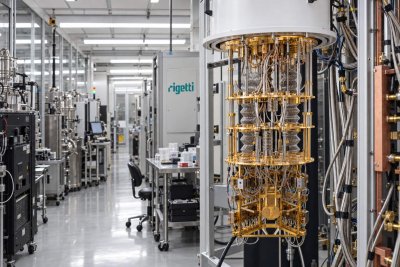
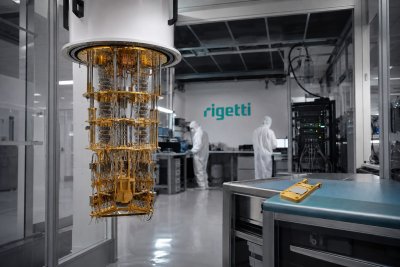
Rigetti Computing posted Q1 revenue of $4.4 million but reported a significant loss of $26 million. The company also announced the general availability of its 108-qubit Cepheus-1-108Q system on multiple cloud platforms, including Amazon Braket, Microsoft Azure Quantum, and qBraid. The key question for investors remains whether customers are paying to access these systems.
D-Wave Systems delivered a more nuanced report, with revenue dropping sharply to $2.9 million from $15 million a year ago. However, bookings—future revenue from customer orders—surged to $33.4 million, boosted by a $20 million system sale and a $10 million quantum-computing-as-a-service agreement with a Fortune 100 client. Traders focused on the strong order pipeline, pushing the stock higher.
Infleqtion's Broader Strategy
Infleqtion differentiates itself with a diverse product portfolio that includes neutral-atom quantum computers, quantum clocks, RF receivers, inertial sensors, and software. This broader approach contrasts with the narrower focus of some competitors, but it also complicates the earnings narrative. Investors will be closely watching the May 14 report to understand which segments are driving revenue.
The company has guided for 2026 revenue of $40 million, up from an expected $32.5 million in 2025. In 2025, Infleqtion reported an operating loss of $35.3 million, or $28.1 million on a non-GAAP basis, which excludes stock-based compensation and deal costs.
Bull and Bear Arguments
Bullish investors point to Infleqtion's existing customer base in defense, space, government research, and critical infrastructure—sectors known for adopting early-stage technology. CEO Matthew Kinsella highlighted "growing demand for deployable quantum technologies" in precision timing, resilient navigation, and scaled quantum systems, suggesting the company does not need to wait for fault-tolerant quantum computers to generate revenue.
On the bearish side, Infleqtion remains a small, money-losing company with a short public market history. If the sector rally is driven more by competitors' M&A-fueled revenue and bookings than by Infleqtion's own fundamentals, the stock could face a correction if the Q1 report fails to show contract wins translating into recognized revenue. As one analyst noted, "a pipeline isn't money in the bank—it's just a promise waiting to be proved."
Recent Contract Wins and Challenges
Infleqtion has secured notable contracts, including a $1 million Phase II award from the U.S. Navy for its QuIRC machine-learning platform for radio-frequency signal processing. The company also received $2 million from DARPA for the HARQ project, which focuses on software flexible enough to operate across different quantum hardware platforms. These wins underscore Infleqtion's technical capabilities but remain modest in scale.
Tuesday's stock jump provides a short-term boost, but the real test comes Thursday afternoon when Infleqtion reports its Q1 results. Investors will be looking for hard evidence of commercial traction in a sector that has long promised more than it has delivered.