Intel Corporation (INTC) continued its upward trajectory on Monday, with shares gaining 2.7% to close at $84.76, building on a post-earnings surge that has pushed the chipmaker's market capitalization to approximately $430.6 billion. The rally marks a significant shift in investor sentiment, as Wall Street reconsiders Intel's role in the artificial intelligence chip race, which has long been dominated by Nvidia (NVDA).
Strong Q1 Results Drive Optimism
The company's first-quarter results, released on Friday, revealed revenue of $13.6 billion, a 7% year-over-year increase. Non-GAAP earnings per share came in at $0.29. The Data Center and AI segment was a standout performer, generating $5.1 billion in revenue, up 22% from the prior year. Intel Foundry, the company's manufacturing unit serving both internal and external clients, contributed $5.4 billion, a 16% increase.
For the second quarter, Intel guided revenue in the range of $13.8 billion to $14.8 billion, signaling continued momentum. CFO David Zinsner noted that the company successfully moved inventory that had accumulated, though he cautioned that such benefits may not repeat in Q2.
CPU Renaissance Reshapes AI Landscape
The rally reflects a broader shift in the AI trade, as investors increasingly look beyond graphics processing units (GPUs) from Nvidia to central processing units (CPUs) like Intel's Xeon line. This shift is driven by the growing importance of AI inference—running trained models to answer queries or perform tasks—where CPUs play a critical role in coordinating hardware. CEO Lip-Bu Tan told investors that "the CPU is reinserting itself" in the AI era, a sentiment echoed by analysts who see a "CPU renaissance" underway.
At least 23 brokerages raised their price targets on Intel following the earnings report, according to Reuters. Evercore ISI's Mark Lipacis attributed the demand to the rollout of agentic AI tools, which handle tasks autonomously and require additional CPUs for heavier workloads.
Analyst Outlook and Risks
Despite the optimism, analysts remain cautious. UBS analyst Timothy Arcuri raised his price target to $83 but maintained a Neutral rating, citing concerns about earnings strength. Seaport Research's Jay Goldberg described Intel as being on its "firmest footing in years," but warned of risks including supply dynamics, valuation, and the company's untested foundry ambitions.
Intel faces competitive pressure from Advanced Micro Devices (AMD), Arm Holdings (ARM), Nvidia, and custom chips developed by major cloud providers. On Monday, AMD dropped 3.7%, while Arm slipped about 9%, underscoring that investors are selectively betting on AI chip winners.
Foundry Ambitions and Strategic Partnerships
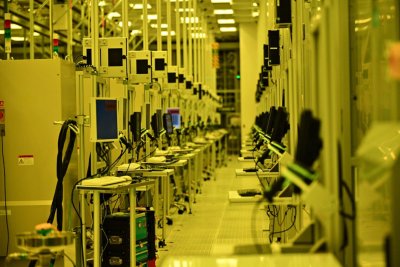
Intel's foundry business remains a key focus. The company announced a strategic partnership on the Terafab project, collaborating with SpaceX, xAI, and Tesla. Additionally, Intel's Xeon 6 chips have been selected as the host CPU inside Nvidia's DGX Rubin NVL8 systems. These deals reinforce CEO Tan's argument that Intel's hardware can be integrated into AI infrastructure, even when not supplying the primary accelerator.
The stock has surged 110% year-to-date, reaching a record high on Friday that eclipsed a peak set 25 years ago. This performance has shed Intel's "AI laggard" label, though the company still faces challenges in reclaiming manufacturing dominance lost to Taiwan Semiconductor Manufacturing Co. (TSM) and in proving that its foundry unit can secure external clients at scale.
As the AI landscape evolves, investors are now focused on how much of the AI stack still relies on Intel, with the company's narrative shifting from being left behind to becoming a key player in the next phase of AI growth.