Rocket Lab shares fell 2.3% to $77.83 on Monday, adding to recent volatility as the market awaits the company's first-quarter earnings report scheduled for May 7. The decline came amid a technical note flagging weak short-term sentiment, even as the company continues to demonstrate strong annual revenue growth and a substantial $1.85 billion backlog.
Market Context and Technical Signals
The stock traded between $77.11 and $81.11 during the session, reflecting the choppiness that has characterized Rocket Lab's recent performance. Stock Traders Daily's Quantitative Research Desk highlighted the weak near-term sentiment, noting it could potentially set up a shift in the mid- or long-term outlook. The analysis also pointed to a resistance level that tends to attract selling pressure, with traders likely scanning for support further down if resistance holds.
Last week's abrupt 3.15% decline to $86.64 had already put traders on alert, raising questions about whether the recent rally was losing steam. Despite these near-term headwinds, Rocket Lab's fundamentals remain robust, with 2025 revenue of $602 million—a 38% increase year-over-year—and a backlog that grew to $1.85 billion.
Upcoming Earnings and Operational Wins
For the first quarter, management projects revenue between $185 million and $200 million, implying a 57% year-on-year increase at the midpoint. On the operational front, the company continues to build momentum. On April 23, Rocket Lab completed its second dedicated launch for Japan's JAXA, sending eight spacecraft into orbit from New Zealand—its 87th launch overall. CEO Sir Peter Beck emphasized that these consecutive JAXA missions demonstrate Electron's position as "the preferred small launcher for national space agencies."
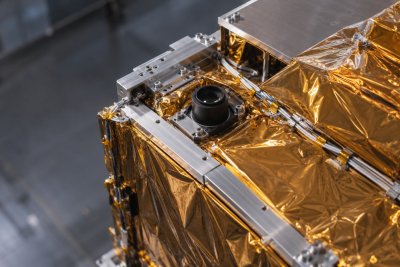
Additionally, Rocket Lab introduced a high-performance star tracker, a navigation system that uses starlight for spacecraft orientation. Brad Clevenger, president of Rocket Lab USA, described the product as a response to "changing needs of commercial and government missions," part of the company's broader push to expand beyond launches and deepen its space systems business.
SpaceX IPO Casts a Long Shadow
The broader space sector is increasingly influenced by SpaceX's anticipated public debut. Reuters reported earlier this month that Elon Musk's company has submitted paperwork for a U.S. IPO, with a potential valuation exceeding $1.75 trillion. "Investors were clamoring for SpaceX exposure," said Angelo Bochanis of Renaissance Capital, while Shay Boloor of Futurum Equities pointed to Starlink as the key driver behind the lofty valuation.
This has reshaped sentiment across the space industry. According to Seraphim Space data cited by Reuters, global space company investment surged to a record $7.95 billion in the first quarter—nearly double the previous quarter. Lucas Bishop of Seraphim described the mood as "risk-on," with capital flowing into what investors perceive as category leaders.
Valuation Concerns and Analyst Views
Despite the positive operational story, valuation remains a concern. A Seeking Alpha analysis flagged Rocket Lab's enterprise value-to-sales ratio as still well above the sector average, suggesting investors may be pricing in significant optimism. The report noted that sentiment hinges on the schedule for the Neutron rocket, with a late-2026 launch target.
According to MarketBeat, 17 analysts maintain a "Moderate Buy" consensus on Rocket Lab, with an average 12-month price target near $83.31. However, a spike in short interest—more traders betting against the stock—signals potential for higher volatility. For now, Rocket Lab holds strong contracts and recent launches, but the stock faces a tougher valuation check where growth alone may not be enough.