Shares of Rocket Lab USA, Inc. retreated sharply in Wednesday trading, shedding 8.8% to $71.65 by midday, following the company's disclosure of plans to raise capital through a substantial equity offering. The aerospace manufacturer and launch service provider filed with the Securities and Exchange Commission to sell up to $1 billion worth of its common stock over time using an at-the-market (ATM) facility. This announcement effectively cooled investor enthusiasm that had propelled the stock upward by 10.2% just one day prior.
Capital Raise Follows Strategic Momentum
The proposed offering arrives at a pivotal moment for Rocket Lab, which has recently showcased significant progress on its next-generation Neutron medium-lift rocket and secured major defense contracts. The company stated that proceeds from the share sale may be allocated toward funding growth initiatives, potential strategic acquisitions, general corporate purposes, and bolstering working capital. Importantly, Rocket Lab clarified it is under no obligation to sell the full $1 billion amount and can discretionarily issue shares into the market over time, avoiding a single large block trade that could exert more pronounced downward pressure on the stock.
Dilution and Financial Implications
In its filing, the company explicitly warned existing shareholders that the equity issuance could result in dilution, reducing the proportional ownership stake of current investors. Based on Rocket Lab's closing share price of $71.31 on Monday, March 17, 2026, selling the entire $1 billion authorization would involve issuing approximately 14 million new shares. As of March 12, the company had 569.4 million shares outstanding. This dilution risk, coupled with potential downward pressure on the stock price and a reduction in earnings per share, was cited as a primary factor behind Wednesday's sell-off.
Rocket Lab's financial position appears robust heading into this capital raise. The company concluded its 2025 fiscal year with a strong cash balance of $828.7 million, supplemented by roughly $270 million in marketable securities. For the fourth quarter of 2025, Rocket Lab reported revenue of approximately $180 million, contributing to a full-year total of $602 million. Perhaps more critically, the company's backlog—representing contracted work not yet recognized as revenue—surged 73% year-over-year to a record $1.85 billion. "We ended the year with a record $1.85 billion in backlog," Chief Executive Peter Beck emphasized to investors in late February.
Neutron Development and Defense Wins Fuel Optimism
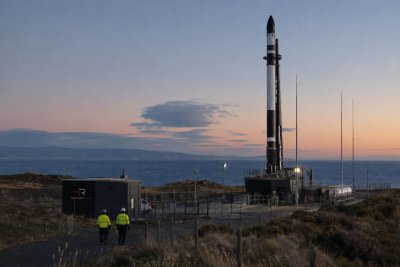
The recent rally preceding the offering announcement was underpinned by concrete operational advancements. The development of the Neutron rocket remains central to Rocket Lab's long-term growth strategy, designed to move the company beyond the capabilities of its smaller Electron launch vehicle. After reporting a stage-one tank rupture during pressure tests in January, the company rebounded with positive news in February, announcing that its "Hungry Hippo" payload fairing and thrust structure for Neutron had successfully cleared qualification testing. Rocket Lab is currently targeting the first launch of the Neutron rocket for the fourth quarter of 2026.
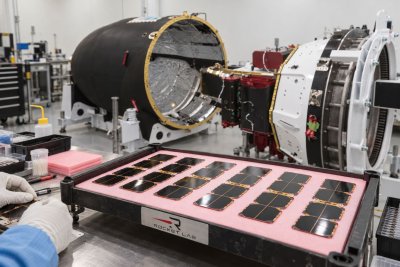
Concurrently, Rocket Lab's defense segment has garnered significant investor attention. The company secured an $816 million award from the Space Development Agency (SDA) as part of a broader $3.5 billion contract to build 72 missile-tracking satellites. Rocket Lab will produce 18 satellites, joining industry giants Lockheed Martin, Northrop Grumman, and L3Harris on the program. The SDA's objective is to establish "near-continuous global coverage" for missile warning and tracking, a high-priority national security capability. Furthermore, Rocket Lab has bolstered its defense offerings through the acquisitions of Optical Support and Precision Components, aimed at enhancing its national-security payload capabilities and precision manufacturing expertise.
Market Context and Risk Factors
Despite the strategic rationale for raising capital, the market's reaction highlights investor sensitivity to dilution, especially for a growth-stage company. Rocket Lab remains unprofitable, reporting a net loss of $52.9 million for its latest quarter. Management's outlook projects an adjusted EBITDA loss—earnings before interest, taxes, depreciation, and amortization, excluding certain items—in the range of $21 million to $27 million for the current quarter. The success of the Neutron program is viewed as a critical path to future profitability, and any further technical setbacks could delay the timeline for the larger rocket to begin generating meaningful revenue.
Wednesday's decline pared back but did not fully erase the week's gains. Even after the pullback, the stock price held slightly above Monday's closing level, suggesting some underlying support based on the company's operational milestones. The ATM offering structure provides Rocket Lab with financial flexibility to capitalize on strategic opportunities without the urgency of a traditional underwritten offering, allowing it to raise funds as market conditions permit. The coming quarters will be crucial as the company balances this new capital influx with the execution risks and immense promise of its Neutron and defense portfolios.