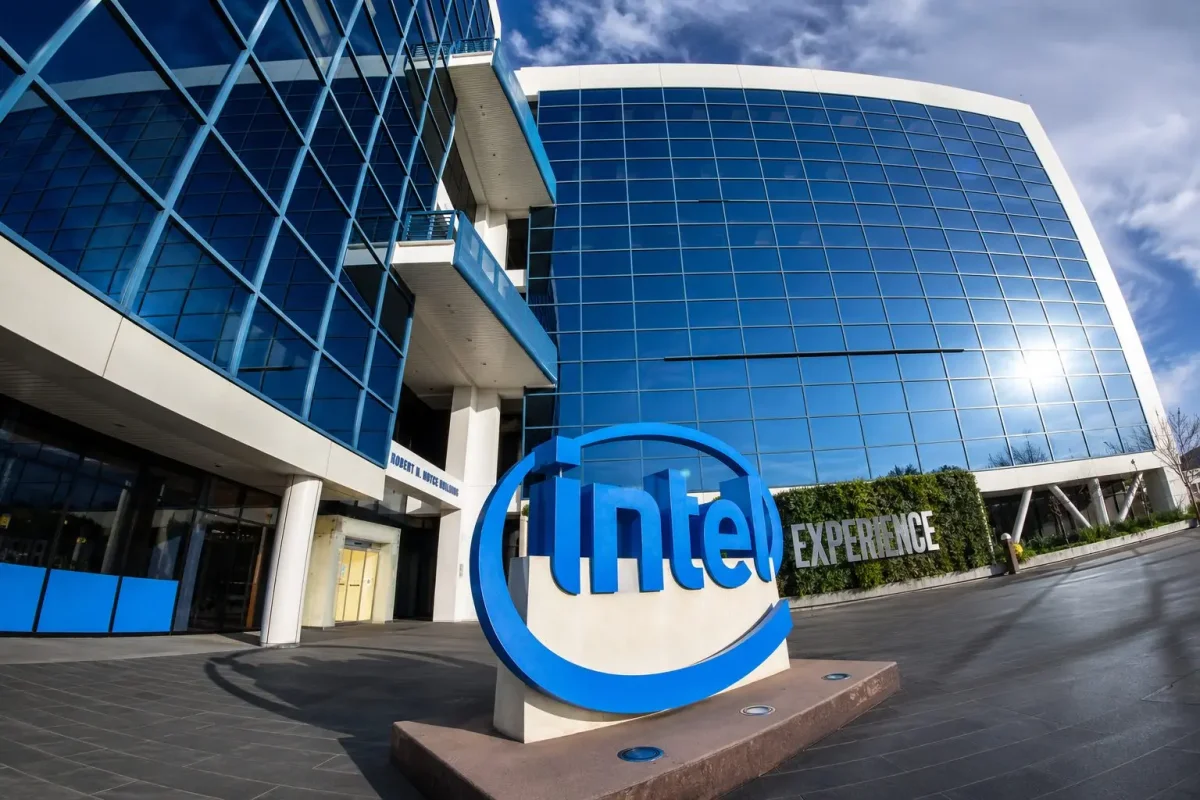
Intel shares dropped 4.6% to $105.25 in late trading Tuesday, reversing a portion of the sharp gains from the prior session as investors locked in profits and a broad selloff swept through the semiconductor sector. The stock had opened at $112.59, briefly touched $113.96, then slumped as low as $99.47, illustrating the rapid repricing of the company's turnaround narrative.
The decline underscores a pivotal moment for Intel, whose stock price has become increasingly tied to expectations that Chief Executive Lip-Bu Tan can transform Intel Foundry into a viable contract chip manufacturer. Monday's rally followed a Reuters report citing The Information that Alphabet's Google had placed an order for more than 3 million tensor processing units, AI chips designed for machine learning, to be produced by Intel in 2028. Jacob Bourne, technology analyst at eMarketer, characterized the news as evidence that major AI players are eager to diversify their supply chains away from Taiwan Semiconductor Manufacturing Co.
However, the broader market backdrop turned hostile. Technology shares resumed their recent slide ahead of key U.S. inflation data and the upcoming initial public offering of SpaceX. Michael O'Rourke, chief market strategist at JonesTrading, described part of the move as a "momentum unwind," as investors sold into crowded winners following a rapid run-up. Nvidia fell 1.8%, AMD dropped 5.4%, the VanEck Semiconductor ETF slid 3.3%, and the Invesco QQQ Trust lost 2.0%, placing Intel's decline squarely within a wider retreat in high-growth chip and technology names.
Adding to the pressure, the reported Google order remains unverified. Reuters stated it could not independently confirm the information, Intel declined to comment, and neither Alphabet nor Nvidia immediately responded. Nvidia has not placed an order with Intel. The company also posted a net loss of $3.73 billion less than a month ago, and building a world-class foundry is expected to require tens of billions of dollars in investment.
On a more positive note, Cadence Design Systems announced an expanded multi-year collaboration with Intel Foundry to optimize Intel 14A, a future chipmaking process, and deliver production-ready process design kits. Cadence CEO Anirudh Devgan called the deeper partnership "a major milestone," while Intel Foundry head Naga Chandrasekaran said it demonstrated Intel's focus on its technology roadmap. Yet process readiness is not equivalent to profitable volume production.
The competitive landscape remains dominated by TSMC, which Reuters reported in May has effectively no 3-nanometer wafer capacity available for AI chips, with Nvidia, AMD, and Broadcom having consumed all available supply. This capacity crunch may drive chip designers to seek a second source such as Intel, but only if Intel can prove it can execute foundry work at scale.
Investors now face a critical juncture. The stock's valuation depends heavily on Intel's ability to secure major foundry customers like Google, but the central report is unconfirmed, and the broader AI trade is vulnerable to profit-taking. The U.S. Consumer Price Index for May, due Wednesday at 8:30 a.m. ET, will provide a key input for interest-rate expectations and growth-stock valuations. Any response from Intel, Alphabet, or Nvidia on the reported order will be closely watched, as will the trajectory of semiconductor breadth. Another down day in Nvidia, AMD, or chip ETFs would signal that Intel's pullback is more sector-led than company-specific.