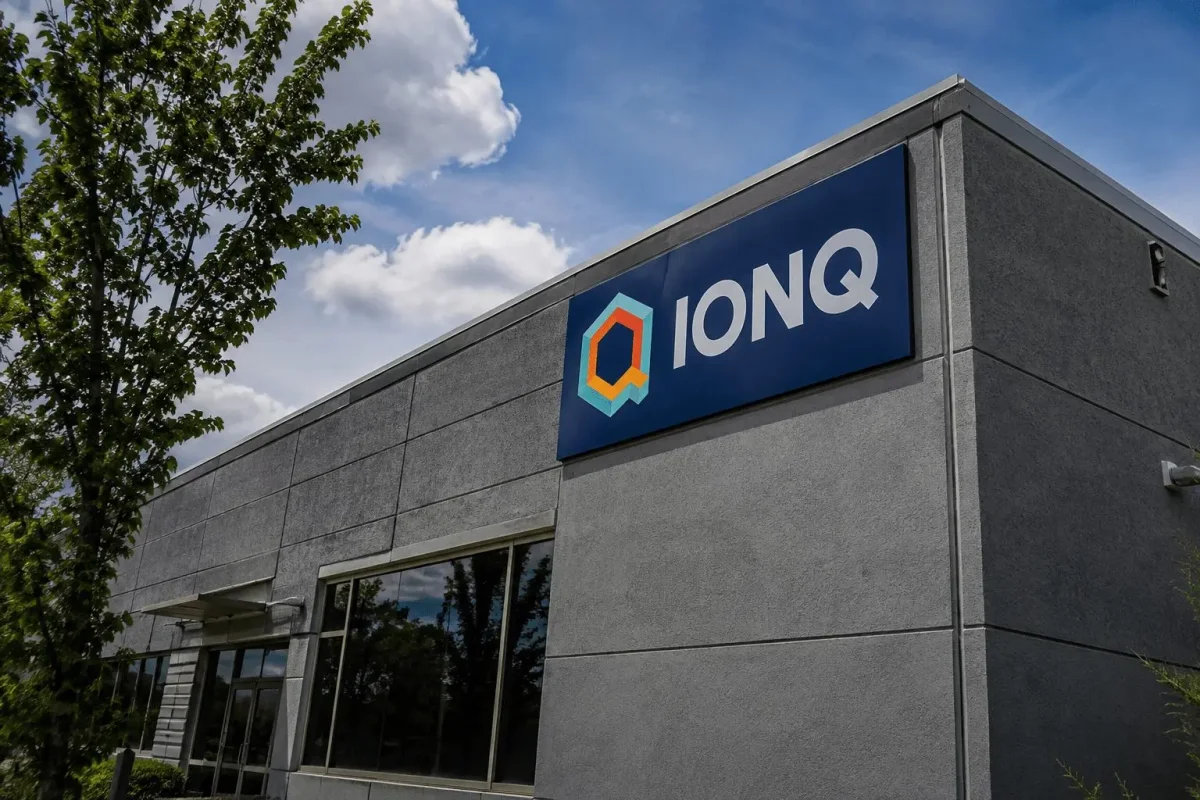
Quantum computing firm IonQ (NYSE:IONQ) reported second-quarter 2026 revenue of $80.05 million, surpassing the consensus estimate of $66.5 million by 20.4%. The company also raised its full-year 2026 revenue guidance to a range of $280 million to $290 million, up from the previous midpoint of $265 million. Despite the upbeat headline numbers, a closer look at the guidance suggests that growth in the second half may be more subdued than investors might hope.
With first-half revenue of $144.718 million, the midpoint of the revised guidance ($285 million) implies second-half revenue of about $140.282 million. That represents a 3.1% decrease compared to the first half. Even at the top end of the guidance range, second-half revenue would only grow by 0.4% sequentially, while the bottom end would imply a 6.5% decline. The company appears to be entering a period of consolidation rather than acceleration.
Shares of IonQ closed Friday at $44.43, up 11.9% on the day and 21.9% for the week. Early premarket trading on Monday indicated a slight pullback of about 1.5%, with shares around $43.77. The stock’s recent surge came after the company delivered better-than-expected adjusted earnings, with an adjusted EPS of -$0.33 versus the consensus of -$0.56, a $0.23 improvement.
The adjusted EBITDA loss of $120.3 million was wider than the $95.6 million loss (excluding SkyWater spending) analysts had modeled, but the GAAP net loss of $1.868 billion included a $1.649 billion non-cash warrant fair-value loss. Excluding that, the operating performance was largely in line with expectations.
Revenue diversification was a key highlight of the quarter. International revenue accounted for roughly 50% of total revenue, commercial customers contributed 60%, and multi-product sales made up 25%. Chief Operating Officer and Chief Financial Officer Inder Singh noted that the revenue base is “broadening in ways that reinforce its durability.” Remaining performance obligations (RPO) reached $485 million, a 297% increase year-over-year, providing visibility into early 2027, according to JPMorgan analyst Mayur Ramdhani.
The guidance increase was largely driven by the second-quarter beat. The company’s Q2 revenue of $80.05 million was $13.55 million above the previous company midpoint for the quarter, which accounted for 67.8% of the $20 million increase in the annual midpoint. The implied second-half revenue rose by just $6.45 million compared to the pre-results baseline, representing a modest 4.8% upward revision.
Analyst reactions were mostly positive. Rosenblatt Securities’ John McPeake maintained a Buy rating with a $100 price target, implying 125.1% upside. Wedbush’s Matt Bryson rated the stock Outperform with a $75 target, and Cantor Fitzgerald’s Troy Jensen set an Overweight rating with a $70 target. Needham’s Quinn Bolton reiterated a Buy with a $65 target, while Benchmark’s Gary Mobley had a Buy with a $60 target. JPMorgan’s Mayur Ramdhani remained Neutral with a $50 target. The consensus price target among 14 analysts is $69.92, representing roughly 57% upside from Friday’s close.
Valuation remains a key consideration. With a market capitalization of $16.49 billion, IonQ trades at about 57.9 times its updated revenue midpoint. After adjusting for $2 billion in pro forma cash (post-SkyWater acquisition), the cash-adjusted multiple falls to roughly 50.9 times. Compared to peers, IonQ appears less stretched: D-Wave Quantum (NASDAQ:QBTS) trades at 624.9 times annualized quarterly revenue, and Rigetti Computing (NASDAQ:RGTI) at 290.8 times. However, IonQ’s multiple still implies investors are pricing in robust growth and rapid contract execution.
The SkyWater acquisition, finalized on July 31, 2026, is not included in the current guidance. Pro forma cash decreases from $3 billion to around $2 billion. IonQ’s next investor conference is scheduled for August 19, with an investor day on September 8. Market participants will be watching whether the recent rally holds and how management addresses the flat second-half outlook.