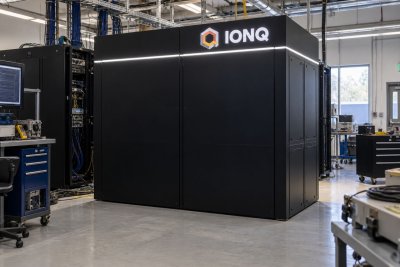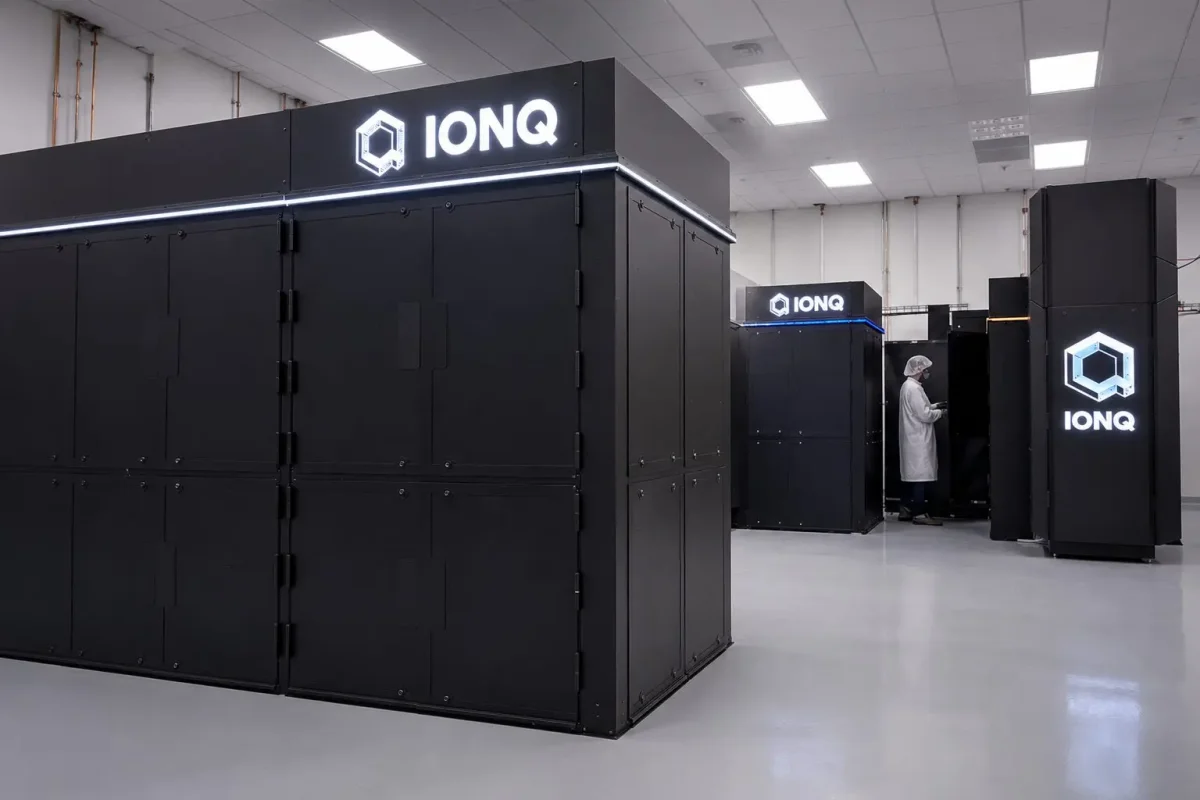
IonQ shares ended the trading week at $57.85, slipping 0.24% from the prior close, as the quantum computing company holds a market capitalization of approximately $21.5 billion. The stock traded between $56.18 and $60.18 on volume of about 24.7 million shares, according to market data.
Wall Street remains cautiously optimistic on IonQ. According to Benzinga's analyst tracker, the consensus rating is Buy with a price target of $64.69. Rosenblatt Securities reaffirmed its Buy rating and $100 price target on June 11, representing the most recent analyst action. MarketBeat reports an average rating of "Moderate Buy" from 17 analysts, with one sell, six hold, and ten buy ratings, and a 12-month target of roughly $68.63.
The stock behaves less like a mature hardware company and more like a long-duration technology option, where shifts in confidence about quantum adoption can significantly impact valuation. In its first-quarter report, IonQ posted revenue of $64.7 million, a 755% year-over-year increase, and raised its full-year 2026 revenue guidance to between $260 million and $270 million. Chairman and CEO Niccolo de Masi stated, "With $64.7 million in revenue, we have once again significantly outperformed our guidance range."
The bull case centers on IonQ's growing commercial traction. The company reported $470 million in remaining performance obligations, representing contracted business not yet recognized as revenue. It also sold its first sixth-generation, chip-based 256-qubit system. Approximately 60% of first-quarter revenue came from commercial customers and 35% from international clients, indicating broadening demand beyond single contracts or government programs.
On the bear side, valuation and execution risk loom large. At current levels, IonQ trades at roughly 81 times the midpoint of its 2026 revenue guidance, a very high price-to-sales multiple. The company also reaffirmed its full-year adjusted EBITDA loss guidance of $310 million to $330 million. Additionally, IonQ's beta stands at 3.18, implying the stock tends to move far more sharply than the broader market.
Sector policy adds another layer of uncertainty. In May, the U.S. Department of Commerce announced $2.013 billion in planned CHIPS Act quantum incentives, with recipients including IBM, GlobalFoundries, D-Wave, Quantinuum, and Rigetti, but not IonQ. While this does not eliminate IonQ's long-term opportunity, it raises the risk that rivals may gain government-backed manufacturing and engineering advantages. Commerce Secretary Howard Lutnick said the investments would lead "the world into a new era of American innovation," underscoring how policy headlines can move quantum stocks even without changes in company fundamentals.
The next major catalyst for IonQ is execution against near-term targets: second-quarter revenue guidance of $65 million to $68 million, progress on the 256-qubit system, and the pending acquisition of SkyWater Technology. Reuters reported in January that the roughly $1.8 billion SkyWater deal is intended to strengthen IonQ's hardware capabilities and supply chain, particularly for federal and defense work.
On the verified facts today, IonQ appears risky rather than clearly cheap or fairly valued. The stock has credible bullish drivers—rapid revenue growth, a large backlog, analyst support, and a strategic push toward full-stack quantum systems—but the price already assumes strong execution, continued funding access, and eventual proof that fault-tolerant quantum computing can become a large commercial market. The key question for investors is not whether quantum computing is promising; it is whether IonQ can convert that promise into repeatable revenue quickly enough to justify a $21 billion-plus valuation.