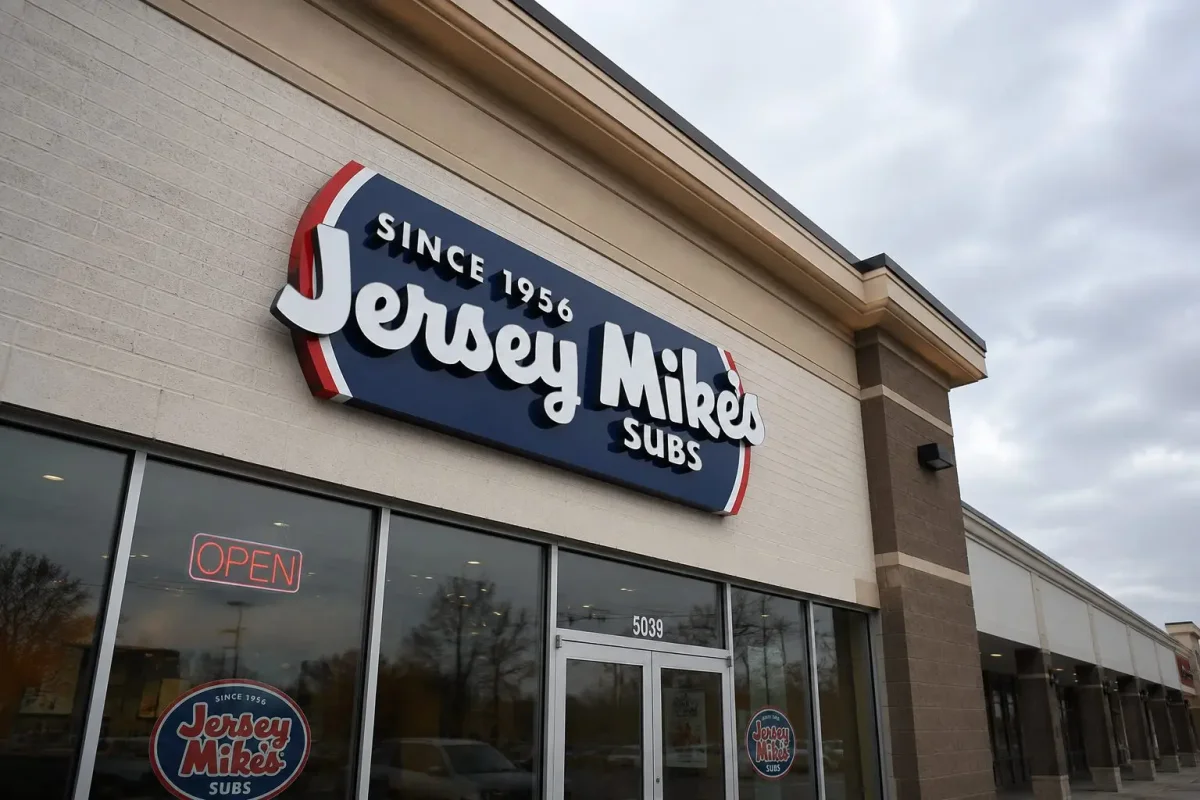
Jersey Mike's Subs made its public market debut on Thursday, and the reception was less than enthusiastic. The sandwich chain's stock closed its first day of trading at $21.63, a 5.96% decline from its initial public offering (IPO) price of $23 per share. This drop erased approximately $435 million in equity value, a figure that surpasses the company's total gross IPO proceeds of about $317 million from newly issued shares.
The IPO, which raised roughly $1 billion in total, saw the company itself issue 13.78 million shares, while existing shareholders sold 29.70 million shares, accounting for 68.3% of the base offering. This heavy selling by current investors, including private equity giant Blackstone (NYSE: BX), which retains nearly 70% ownership and voting control, may have contributed to the lackluster debut. Jersey Mike's will not receive any proceeds from the sale of shares by existing stockholders.
On its first day, shares opened at $21, down 8.7% from the offer price, before recovering slightly to close at $21.63. Trading volume was substantial, with approximately 36.1 million shares changing hands, representing about 83% of the base offering. This high turnover relative to the number of shares issued suggests significant investor interest, but the price action indicates a cautious sentiment.
The company's financial performance, however, shows strength. Systemwide sales, which include franchise locations, increased 13% to $4.2 billion in 2025, compared to an estimated $3.72 billion in 2024. Revenue advanced 11% to $724 million, while adjusted EBITDA rose 29% to $339 million. These figures underscore the brand's growth trajectory, though comparable-store sales growth decelerated to 2.3% from a previous 3.6%, a potential concern for investors.
CEO Charlie Morrison expressed confidence in the company's business model, citing "predictability in performance that we know investors love to see." He outlined ambitious expansion plans, projecting 7,500 stores in the U.S. and another 7,500 internationally, up from the current 3,300 locations. However, such aggressive growth carries execution risks, and the rapid timeline of the IPO—just 18 months after Blackstone acquired its controlling stake—may have raised questions about valuation.
At Thursday's close, the company's equity value stood at $6.87 billion, representing 9.5 times projected 2025 revenue and 20.3 times adjusted EBITDA. These multiples are relatively high compared to the broader restaurant sector, which has seen subdued performance. The Dow Jones U.S. Restaurants & Bars Index has dropped more than 1% so far this year, while the wider market has climbed roughly 7%.
Despite the initial stumble, some analysts view the IPO as a success. Lukas Muehlbauer of IPOX Research described the $1 billion raised as "an impressive outcome," highlighting the strong demand for shares despite the price decline. However, the company carries significant debt—$2.1 billion in fixed-rate debt and $232 million in cash, with net leverage at 5.5 times adjusted EBITDA—which could weigh on future performance.
As trading resumes on Friday, investors face a critical test: whether to view $21.63 as a new baseline or as a warning sign. An additional 6.52 million shares may be sold through an overallotment option, and the deal is set to close on Friday. The outcome will provide further insight into market sentiment toward this high-profile IPO.