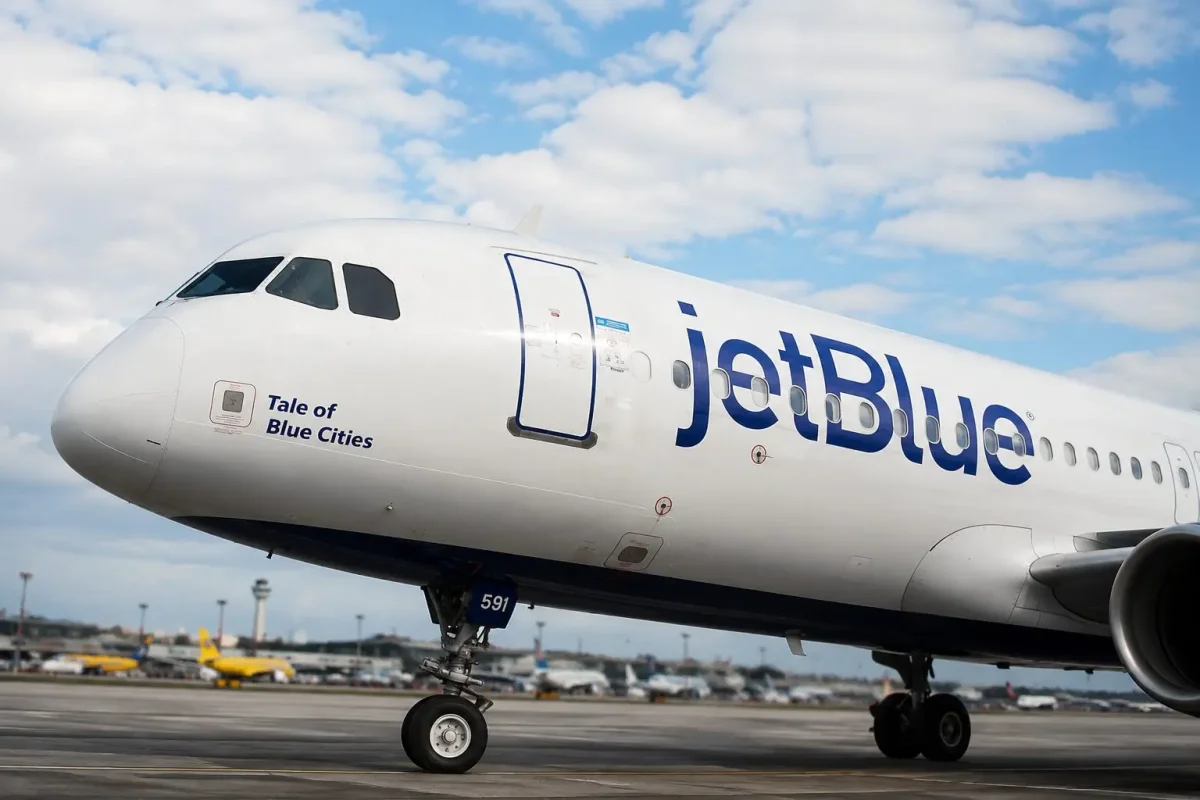
JetBlue Airways (NASDAQ:JBLU) has introduced a new installment payment option for flight bookings, aiming to stimulate demand as surging fuel expenses threaten to offset expected gains from higher ticket prices. The move comes as the carrier faces a challenging cost environment.
According to its second-quarter guidance, JetBlue's projected revenue is approximately $185 million below the combined midpoint of fuel and core non-fuel costs, before accounting for other operating items. The airline is set to report its Q2 results on July 28, a key date for investors assessing whether higher fares can keep pace with an anticipated 85% year-over-year increase in fuel expenses.
JetBlue shares closed up about 4.5% at $5.59 on Wednesday, recovering nearly all of Tuesday's 4.8% decline following a broader airline rally. The new payment solution, branded ClarityPay, allows eligible customers to spread payments over periods ranging from six weeks to 48 months, with annual percentage rates from 0% to 36%. A promotional offer provides 0% financing for up to 12 months until August 15. For illustration, a $219.49 fare—the first-quarter average—would result in monthly payments of $18.29 over a year with no interest, though eligibility and additional charges may apply.
Ed Pouthier, JetBlue's vice president of loyalty and personalization, said ClarityPay will offer customers "more flexibility when planning and booking travel." Tom Carter, commercial chief at ClarityPay, noted the rollout aims to "drive future purchases within the JetBlue ecosystem." The announcement did not disclose merchant fees, customer adoption targets, or revenue projections.
JetBlue's June guidance indicated Q2 capacity growth of 2% to 4%, revenue per available seat mile (RASM) up 9% to 12%, and cost per available seat mile ex-fuel (CASM-ex) rising 3% to 5%. An illustrative scenario based on these ranges, applying last year's numbers and assuming fuel usage moves with capacity, shows a residual—revenue minus estimated fuel and CASM-ex costs—ranging from a negative $248 million on the downside to negative $120 million on the upside, with a midpoint deficit of $185 million. This model is not official company guidance but highlights the magnitude of the cost-revenue imbalance.
In the upside case, revenue would increase by about $388 million year-over-year, but estimated fuel outlays would climb roughly $426 million, alongside higher labor, maintenance, and other expenses. JetBlue's GAAP operating margin was just 0.3% in Q2 2025, leaving little cushion for additional cost pressures.
United Airlines (NASDAQ:UAL) provided a peer update after the close Wednesday, posting 3.5% capacity growth and unit revenue up 12.1%, with fuel averaging $4.19 per gallon. United said fare and revenue moves offset about half of its higher Q2 fuel bill, while JetBlue aims to recover at least 40%. United expects full recovery by early 2027, while JetBlue targets early 2027 as well. United's recent fuel cost spike of roughly $575 million over two weeks has pressured its outlook, with Q3 adjusted earnings guidance below analyst expectations, sending shares down 5% after hours. CEO Scott Kirby stated United was "built to thrive in every environment."
JetBlue's approach may prove aggressive but could beat unit-revenue forecasts through capacity cuts, fuel efficiency gains, or increased loyalty and ancillary revenue. ClarityPay might boost conversion for higher-priced tickets. However, risks include standard loan rates up to 36%, lack of adoption projections, and further jet fuel price increases. JetBlue ended March with $2.4 billion in liquidity and $8.44 billion in debt. S&P Global Ratings (NYSE:SPGI) downgraded JetBlue to CCC+ in June, stating it no longer expects positive free cash flow until 2028, though it maintains a stable outlook and sees liquidity covering needs through 2027. The checkout tool can ease upfront payments but does not reduce fuel costs.