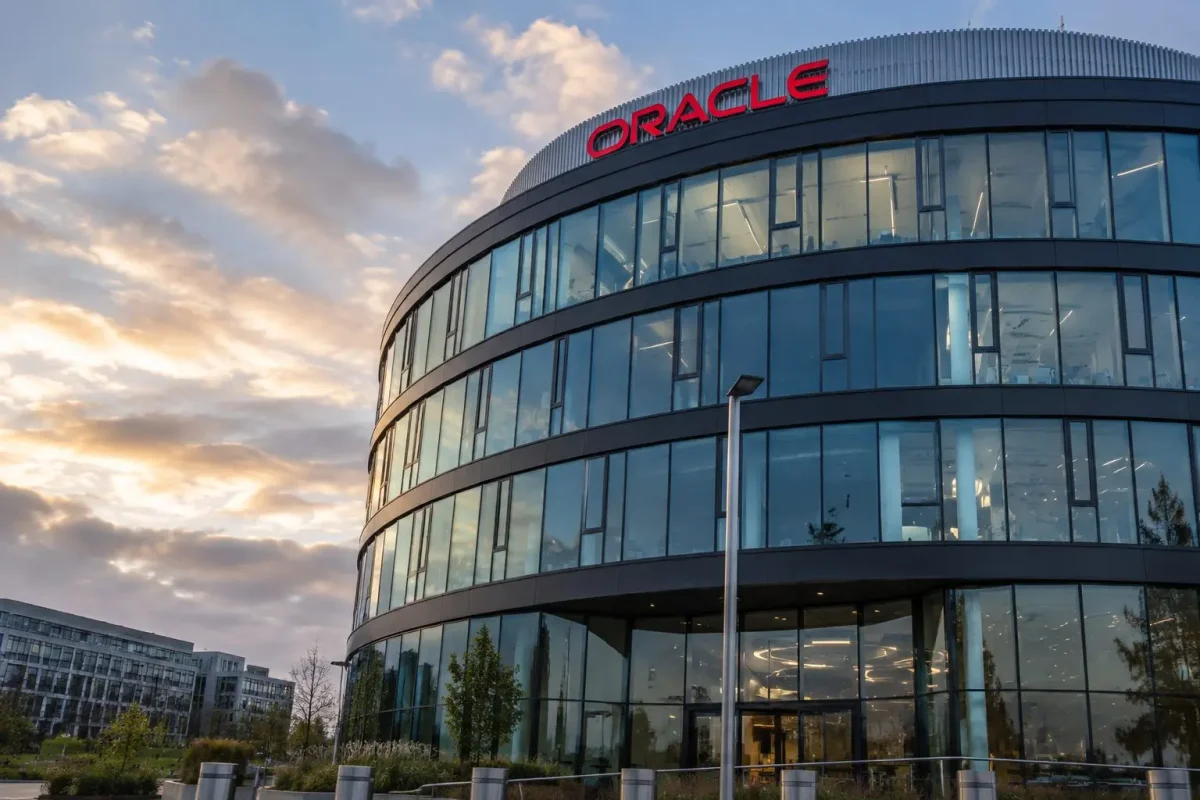
Oracle Corporation (NYSE:ORCL) has introduced a new AI-agent builder for its Fusion Applications customers at no additional cost, a strategic move designed to prioritize adoption over immediate monetization in the less dynamic segment of its cloud portfolio. AI agents are software programs capable of planning and executing tasks autonomously. This launch comes as Oracle's cloud revenue mix undergoes a significant shift in fiscal 2026, with infrastructure surpassing applications for the first time in annual results.
In the fiscal year ended May 31, 2026, cloud infrastructure revenue surged 77% to $18.1 billion, while cloud applications grew only 11% to $15.9 billion. Infrastructure's share of Oracle's total cloud revenue rose to 53%, up from an estimated 42% a year earlier. This shift ties a larger portion of Oracle's growth to capital-intensive data centers, chips, and power, which require substantial upfront investment before generating customer revenue.
Oracle shares rose 3.8% to $132.77 in Wednesday afternoon trading, but the gain appeared to be part of a broader technology rally. Microsoft Corporation (NASDAQ:MSFT) gained 2.8%, Amazon.com Inc. (NASDAQ:AMZN) added 2.9%, and Alphabet Inc. (NASDAQ:GOOGL) rose 3.3%, suggesting that Oracle's product launch may not have been the primary driver of its stock movement. The rebound left Oracle less than 1% above Monday's close after a 2.7% decline on Tuesday.
Within Fusion, business users can now build applications using natural-language instructions, while developers can leverage tools like VS Code, Git, Codex, and Claude Code within Oracle's security, approval, and audit frameworks. Oracle reports that over 80,000 experts have been certified on its AI Agent Studio, and customers can extend more than 1,000 existing agents and 22 recently released Fusion agent applications. “Enterprise software is moving beyond systems that record work to systems that actively drive and execute outcomes,” said Chris Leone, Oracle's executive vice president for applications development.
Since no separate fee is attached, the AI-agent builder does not directly lift sales at launch. The investor case is indirect: the tool could help Oracle retain customers, add users, and move more business processes into Fusion subscriptions. Oracle did not provide a revenue target or customer adoption figure for the announcement. In a separate release, privately held retailer Bealls reported that an Oracle pricing product increased its clearance sales dollars by 25% in one year, though the effect on profit and fees paid to Oracle were not disclosed.
The need to draw more growth from applications becomes clearer when examining Oracle's cash flow. Total revenue rose 17% to $67.4 billion in fiscal 2026, while operating cash flow increased 54% to $32.0 billion. However, capital expenditure soared 162% to $55.7 billion, resulting in negative free cash flow of $23.7 billion, compared to negative $0.4 billion a year earlier. Capital spending as a share of revenue climbed to 83%, up from 37% in fiscal 2025.
Credit rating agencies have taken note. S&P Global Ratings (NYSE:SPGI) recently downgraded Oracle to BBB-, one notch above speculative grade, citing that it had “underestimated the scale of the investments required.” S&P estimates that OpenAI represents roughly half of Oracle's $638 billion in remaining performance obligations (RPO) and expects infrastructure to approach 60% of Oracle's revenue by fiscal 2028, compared to 27% in fiscal 2026.
The backlog conversion is slow. Oracle expects only 12% of RPO to turn into revenue over the first 12 months, with 34% over the following two years, leaving about 54% (roughly $345 billion) beyond three years. Meanwhile, the cost of building capacity comes much sooner, creating a timing gap that drives negative free cash flow. Management says construction is accelerating, with CEO Clay Magouyrk noting that fiscal first-quarter capacity delivery was “approaching one gigawatt,” nearly matching the prior four quarters combined. Oracle forecasts first-quarter revenue growth of 27% to 29% and cloud growth of 58% to 64%.
The Fusion builder offers a way to seek more software growth without building another data center, but it may not alter near-term financials. Free tools can increase usage without lifting prices, and more agent activity could add computing and support costs, which Oracle has not disclosed. CFO Hilary Maxson has said gross margins will “step down” as new data centers ramp. eMarketer analyst Jacob Bourne noted that “the demand is real,” but “the funding question is getting harder, not easier.” For shareholders, the key proof point will be whether cloud-application growth rises above 11% without widening the cash deficit, while the backlog converts on schedule. Tuesday's launch may help defend Oracle's software base, but it has not yet demonstrated it can rebalance the economics of the company's AI push.