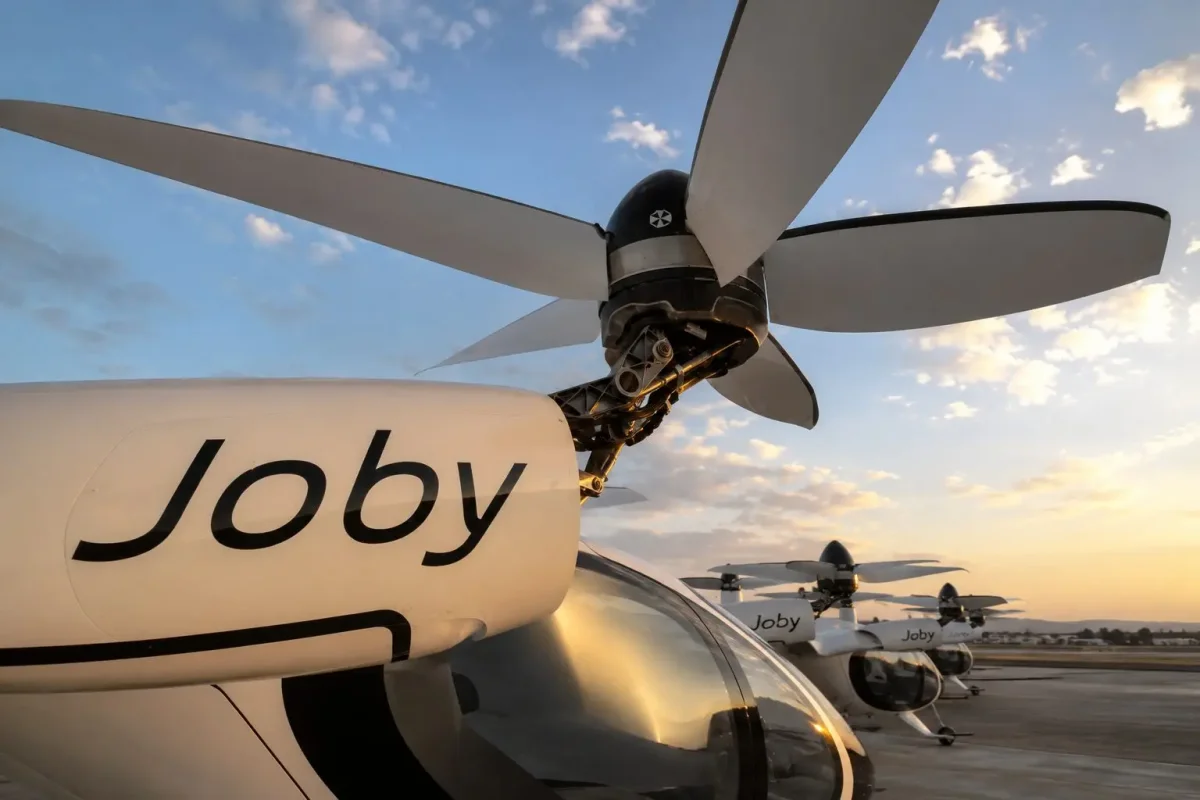
Joby Aviation (NYSE:JOBY) experienced a significant stock decline on Friday, with shares falling 5.7% to $7.11 in afternoon trading. The drop came as analysts scrutinized the company's recently announced partnership with Virgin Atlantic, highlighting a lack of clarity on revenue generation and financial terms.
The agreement, described as binding and multi-year, failed to disclose key details such as the deal's monetary value, intended launch date, flight frequency, or revenue-sharing arrangements. This ambiguity prompted concerns among investors about the near-term financial impact and long-term revenue expectations for the eVTOL (electric vertical takeoff and landing) aircraft developer.
Since Tuesday's close, before the Virgin announcement, Joby's stock has lost 7.2% of its value. The broader eVTOL sector also faced headwinds, with Archer Aviation (NYSE:ACHR) falling 4.7%, Eve Holding (NYSE:EVEX) declining 4.8%, and Vertical Aerospace (NYSE:EVTL) dropping 5.3%. The average decline across these four stocks was 5.1%, compared to a 1.0% slip in the Invesco QQQ Trust (NASDAQ:QQQ).
An analysis of Joby's valuation reveals a cash-and-debt-adjusted market value proxy of approximately $4.94 billion, which is 2.4 times that of Archer's $2.04 billion. This premium persists despite Joby's first-quarter adjusted EBITDA loss of $178.5 million, only 3.5% higher than Archer's $172.5 million loss. Both companies maintained roughly $1.7 billion in net cash as of March 31.
Revenue comparisons remain complicated. Joby's first-quarter revenue of $24.2 million was largely driven by its BLADE passenger operations, while Archer's $1.6 million came primarily from leasing activities at Hawthorne Airport. The Virgin deal expands Joby's distribution channel, with Virgin set to offer Joby flights on its website and app. Joby retains responsibility for aircraft operations, route oversight, and regulatory approvals.
Joby plans to establish hubs at Heathrow and Manchester airports. The company estimates an eight-minute flight from Heathrow to central London and a 15-minute journey from Manchester to Leeds. Bonny Simi, Joby's president of operations, projected a cost per seat of $130 to $160, describing it as "very equivalent" to Uber Black from Uber Technologies (NYSE:UBER). Gross ticket sales for a fully occupied four-seat cabin would range from $520 to $640, though this is an early projection excluding costs, discounts, or partner splits.
Despite these projections, the data does not support a reliable revenue forecast. Joby has not disclosed anticipated flight numbers, passenger loads, profit margins, or a specific launch date. Investors are expected to focus on these metrics when the company reports its second-quarter results after market close on August 5. Key areas of interest include updates on cash burn, certification milestones, and more concrete commercial indicators.
Potential risks include certification delays, significant cash burn, shareholder dilution, and slower UK approval processes. However, the valuation premium could be justified by accelerated testing or secured paid orders. For now, the market remains cautious, with the Virgin deal serving as a distribution expansion but leaving revenue questions unanswered.