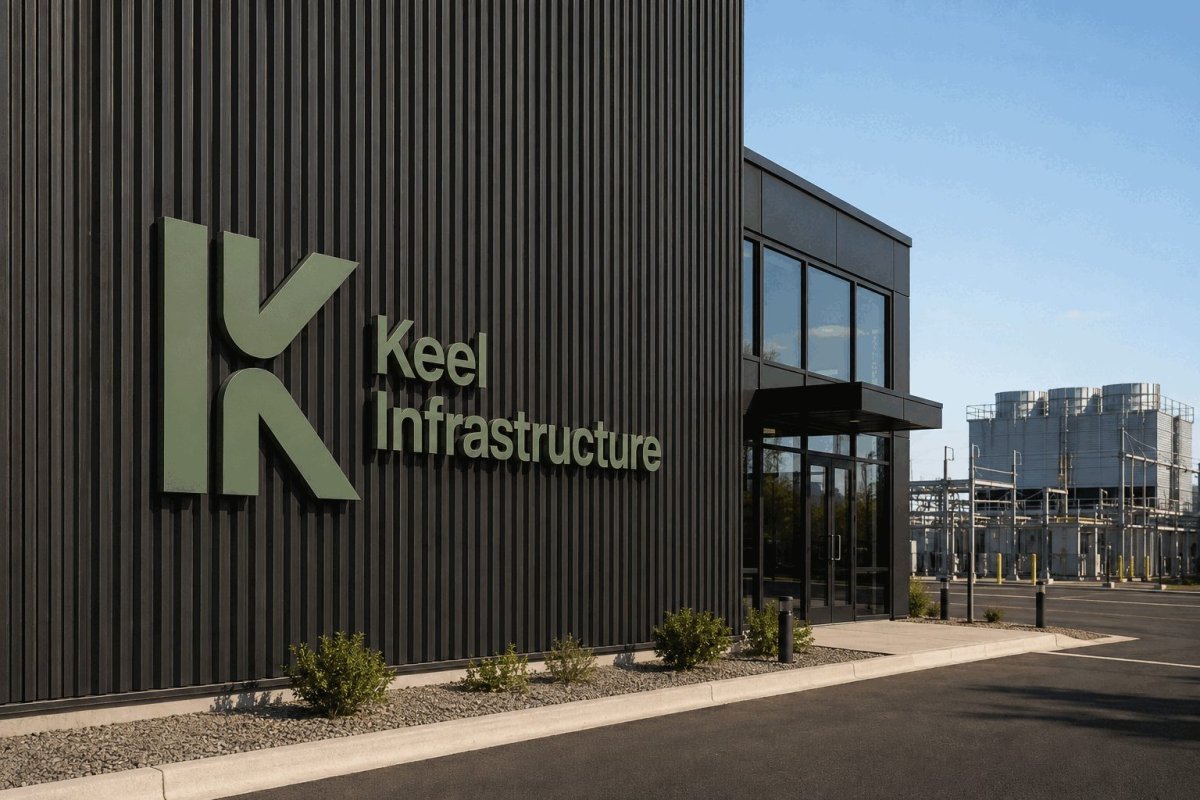
Keel Infrastructure Corp. (NASDAQ:KEEL) experienced a sharp sell-off in Monday's trading session, with shares tumbling 11.3% to $5.26. The decline, accompanied by heavy volume of 49.1 million shares, placed Keel among the most actively traded stocks on major exchanges. The move comes despite the company reporting a substantial liquidity position of $819 million, which represents approximately 26% of its current $3.10 billion market capitalization.
Market Reaction and Context
The sell-off appears to be driven by renewed concerns over the company's execution strategy and valuation, particularly as its second-quarter update highlighted ongoing negotiations at three key properties without finalizing any tenant leases. This has left investors questioning the timeline for revenue generation from its high-performance computing (HPC) and AI data center projects.
Keel's liquidity cushion, while providing a runway for operations, does not necessarily validate the underlying economics of its project pipeline. The company currently lists 341 megawatts (MW) of capacity online and an additional 430 MW contracted for future supply, together representing roughly 35% of its 2.2-gigawatt total pipeline. The remaining 68% (approximately 1.5 GW) is still pending approval or under technical assessment.
Financial Performance and Challenges
The company's legacy business is contracting faster than its new model can generate revenue. Second-quarter sales fell by half to $30.4 million, while adjusted EBITDA swung to a loss of $23.7 million. The company also reported a continuing-operations loss of $64.0 million, a stark reversal from a $13.2 million profit in the prior-year period. U.S. Bitcoin mining operations were completely shut down to facilitate HPC construction, a strategic pivot that has yet to yield tangible results.
On the balance sheet, Keel improved its position by securing $458 million from 1.25% convertible notes during the quarter. As of August 7, liquidity comprised $698 million in cash and $121 million in unencumbered Bitcoin. The conversion price for these notes is set at $7.41 per share, which may present future dilution risk.
Valuation and Analyst Perspectives
Current valuation metrics suggest the market is pricing in significant lease conversion success. Extrapolating Q2 revenue to a full year yields approximately $121.7 million, implying a valuation of nearly 25 times this mechanical run rate. This premium underscores the market's optimism about potential AI leases, but also highlights the execution risk if negotiations stall.
Analyst targets vary widely, reflecting the debate. BTIG initiated with a Buy rating and an $8.00 target, while Keefe, Bruyette & Woods set a Market Perform with a $4.50 target. Alliance Global Partners and H.C. Wainwright maintain Buy ratings with targets of $8.00 and $5.50, respectively, while Chardan Capital has a $4.50 Buy. Monday's price sits above the lower targets but remains 34% below the highest.
Key Milestones to Watch
Investors are seeking concrete evidence of progress: executed leases, finalized permits, and confirmed construction timelines for the Panther Creek, Sharon, and Moses Lake sites. Additionally, Keel must demonstrate that its $819 million liquidity is sufficient to bridge these projects to funding. CEO Ben Gagnon previously stated, "Power is the constraint. Everything else is downstream of it," noting that all three sites are close to securing full permits with multiple candidates in talks.
Risks Ahead
Several risks remain: lease negotiations may break down or face delays, permit approvals could encounter setbacks, and construction costs may overrun. Additionally, Bitcoin price volatility and potential dilution from convertible notes or further capital raises could pressure the stock. The company's transition from a Bitcoin miner to an HPC/AI infrastructure provider is a high-stakes pivot, and the market's patience will be tested until tangible lease agreements are announced.
As trading continues, all intraday figures are preliminary and subject to change. The market's reaction underscores the delicate balance between Keel's cash buffer and the urgent need to convert its pipeline into revenue-generating assets.
