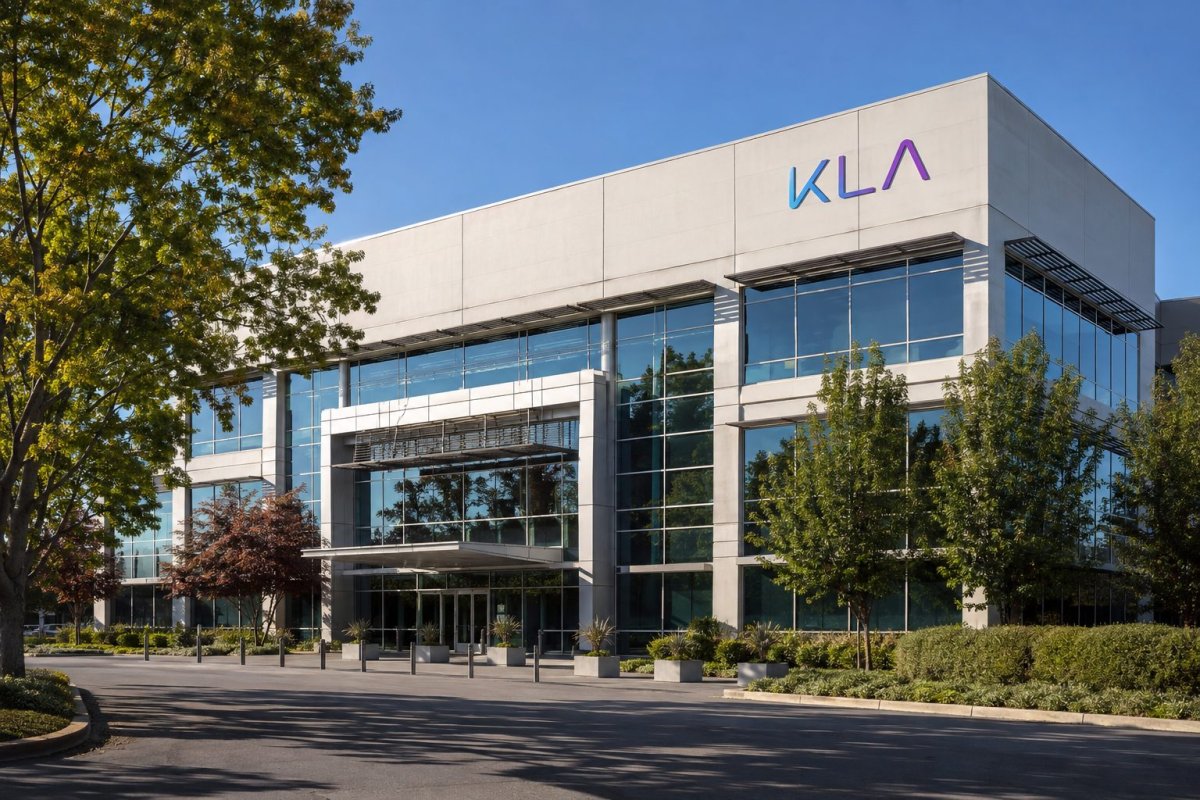
KLA Corporation (NASDAQ:KLAC) has seen its market capitalization erode by approximately $24.2 billion over the past two trading sessions, a sharp reversal that underscores growing investor caution even in the face of robust financial guidance. The semiconductor capital equipment maker's shares tumbled 3.9% to $187.27 on Wednesday, following a 5.3% decline on Tuesday, marking a cumulative two-day drop of 8.98%.
The magnitude of the selloff is striking when measured against the company's operational performance. The $24.2 billion loss in market value is roughly 6.6 times KLA's most recent quarterly revenue of $3.658 billion, a figure that highlights how investor sentiment has diverged sharply from near-term fundamentals. Even as KLA guided for September-quarter sales of $4.0 billion at the midpoint—a 9.4% sequential increase—the market's reaction suggests that concerns over valuation, interest rates, and the sustainability of AI-driven capital expenditure are outweighing positive earnings momentum.
Market Context: A Sector-Wide Pullback
The selloff in KLA was not an isolated event. Peer chip-equipment makers also suffered significant declines on Wednesday. Lam Research (NASDAQ:LRCX) dropped 6.3%, Applied Materials (NASDAQ:AMAT) lost 3.5%, and ASML (NASDAQ:ASML) fell 2.2% in European trading. The broader market, as measured by the S&P 500, gained 0.2% on the same day, underscoring that the weakness was specific to the semiconductor equipment sector rather than a broad market move.
KLA's shares now sit 39.1% below their June 30 peak, a deeper drawdown than its peers. Lam Research is 30% off its high, Applied Materials 32.9%, and ASML roughly 12%. The sector continues to grapple with elevated bond yields, which raise the discount rate applied to future earnings, and heavy positioning in AI-related names that leaves little room for disappointment.
Fundamentals Remain Strong, But Valuation Is Rich
Despite the market's pessimism, KLA's operational performance remains solid. Revenue for the June quarter increased 15.2% year-over-year, driven by product revenue growth of 14.8% and service revenue up 16.8%. The company generated $817 million in free cash flow, representing a 22.3% margin. Chief Executive Rick Wallace cited "strengthening" growth drivers through 2027, linked to increasingly complex foundry, logic, memory, and advanced-packaging designs.
However, the market's concern may stem from valuation. KLA trades at roughly 51.1 times trailing earnings, a multiple that leaves little room for error. While consensus estimates call for 33.3% revenue growth and 44.9% adjusted EPS growth in fiscal 2027, the rich valuation amplifies any negative sentiment shift. As one analyst noted, "Trading at a 51-times multiple offers minimal cushion for any guidance cuts."
Analyst Views: Upside Potential vs. Near-Term Risks
Wall Street remains largely bullish on KLA, with a median price target of $230, implying a potential upside of 22.8% from the current close. The average target is $231.78, and the high sits at $325. Recent analyst actions include Bernstein's David Dai (Buy, $250), TD Cowen's Krish Sankar (Buy, $260), and Cantor Fitzgerald's C.J. Muse (Buy, $325).
Yet, the wide range of targets reflects uncertainty. The low target is $165, suggesting that some analysts see further downside. The market's reaction to KLA's guidance suggests that investors are not dismissing the company's growth prospects but are demanding stronger evidence before paying premium multiples.
Key Catalysts Ahead
Investors will be closely monitoring two factors in the coming week: bond yields and Nvidia's (NASDAQ:NVDA) upcoming earnings report. Rising yields could further pressure high-multiple tech stocks, while Nvidia's results are seen as a barometer for AI hardware demand, which drives much of the equipment sector's outlook.
KLA shares rose slightly to $189.12 in after-hours trading, hinting at a tentative recovery. However, the two-day decline remains the dominant indicator. The selloff may be overdone, particularly if foundry and memory investment picks up, but risks such as export restrictions, China exposure, supply bottlenecks, or reduced equipment spending could weigh on orders.
In summary, KLA's recent slide reflects a market that is increasingly selective, rewarding companies with clear, near-term proof of AI-driven growth and punishing those that trade at rich valuations. The coming weeks will be critical in determining whether the selloff was a temporary correction or the start of a more prolonged de-rating.