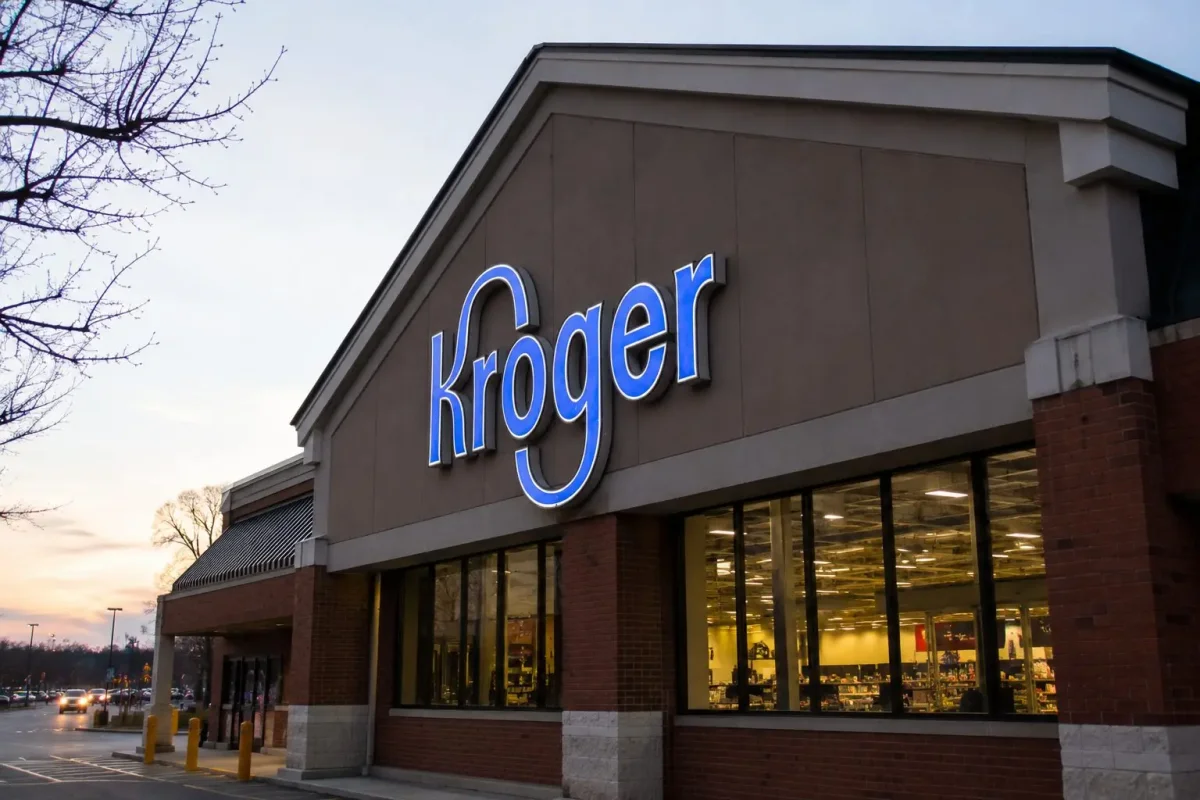
Kroger (NYSE:KR) has reached an agreement to acquire family-owned regional grocer Giant Eagle for $1.65 billion, marking a strategic pivot toward localized expansion after its larger merger with Albertsons Companies (NYSE:ACI) was blocked by courts. The transaction, announced on July 1, 2026, values Giant Eagle at approximately 0.18 times its annual sales of roughly $9 billion, a modest multiple that underscores the deal's targeted nature.
Deal Structure and Valuation
The purchase price consists of $1.25 billion in cash and the assumption of about $400 million in Giant Eagle liabilities. This equates to roughly $7.9 million per supermarket or standalone pharmacy location, based on Giant Eagle's 197 supermarkets and 11 standalone pharmacies. For Kroger, the $1.65 billion outlay represents just 4.8% of its current market value of $34.15 billion, making it a relatively small but strategically significant bet.
Market Reaction and Financial Metrics
Kroger shares were trading down 38 cents at $55.53 in premarket activity following the announcement. The deal's valuation metrics are straightforward: at 0.18 times sales, it is a fraction of what Kroger would have paid for Albertsons. Each Giant Eagle location generates about $43.3 million in annual sales, providing a clear picture of the asset's revenue profile.
Strategic Context and Geographic Focus
The acquisition centers on Pittsburgh, northern Ohio, and nearby grocery markets, a region where Giant Eagle holds a strong identity. Kroger CEO Greg Foran described Giant Eagle as a "well-run, high-quality regional grocer" with a clear strategic fit. Giant Eagle CEO Bill Artman emphasized that the deal would deliver "better everyday value" to customers. This transaction comes after Kroger's failed $24.6 billion Albertsons plan, which would have added 2,273 stores across 34 states. In contrast, the Giant Eagle deal adds 208 locations in a concentrated geography, including parts of West Virginia, Maryland, and Indiana.
Financial Impact and Debt Considerations
Kroger plans to fund the deal with cash, maintain its dividend (subject to board approval), continue its $2 billion share buyback program, and keep net total debt-to-adjusted EBITDA within 2.3 to 2.5 times post-close. The company expects the acquisition to add to adjusted earnings per share in the second full year after closing, excluding one-time costs. Kroger's current net total debt-to-adjusted EBITDA ratio stands at 1.75 times, with net total debt of $14.34 billion and rolling four-quarter adjusted EBITDA of $8.18 billion. Adding the full $1.65 billion purchase price as incremental net debt would increase that ratio by about 0.20 turns, a manageable level.
Regulatory Outlook and Divestitures
Kroger and Giant Eagle anticipate selling a limited number of stores to obtain regulatory clearance, with the transaction expected to close in 2027. This contrasts sharply with the failed Albertsons deal, where 579 stores were proposed for divestiture to C&S Wholesale Grocers. The limited divestiture signal is crucial, as federal and state courts blocked the earlier merger on competition grounds in 2024.
Local and Operational Risks
A key local risk involves the Giant Eagle brand identity in Pittsburgh, where it is deeply embedded. It remains unclear whether Giant Eagle stores will retain their name or be converted to Kroger, a decision that could affect customer loyalty, labor relations, and private-label sales. Investors should monitor these developments closely.
Broader Market Context
The acquisition adds sales equivalent to roughly 6.1% of Kroger's 2025 revenue base of $147.6 billion. Kroger reaffirmed its 2026 guidance for identical sales (excluding fuel) growth of 1% to 2% and adjusted EPS of $5.10 to $5.30. The company continues to face intense competition from Walmart (NYSE:WMT) and Amazon (NASDAQ:AMZN) on price, delivery, and loyalty programs. With this deal, Kroger is making a calculated regional bet rather than reigniting a national merger battle.