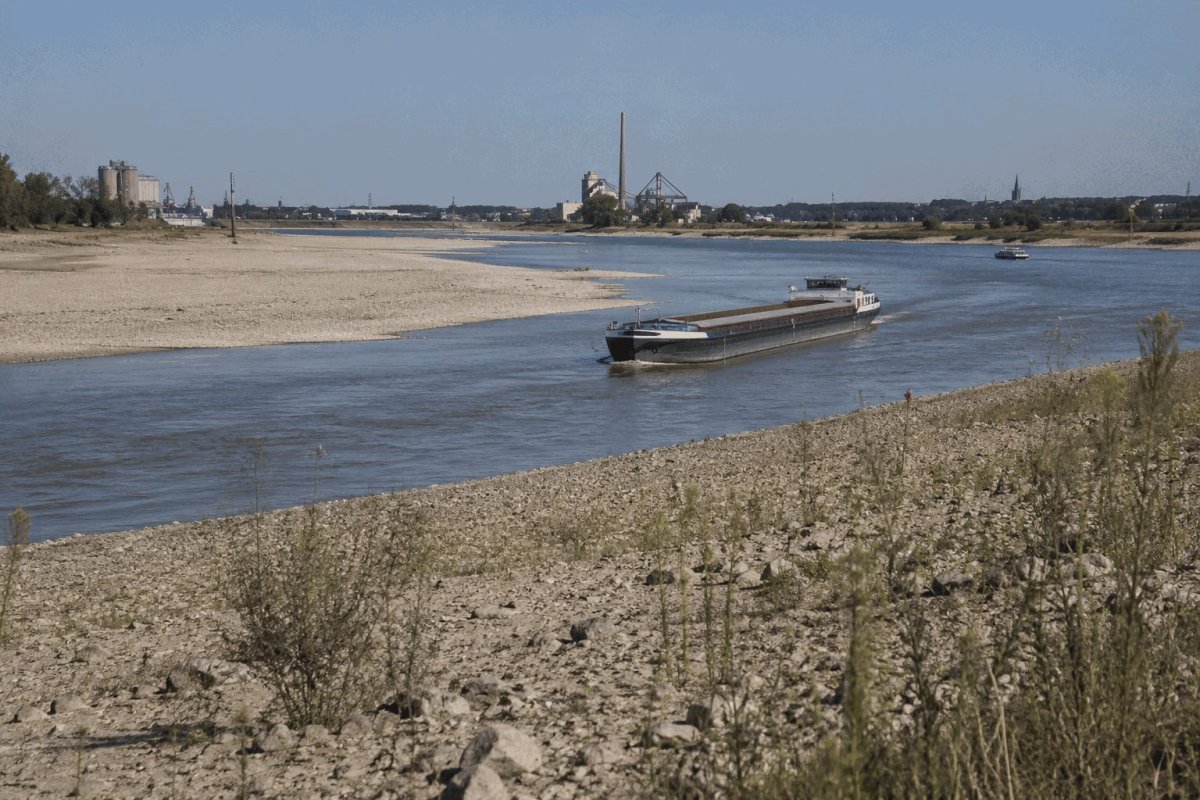
Frankfurt, August 15, 2026 – The Rhine River's water level at the key Kaub chokepoint plunged to a record low of 8 centimeters on Saturday morning, deepening concerns over German industrial production. The gauge, which measures navigability, now sits nearly 90% below the 78-centimeter threshold considered essential for efficient cargo shipping. This marks the lowest reading ever recorded, surpassing the previous 2018 record of 25 centimeters.
The drop comes as European cash markets remain closed for the weekend, but traders and analysts are bracing for a volatile Monday open. The low water levels have already forced a significant shift of cargo from barges to road and rail, driving up logistics costs and threatening supply chains across the country's manufacturing heartland.
Industrial Output at Risk
Research from the Kiel Institute for the World Economy indicates that a 30-day period of low water can reduce German industrial output by approximately 1%, assuming no other changes. The current conditions closely mirror that stress scenario, with Kaub last exceeding the 78-centimeter mark in mid-July. While the figure is based on historical patterns and doesn't account for stockpiles or contingency plans, the timing raises red flags.
Freight costs have already soared. Tanker-barge shipping rates from Rotterdam to Karlsruhe jumped to €150–€155 per ton in late July, a 233%–244% increase from the €45 level seen at the end of June. A single barge can carry the equivalent of up to 150 trucks, and with road haulage already at maximum capacity, the strain is evident. To cover refined-fuel flows alone, an estimated 3,000 tanker trucks would be needed daily.
Sector-Specific Impact
The disruption hits several key industries. Chemical producers like Covestro (ETR:1COV) have declared force majeure on certain polyols due to feedstock shortages. Utilities including Uniper (ETR:UN0) and EnBW (ETR:EBK) are grappling with reduced hydroelectric output and cooling water constraints. Steelmaker Salzgitter (ETR:SZG) has rerouted coal shipments from Rotterdam to rail, while agricultural cooperative RWZ has moved less than 10% of its usual July–August volumes.
"Alarm bells are ringing loudly," said Wolfgang Grosse Entrup, head of Germany's chemical industry association. "Companies are reporting increased costs, logistical bottlenecks, and reduced output." The situation has prompted some German states to ease Sunday truck driving rules, but this does little to expand rail capacity or provide additional drivers.
Equity Market Implications
Investors have taken note. Goldman Sachs (NYSE:GS) adjusted its stance on European chemical stocks in June, before the latest drop. The bank upgraded Givaudan (SWX:GIVN) to Buy, lifted Clariant (SWX:CLN) to Neutral, but cut Evonik (ETR:EVK) to Neutral and downgraded DSM-Firmenich (AMS:DSFIR) and Syensqo (EBR:SYENS) to Sell. These ratings predate the record low, so they may not fully reflect the latest logistics pressures.
Looking ahead, the key risk is whether the Rhine remains at single-digit levels for another week. Intense rainfall could quickly raise the water level and ease freight premiums, but continued high temperatures could worsen the situation, pushing up local fuel and chemical prices. Soft industrial demand might partially offset the disruption, but the 1% output hit remains a real possibility.
Next week, investors should monitor Kaub readings, force-majeure announcements, and freight rates. A rise above 78 centimeters would provide relief, but another week in the single digits would make the historical output test harder to dismiss.