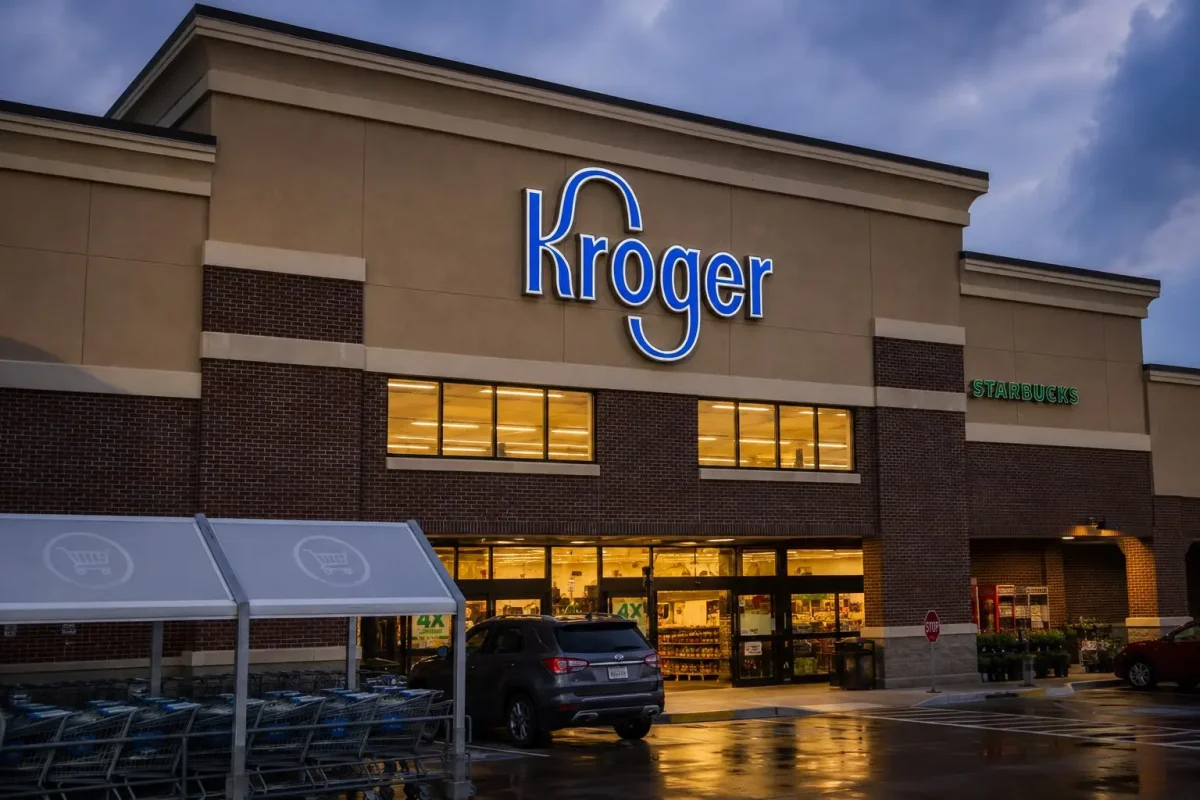
Kroger shares edged lower in premarket trading Thursday after the supermarket chain reported first-quarter adjusted earnings that fell short of analyst expectations by a single penny, overshadowing a better-than-expected revenue performance. The stock slipped roughly 3% as investors weighed the impact of the company's price investment strategy and rising transportation costs on profitability.
The Cincinnati-based grocer posted adjusted earnings per share of $1.58 for the quarter ended in May, compared with the $1.59 consensus estimate compiled by LSEG from Reuters data. Revenue, however, came in at $46.1 billion, surpassing the $45.47 billion analysts had forecast and up from $45.1 billion in the same period last year.
Kroger reaffirmed its full-year 2026 guidance, projecting identical sales growth excluding fuel of 1.0% to 2.0% and adjusted EPS in the range of $5.10 to $5.30. The company also maintained its free cash flow outlook of $2.7 billion to $2.9 billion, which management said would support share buybacks and store investments.
The mixed results come as CEO Greg Foran, who took the helm earlier this year, continues to implement a strategy focused on price cuts to win back customers from discount giants Walmart and Costco. While the sales beat suggests shoppers are responding, the margin compression highlights the challenges of competing on price in a high-cost environment.
Gross margin fell to 22.7% from 23.0% a year earlier, driven by higher fuel sales, increased transportation expenses, egg deflation, and planned price reductions. These headwinds were partially offset by a favorable pharmacy mix, improved e-commerce profitability, and sourcing gains.
Kroger's identical sales, excluding fuel, grew 1.0% during the quarter, while adjusted e-commerce sales surged 19%, indicating that the company's digital investments are gaining traction. Despite these positives, the stock has underperformed the broader market, with shares closing Wednesday at $61.82, down 3.6% on the day, compared with a 1.21% decline in the S&P 500 and a 0.98% drop in the Dow Jones Industrial Average.
Investor skepticism centers on whether Foran's value strategy can successfully defend market share without eroding margins further. The company faces ongoing risks from labor negotiations, competitive pressures, tariff uncertainties, cautious consumer spending, and litigation related to the terminated Albertsons merger.
Kroger's performance this quarter positions it as a company in transition, balancing the need to attract price-sensitive shoppers with the imperative to maintain profitability. While the sales numbers indicate customer retention, the stock's reaction suggests the market is waiting for clearer evidence that the strategy will deliver sustainable financial results.