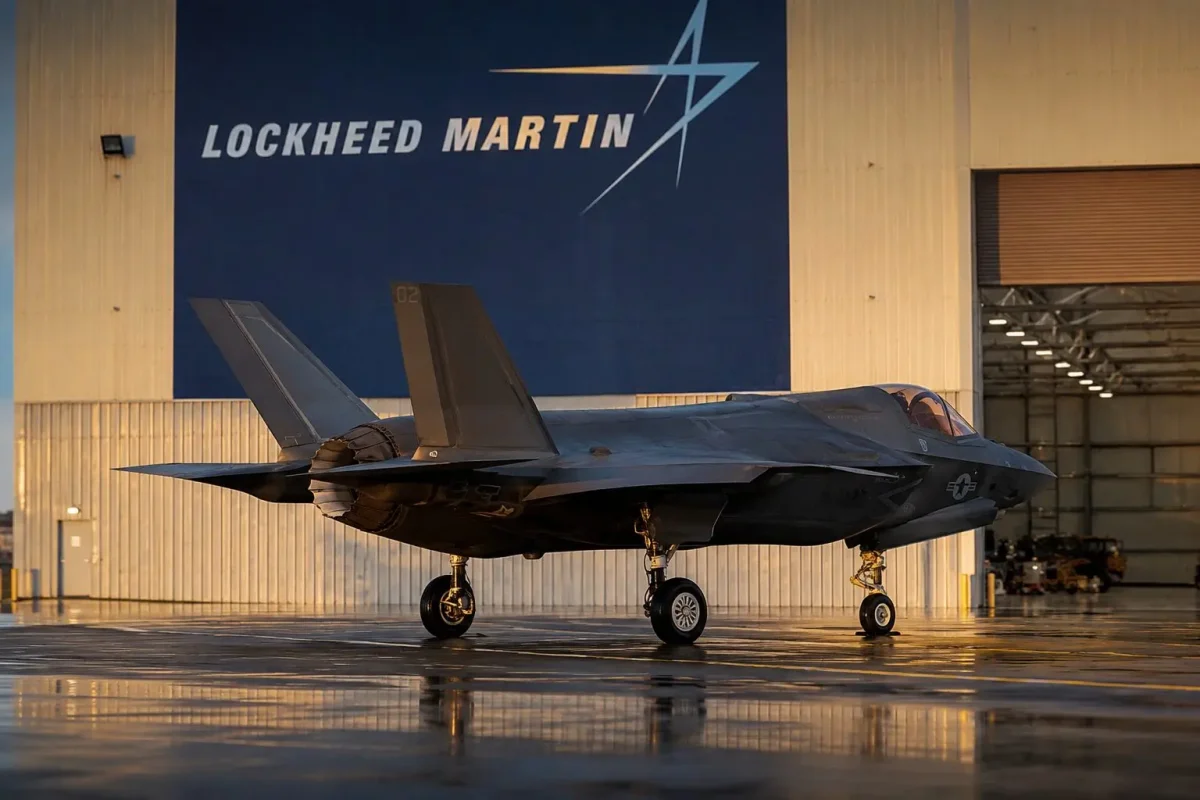
Lockheed Martin (NYSE:LMT) shares surged 10.5% on Thursday, closing at $568.59, as the defense giant delivered a significant upgrade to its free cash flow outlook. The stock's rally came on volume more than double its 65-day average, reflecting strong investor enthusiasm following the company's quarterly results.
The key driver of the upgrade was a $450 million increase in the midpoint of Lockheed's 2026 free cash flow guidance, now projected between $7.00 billion and $7.20 billion. This improvement was directly tied to a $450 million reduction in planned capital expenditures, which fell to a range of $2.00 billion to $2.40 billion from the previous $2.50 billion to $2.80 billion. Operating cash flow guidance remained flat at $9.20 billion to $9.40 billion, indicating that the cash flow gain stemmed entirely from lower spending rather than operational improvements.
Chief Financial Officer Evan Scott explained that part of the capex reduction is due to timing, noting that a missile facility will initially be leased and acquired next year to optimize taxes. He emphasized that the company's $8 billion-to-$9 billion munitions pledge "is unchanged." Scott also highlighted a "real opportunity here for more partnerships to scale production faster, particularly in Europe," suggesting that some cost reductions could become permanent as partners supply factory facilities and capital.
Demand for Lockheed's products remained exceptionally strong. The company secured $65 billion in new orders during the quarter, compared to $20.1 billion in revenue, resulting in an initial book-to-bill ratio of 3.2. Backlog reached a record $230.4 billion, approximately 2.9 times its projected annual sales. Growth was led by the Missiles and Fire Control segment, where revenue climbed 19% to $4.10 billion and operating profit advanced 24%, driven by increases in PAC-3, THAAD, and Precision Strike Missile volumes.
Overall, group sales rose 11% to $20.1 billion, with diluted EPS of $7.94. The updated sales range of $79.75 billion to $81.75 billion surpassed the analyst estimate of $79.14 billion. The results contrasted sharply with the same period last year, which included $1.6 billion in program losses and $169 million in additional charges.
Looking ahead, Lockheed faces both opportunities and risks. The company is ramping up output across 10 munitions lines and multiple aircraft projects, but technical benchmarks for classified programs remain demanding. Some of the capex reduction will defer expenditures to 2027, and delays in these areas could erode the cash conversion rate that investors have favored. Thursday's rally reflected expectations of robust demand and improved short-term cash flow, but the upcoming challenge is determining whether reduced spending signals lasting efficiency rather than postponed capacity investments.
In a broader market context, RTX Corporation (NYSE:RTX) also lifted its guidance on Thursday, with shares rising 7.7%. RTX posted a 14% increase in sales and reported a backlog of $289 billion. Lockheed shares had declined 2.8% over the prior week before climbing 11.8% from July 17 to Thursday. A peer review session is set for next week, with General Dynamics (NYSE:GD) scheduled to announce its second-quarter earnings on July 29. Lockheed has no investor events on its calendar.