Marathon Petroleum Corporation (NYSE: MPC) saw its market capitalization increase by an estimated $8.5 billion last week, driven by record-high refining margins that propelled shares to a 52-week high. The stock closed Friday at $312.60, marking a 10.2% weekly gain and a 2.2% rise on the day.
The surge in market value—nearly matching the company's $8.6 billion share buyback authorization announced in May—reflects the impact of extraordinarily favorable conditions in the refining sector. The U.S. 3-2-1 crack spread, a key measure of refining profitability, settled at $69.66 per barrel on Thursday, setting an all-time high for the third consecutive session. Diesel margins exceeded $91 per barrel, underscoring the strength in distillate markets.
Independent oil analyst John Kemp noted on Thursday that the current margin strength is primarily driven by diesel, adding that "encouraging refiners to revert to max-gasoline mode will require higher gasoline prices." Gasoline stocks have declined to 210.5 million barrels, the lowest seasonal level since 2012, while diesel inventories rose by 4.5 million barrels but remain below typical seasonal levels.
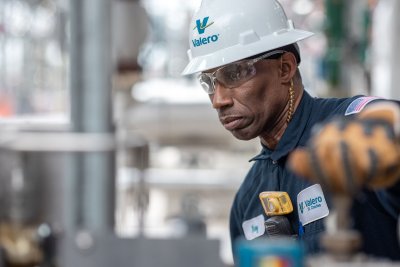
The rally in Marathon's stock was echoed by other major refiners. Valero Energy (NYSE: VLO) advanced 10.3% for the week, closing at $309.65, while Phillips 66 (NYSE: PSX) added 9.8% to $206.86. The broader S&P 500, however, fell 1.6% during the same period, highlighting the divergence between energy and the rest of the market.
Marathon's second-quarter outlook underscores the operational leverage at play. The company forecasts throughput of 2.99 million barrels per day, with turnaround costs of $300 million and operating costs of $5.65 per barrel. A $1 per barrel change in margin over a 91-day quarter equates to roughly $272 million in additional refining margin, though this is a simplified calculation that does not account for hedging, outages, or other costs.
CEO Maryann Mannen stated in May that Marathon remains "largely insulated from global crude supply disruptions" due to its reliance on U.S. and Canadian crude. The company's ability to capture benchmark crack spreads is influenced by factors such as product yields, crude mix, and hedging.
The upcoming Energy Information Administration (EIA) petroleum report, scheduled for Wednesday, July 22, will be closely watched for further clues on inventory trends. Market participants are focused on gasoline and diesel supplies, as well as refinery utilization rates. Marathon is set to report its second-quarter results on August 4, which will provide insight into realized margins, throughput, and the pace of share buybacks.
Despite the bullish momentum, risks remain. Product cracks could decline rapidly if crude prices rise or fuel demand weakens. Cash conversion may be affected by outages, hedging losses, or extended maintenance. The stock also faces heightened expectations, and upcoming inventory data will be critical in determining whether product shortages can sustain the recent valuation boost.