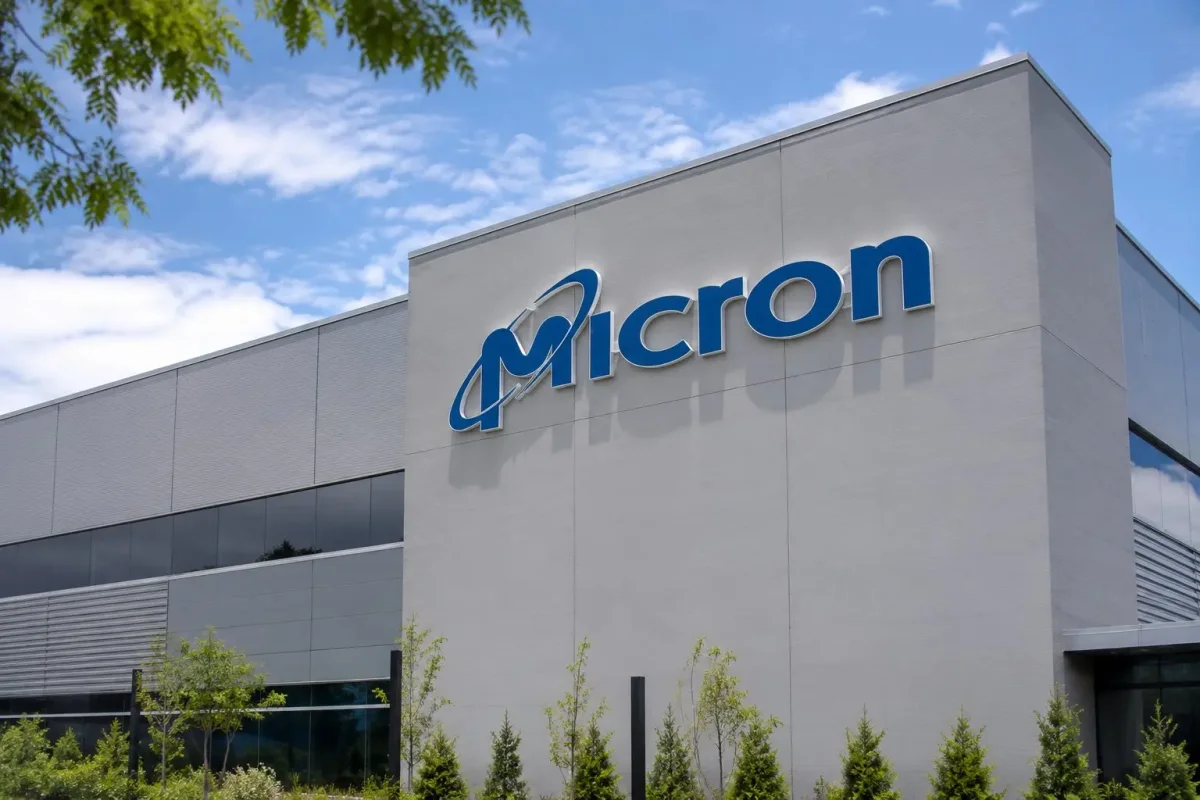
Micron Technology (MU) shares extended their decline on Wednesday, falling 4.7% to $891.88, as selling pressure continued to weigh on AI-linked chipmakers. The stock, which had been one of the standout performers in the semiconductor space this year, is now facing increased scrutiny from investors questioning its valuation.
The broader Philadelphia semiconductor index dropped 3.6%, with heavyweights Nvidia and Broadcom dragging the S&P 500 lower. The Nasdaq Composite shed 1.98%, reflecting a broad risk-off mood in tech stocks.
Micron's recent trading has been particularly volatile. After a 7.7% drop last Thursday, the stock plunged 13.3% on Friday, only to bounce 9.9% on Monday. Wednesday's decline came despite the company announcing a major milestone: it has selected Bechtel for the engineering, procurement, and construction of the first phase of its memory manufacturing facility in Clay, New York.
The New York project, located at White Pine Commerce Park in Onondaga County, is expected to be the largest chip plant in the United States. According to Micron and Bechtel, the project will create 50,000 jobs in New York and more than 4,500 construction jobs. Micron executive Manish Bhatia described the facility as 'the most advanced memory manufacturing in the world,' highlighting its potential to support AI demand.
However, investors are increasingly focused on whether the massive capital expenditures required for such projects will pay off if the AI trade loses momentum. The key test will come on June 24, when Micron reports its fiscal third-quarter results after the market close, followed by an analyst call at 6 p.m. EDT.
The company's recent financial performance has been stellar. In its fiscal second quarter ended March 18, Micron reported revenue of $23.86 billion, up from $13.64 billion in the prior quarter and $8.05 billion a year earlier. GAAP net income came in at $13.79 billion, or $12.07 per diluted share. For the fiscal third quarter, Micron projects revenue of $33.5 billion, plus or minus $750 million, and non-GAAP diluted EPS of $19.15, plus or minus 40 cents.
Micron's products are critical for AI systems. High-bandwidth memory (HBM), a stack of fast memory chips placed next to AI processors, allows data to move quickly. DRAM serves as working memory in servers and PCs, while NAND is used for storage in solid-state drives and phones. In its latest 10-Q filing, Micron noted that AI-driven demand for memory and storage is outpacing supply, which supports pricing and margins.
In the second quarter, DRAM sales jumped 74% from the prior quarter, with average selling prices up by the mid-60% range. NAND sales climbed 82%, with average selling prices increasing in the high-70% range. These higher ASPs are a key driver of profitability during memory upcycles.
Nevertheless, memory remains a cyclical business. Micron's 10-Q warns that rivals may increase capital spending, leading to more global supply and potential pressure on prices if demand doesn't keep pace. The company also cited risks from construction, higher costs, tariffs, trade restrictions, and the challenge of making expanded capacity profitable.
With the stock having surged to a trillion-dollar valuation earlier this year, the June 24 earnings report will be crucial. Investors will be looking for evidence that pricing, margins, and supply deals can sustain that valuation. The outcome could determine whether Micron's AI memory trade regains its footing or faces further headwinds.