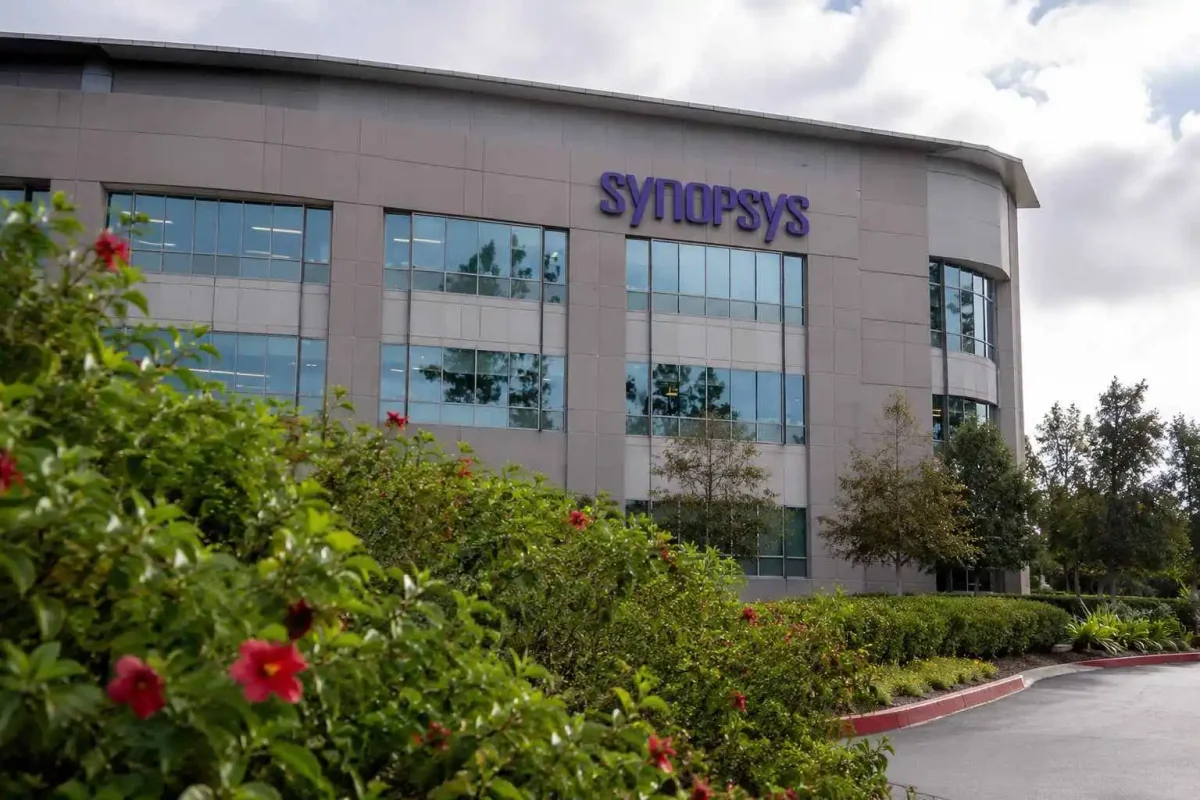
Synopsys (NASDAQ:SNPS) shares continued their downward trajectory, closing at $373.47 on Friday, down 2.8% for the week. The stock is now just 2.0% above its 52-week low of $366, reflecting persistent investor caution despite improving credit fundamentals. The Nasdaq Composite fell 2.0% over the same period, with semiconductor stocks retreating on Friday.
In a contrasting development, S&P Global Ratings (NYSE:SPGI) raised its outlook on Synopsys from stable to positive on Thursday, while affirming its BBB rating. The agency cited declining leverage as a key factor, noting that adjusted leverage has fallen to 2.3 times and is projected to reach 1.8 times in fiscal 2026 and 1.2 times by 2027. A credit rating upgrade could occur within the next 12 to 24 months, according to S&P.
Synopsys has made significant progress in reducing the debt incurred from its $14.3 billion acquisition of Ansys. The company has already repaid $4.3 billion of that amount, with a $2 billion contribution from Nvidia (NASDAQ:NVDA) providing additional support. However, equity investors remain focused on organic growth challenges, as evidenced by the stock's 42.7% decline from its 52-week peak.
Valuation comparisons with peer Cadence Design Systems (NASDAQ:CDNS) highlight the divergence. Based on the midpoint of current-year non-GAAP EPS guidance, Synopsys trades at a price-to-earnings ratio of 25.3x, compared to Cadence's 41.3x, representing a roughly 39% discount. Cadence shares ended the week at $326.24, down 1.2%, and 21.7% below their 52-week high.
S&P Global attributed Synopsys' lower valuation to recent pro-forma revenue growth of less than 6% and EDA growth of 8%, below the historical EDA growth rate of over 10%. The agency noted that this slower growth, combined with integration risks from the Ansys acquisition, has tempered investor enthusiasm.
Synopsys reported a 42% increase in second-quarter revenue to $2.276 billion, driven by the Ansys unit. However, adjusted earnings per share declined to $3.35 from $3.67 a year earlier. Management raised full-year revenue guidance to a range of $9.625 billion to $9.705 billion and adjusted EPS guidance to $14.72 to $14.80. CEO Sassine Ghazi highlighted that artificial intelligence is "driving demand across our portfolio."
Investors are now looking ahead to Cadence's earnings report, due after the market close on Monday, July 27. Cadence previously forecast revenue between $1.555 billion and $1.595 billion and adjusted EPS of $2.02 to $2.08. Synopsys is scheduled to report July-quarter earnings on August 26, followed by an investor day on September 30 in New York.
Risks to Synopsys' outlook include potential additional export-control modifications, tighter China regulations, soft Design IP results, or a longer-than-expected timeline for Ansys integration. These factors could slow both growth and debt reduction efforts. For now, the balance sheet is strengthening faster than the share price, and Monday's Cadence report will reveal whether this divergence is company-specific or reflects a broader sector trend.