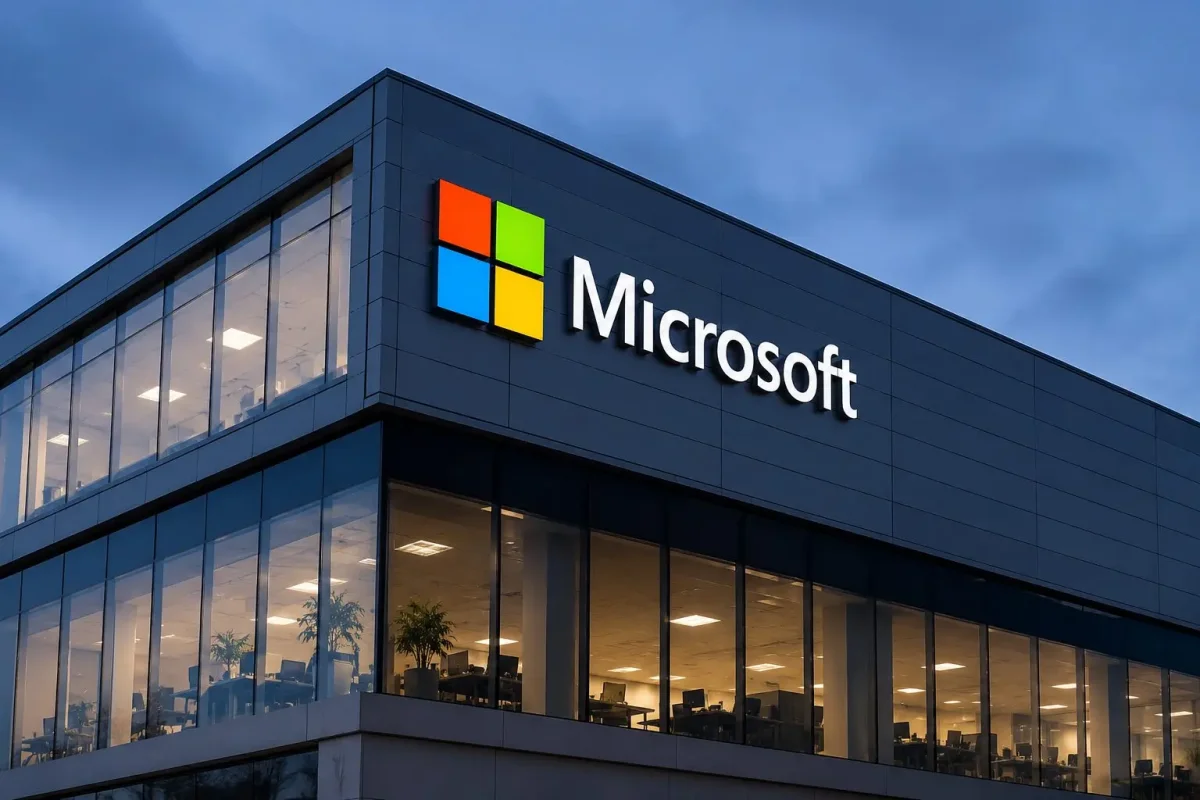
NEW YORK, July 3, 2026 – U.S. stock markets were closed on July 3 for the Independence Day holiday, but the final trading session of the week on Thursday saw a notable divergence among major technology names. Microsoft Corporation (NASDAQ:MSFT) emerged as a standout performer, gaining 4.7% from the previous Friday's close through July 2, while the broader technology sector, as measured by the State Street Technology Select Sector SPDR ETF (NYSEARCA:XLK), slipped 0.3% over the same period. The SPDR S&P 500 ETF Trust (NYSEARCA:SPY) rose 2.2%, underscoring the rotation within the market.
Microsoft closed at $390.49 on July 2, up 1.6% on the day, giving the company a market capitalization of nearly $2.91 trillion. This marked a gain of approximately $130.4 billion in equity value from the June 26 close of $372.97. The outperformance relative to XLK was roughly five percentage points over four sessions, a notable spread that highlights renewed investor confidence in the software giant's AI strategy.
The catalyst for this move appears to be Microsoft's announcement on July 2 that it would invest $2.5 billion in a new AI deployment arm called Microsoft Frontier Company. This unit will place 6,000 industry and engineering experts with clients to help them integrate and monetize AI solutions. Judson Althoff, CEO of Microsoft Commercial Business, stated that customers have "moved well beyond experimentation" and are now seeking "measurable business outcomes" and returns on their AI investments. This deployment push directly addresses a key investor concern: whether Microsoft's massive AI spending can translate into tangible revenue.
The $2.5 billion Frontier Company spend represents a mere 0.09% of Microsoft's current market cap and about 1.3% of its projected 2026 capital expenditure plan of around $190 billion. However, the market's reaction suggests that investors are viewing this as a positive signal that AI investments are beginning to convert into contracts, usage, and margin improvement. Microsoft's latest fiscal third-quarter results, reported on April 29, showed revenue climbing 18% to $82.9 billion, with Microsoft Cloud revenue jumping 29% to $54.5 billion. Azure and other cloud services grew 40%, and CEO Satya Nadella noted that the AI business had reached a $37 billion annual run rate, up 123% year-over-year.
Despite these gains, Microsoft's stock has faced significant headwinds in 2026. According to Barron's, Microsoft lost 23% in the first six months of the year, its worst first-half performance since 2000, with a 17% decline in June alone. The recent bounce suggests some buyers are returning after the sharp selloff, but the broader tech sector remains under pressure. The Nasdaq Composite fell 0.8% on Thursday, while the Dow Jones Industrial Average rose 1.1%, indicating a split market.
The high level of capital expenditure remains a focal point. CFO Amy Hood has guided that capital expenditures will exceed $40 billion in fiscal Q4 and climb to around $190 billion in calendar 2026, with about $25 billion attributed to pricier components. Hood expressed confidence in the return on these investments, citing strong demand, product usage, and efficiency gains on the platform. However, some analysts remain cautious. Guggenheim's John DiFucci recently told MarketWatch that artificial intelligence poses a "major threat" to software companies, though he does not see it as a "death knell" for the sector. Microsoft is exposed on both fronts, selling software subscriptions and backing one of the largest AI infrastructure projects in the market.
Looking ahead, traders will be watching to see if Microsoft can maintain its five-point lead over XLK when U.S. cash stocks reopen next week. If the software bid fades, attention will shift back to the $190 billion capex plan. If it holds, the July 2 customer deployment push will likely remain priced in as a positive development for the company's AI monetization narrative.